Ecol Evol. 2012 Mar;2(3):487-92. doi: 10.1002/ece3.209.
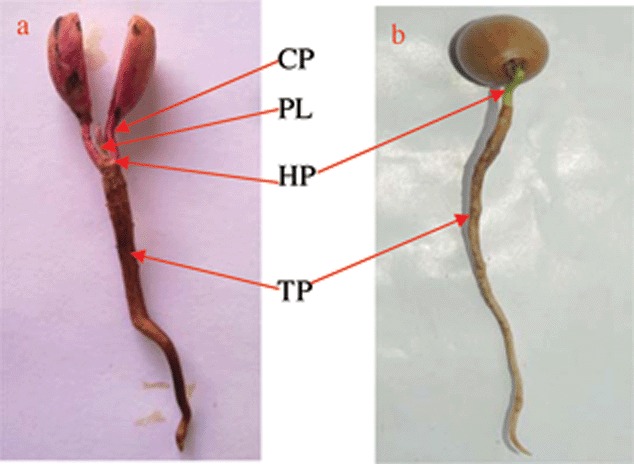
Early germination of white oaks is widely viewed as an evolutionary strategy to escape rodent predation; yet, the mechanism by which this is accomplished is poorly understood. We report that chestnut oak Quercus montana (CO) and white oak Q. alba (WO) (from North America), and oriental cork oak Q. variabilis (OO) and Mongolian oak Q. mongolica (MO) (from Asia) can escape predation and successfully establish from only taproots. During germination in autumn, cotyledonary petioles of acorns of CO and WO elongate and push the plumule out of the cotyledons, whereas OO and MO extend only the hypocotyls and retain the plumule within the cotyledons. Experiments showed that the pruned taproots (>6 cm) of CO and WO acorns containing the plumule successfully germinated and survived, and the pruned taproots (≥12 cm) of OO and MO acorns without the plumule successfully regenerated along with the detached acorns, thus producing two seedlings. We argue that these two distinct regeneration morphologies reflect alternative strategies for escaping seed predation.
白橡树的早期萌发被广泛认为是一种逃避啮齿动物捕食的进化策略;然而,其实现的机制还知之甚少。我们报告称,来自北美的栗叶栎(Quercus montana,CO)和白栎(Quercus alba,WO),以及来自亚洲的栓皮栎(Quercus variabilis,OO)和蒙古栎(Quercus mongolica,MO)可以逃避捕食,并仅通过主根成功建立。在秋季萌发期间,CO 和 WO 的橡子的子叶叶柄伸长并将胚芽推出子叶,而 OO 和 MO 仅延伸下胚轴并将胚芽保留在子叶内。实验表明,修剪后的包含胚芽的 CO 和 WO 橡子的主根(>6 厘米)成功萌发并存活,而修剪后的无胚芽的 OO 和 MO 橡子的主根(≥12 厘米)与分离的橡子一起成功再生,从而产生两个幼苗。我们认为,这两种不同的再生形态反映了逃避种子捕食的两种替代策略。