Bloomberg School of Public Health, Johns Hopkins University, Baltimore, MD, USA.
Confl Health. 2012 Jul 23;6(1):2. doi: 10.1186/1752-1505-6-2.
Neonatal deaths account for over 40% of all deaths in children younger than five years of age and neonatal mortality rates are highest in areas affected by humanitarian emergencies. Of the ten countries with the highest neonatal mortality rates globally, six are currently or recently affected by a humanitarian emergency. Yet, little is known about newborn care in crisis settings. Understanding current policies and practices for the care of newborns used by humanitarian aid organizations will inform efforts to improve care in these challenging settings.
Between August 18 and September 25, 2009, 56 respondents that work in humanitarian emergencies completed a web-based survey either in English or French. A snow ball sampling technique was used to identify organizations that provide health services during humanitarian emergencies to gather information on current practices for maternal and newborn care in these settings. Information was collected about continuum-of-care services for maternal, newborn and child health, referral services, training and capacity development, health information systems, policies and guidelines, and organizational priorities. Data were entered into MS Excel and frequencies and percentages were calculated.
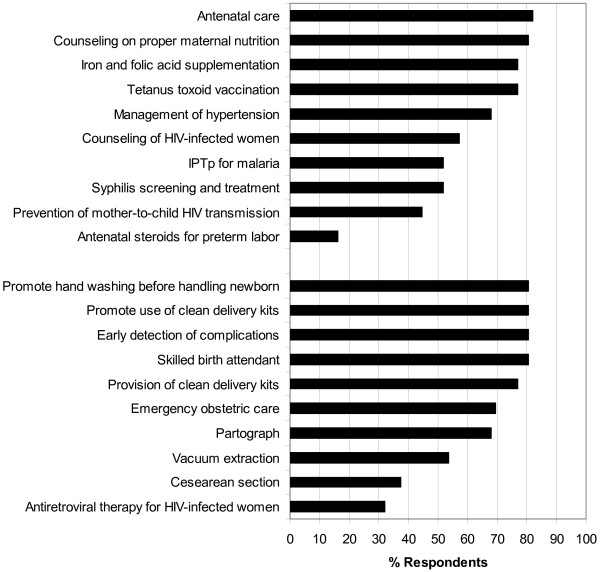
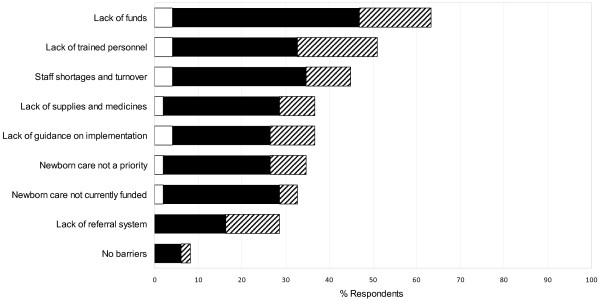
The majority of responding organizations reported implementing components of neonatal and maternal health interventions. However, multiple barriers exist in providing comprehensive care, including: funding shortages (63.3%), gaps in training (51.0%) and staff shortages and turnover (44.9%).
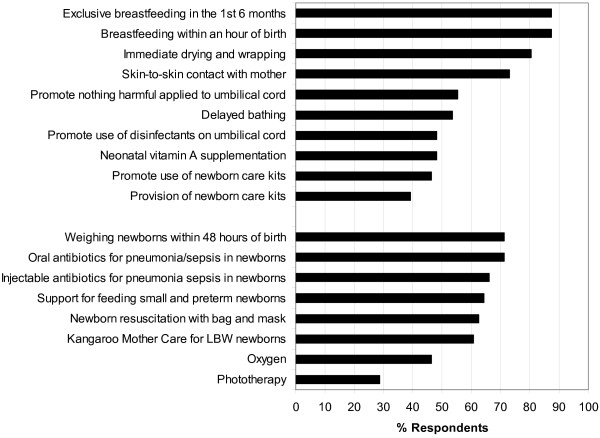
Neonatal care is provided by most of the responding humanitarian organizations; however, the quality, breadth and consistency of this care are limited.
新生儿死亡占五岁以下儿童所有死亡人数的 40%以上,而新生儿死亡率在受人道主义紧急情况影响的地区最高。在全球新生儿死亡率最高的十个国家中,有六个国家目前或最近受到人道主义紧急情况的影响。然而,对于危机环境中的新生儿护理知之甚少。了解人道主义援助组织用于新生儿护理的现行政策和做法,将为改善这些具有挑战性环境中的护理工作提供信息。
2009 年 8 月 18 日至 9 月 25 日,56 名在人道主义紧急情况下工作的受访者以英语或法语完成了在线调查。采用滚雪球抽样技术确定在人道主义紧急情况下提供卫生服务的组织,以收集有关这些环境中孕产妇和新生儿护理的现行做法的信息。收集了关于孕产妇、新生儿和儿童健康的连续护理服务、转介服务、培训和能力发展、卫生信息系统、政策和准则以及组织优先事项的信息。数据输入到 MS Excel 中,并计算了频率和百分比。
大多数回应组织报告实施了新生儿和孕产妇健康干预措施的组成部分。然而,提供全面护理存在多种障碍,包括:资金短缺(63.3%)、培训差距(51.0%)以及人员短缺和人员流动(44.9%)。
大多数回应的人道主义组织都提供新生儿护理;然而,这种护理的质量、广度和一致性受到限制。