Program on Genomics and Nutrition, Department of Epidemiology, Fielding School of Public Health, and Departments of Medicine and Obstetrics and Gynecology, David Geffen School of Medicine, University of California Los Angeles (UCLA), Los Angeles, CA, USA.
Diabetes. 2012 Nov;61(11):2998-3004. doi: 10.2337/db12-0241. Epub 2012 Jul 24.
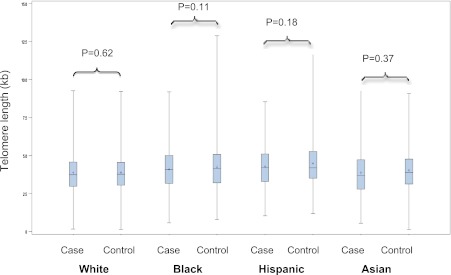
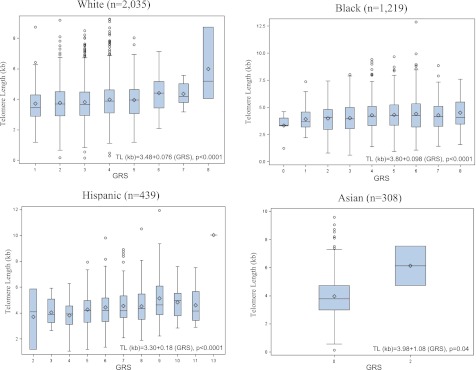
Telomere length (TL) has been implicated in the pathogenesis of age-related disorders. However, there are no prospective studies directly investigating the role of TL and relevant genes in diabetes development. In the multiethnic Women's Health Initiative, we identified 1,675 incident diabetes case participants in 6 years of follow-up and 2,382 control participants matched by age, ethnicity, clinical center, time of blood draw, and follow-up duration. Leukocyte TL at baseline was measured using quantitative PCR, and Mendelian randomization analysis was conducted to test whether TL is causally associated with diabetes risk. After adjustment for matching and known diabetes risk factors, odds ratios per 1-kilobase increment were 1.00 (95% CI 0.90-1.11) in whites, 0.95 (0.85-1.06) in blacks, 0.96 (0.79-1.17) in Hispanics, and 0.88 (0.70-1.10) in Asians. Of the 80 single nucleotide polymorphisms (SNPs) in nine genes involved in telomere regulation, 14 SNPs were predictive of TL, but none were significantly associated with diabetes risk. Using ethnicity-specific SNPs as randomization instruments, we observed no statistically significant association between TL and diabetes risk (P = 0.52). Although leukocyte TL was weakly associated with diabetes risk, this association was not independent of known risk factors. These prospective findings indicate limited clinical utility of TL in diabetes risk stratification among postmenopausal women.
端粒长度 (TL) 与与年龄相关疾病的发病机制有关。然而,目前还没有前瞻性研究直接调查 TL 和相关基因在糖尿病发展中的作用。在多民族妇女健康倡议中,我们在 6 年的随访中确定了 1675 例新发糖尿病病例参与者和 2382 例按年龄、种族、临床中心、采血时间和随访时间匹配的对照参与者。使用定量 PCR 测量基线时的白细胞 TL,并进行孟德尔随机化分析,以测试 TL 是否与糖尿病风险有因果关系。在调整匹配和已知糖尿病危险因素后,每增加 1 千碱基的比值比为 1.00(95%CI 0.90-1.11)白人、0.95(0.85-1.06)黑人、0.96(0.79-1.17)西班牙裔和 0.88(0.70-1.10)亚洲人。在参与端粒调节的九个基因中的 80 个单核苷酸多态性(SNP)中,有 14 个 SNP 可预测 TL,但没有一个与糖尿病风险显著相关。使用特定于族裔的 SNP 作为随机化工具,我们没有观察到 TL 与糖尿病风险之间存在统计学上显著的关联(P=0.52)。尽管白细胞 TL 与糖尿病风险呈弱相关,但这种关联不受已知危险因素的影响。这些前瞻性发现表明,TL 在绝经后妇女的糖尿病风险分层中临床应用价值有限。