Department of Psychiatry, Center for Neuroscience, University of Pittsburgh, Pittsburgh, PA 15219, USA.
Transl Psychiatry. 2012 May 1;2(5):e109. doi: 10.1038/tp.2012.34.
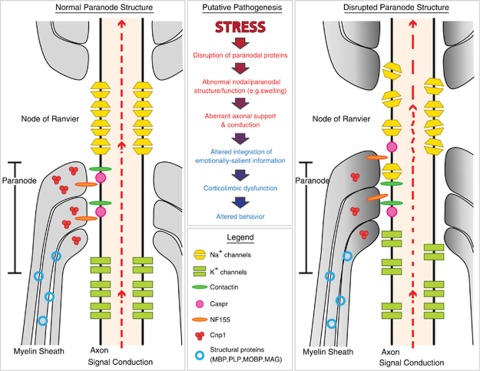
Altered glial structure and function is implicated in several major mental illnesses and increasing evidence specifically links changes in oligodendrocytes with disrupted mood regulation. Low density and reduced expression of oligodendrocyte-specific gene transcripts in postmortem human subjects points toward decreased oligodendrocyte function in most of the major mental illnesses. Similar features are observed in rodent models of stress-induced depressive-like phenotypes, such as the unpredictable chronic mild stress and chronic corticosterone exposure, suggesting an effect downstream from stress. However, whether oligodendrocyte changes are a causal component of psychiatric phenotypes is not known. Traditional views that identify oligodendrocytes solely as nonfunctional support cells are being challenged, and recent studies suggest a more dynamic role for oligodendrocytes in neuronal functioning than previously considered, with the region adjacent to the node of Ranvier (i.e., paranode) considered a critical region of glial-neuronal interaction. Here, we briefly review the current knowledge regarding oligodendrocyte disruptions in psychiatric disorders and related animal models, with a focus on major depression. We then highlight several rodent studies, which suggest that alterations in oligodendrocyte structure and function can produce behavioral changes that are informative of mood regulatory mechanisms. Together, these studies suggest a model, whereby impaired oligodendrocyte and possibly paranode structure and function can impact neural circuitry, leading to downstream effects related to emotionality in rodents, and potentially to mood regulation in human psychiatric disorders.
胶质细胞结构和功能的改变与几种主要的精神疾病有关,越来越多的证据特别表明少突胶质细胞的变化与情绪调节障碍有关。在尸检的人类受试者中,少突胶质细胞特异性基因转录本的低密度和表达减少表明,大多数主要精神疾病中的少突胶质细胞功能下降。在应激诱导的抑郁样表型的啮齿动物模型中也观察到类似的特征,如不可预测的慢性轻度应激和慢性皮质酮暴露,这表明这是应激的下游效应。然而,少突胶质细胞的变化是否是精神表型的一个因果成分尚不清楚。传统观点认为少突胶质细胞仅仅是无功能的支持细胞,但最近的研究表明,少突胶质细胞在神经元功能中的作用比以前认为的更为动态,与郎飞节(即节间结)相邻的区域被认为是胶质细胞-神经元相互作用的关键区域。在这里,我们简要回顾了关于精神疾病和相关动物模型中少突胶质细胞破坏的现有知识,重点是重度抑郁症。然后,我们强调了几项啮齿动物研究,这些研究表明,少突胶质细胞结构和功能的改变可以产生与情绪调节机制相关的行为变化。总之,这些研究表明,少突胶质细胞和可能的节间结结构和功能的损伤可能会影响神经回路,导致啮齿动物情绪方面的下游效应,并可能导致人类精神疾病中的情绪调节。