Department of Biological Psychology, VU University Amsterdam, Amsterdam, The Netherlands.
Transl Psychiatry. 2011 Oct 18;1(10):e50. doi: 10.1038/tp.2011.45.
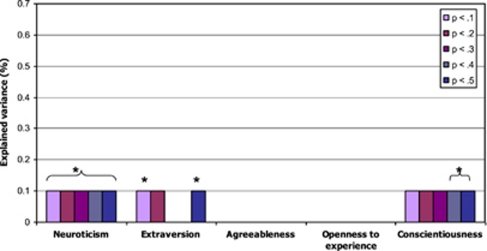
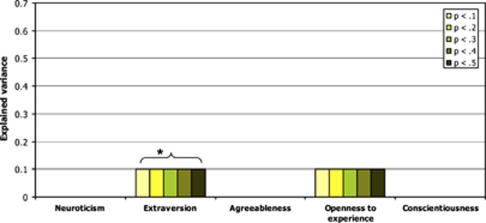
The relationship between major depressive disorder (MDD) and bipolar disorder (BD) remains controversial. Previous research has reported differences and similarities in risk factors for MDD and BD, such as predisposing personality traits. For example, high neuroticism is related to both disorders, whereas openness to experience is specific for BD. This study examined the genetic association between personality and MDD and BD by applying polygenic scores for neuroticism, extraversion, openness to experience, agreeableness and conscientiousness to both disorders. Polygenic scores reflect the weighted sum of multiple single-nucleotide polymorphism alleles associated with the trait for an individual and were based on a meta-analysis of genome-wide association studies for personality traits including 13,835 subjects. Polygenic scores were tested for MDD in the combined Genetic Association Information Network (GAIN-MDD) and MDD2000+ samples (N=8921) and for BD in the combined Systematic Treatment Enhancement Program for Bipolar Disorder and Wellcome Trust Case-Control Consortium samples (N=6329) using logistic regression analyses. At the phenotypic level, personality dimensions were associated with MDD and BD. Polygenic neuroticism scores were significantly positively associated with MDD, whereas polygenic extraversion scores were significantly positively associated with BD. The explained variance of MDD and BD, ∼0.1%, was highly comparable to the variance explained by the polygenic personality scores in the corresponding personality traits themselves (between 0.1 and 0.4%). This indicates that the proportions of variance explained in mood disorders are at the upper limit of what could have been expected. This study suggests shared genetic risk factors for neuroticism and MDD on the one hand and for extraversion and BD on the other.
重度抑郁症(MDD)和双相情感障碍(BD)之间的关系仍存在争议。以前的研究报告了 MDD 和 BD 的风险因素之间的差异和相似之处,例如潜在的人格特质。例如,高神经质与这两种疾病都有关,而开放性体验则是 BD 的特异性。本研究通过应用神经质、外向性、开放性体验、宜人性和尽责性的多基因评分来研究人格与 MDD 和 BD 之间的遗传关联。多基因评分反映了个体与特质相关的多个单核苷酸多态性等位基因的加权总和,该评分基于包括 13835 名受试者在内的人格特质全基因组关联研究的荟萃分析。多基因评分使用逻辑回归分析在合并的遗传关联信息网络(GAIN-MDD)和 MDD2000+样本(N=8921)中针对 MDD 进行了测试,在合并的系统治疗增强计划治疗双相情感障碍和惠康信托基金病例对照联盟样本(N=6329)中针对 BD 进行了测试。在表型水平上,人格维度与 MDD 和 BD 相关。多基因神经质评分与 MDD 显著正相关,而多基因外向性评分与 BD 显著正相关。MDD 和 BD 的解释方差(约为 0.1%)与多基因人格评分在相应人格特质中解释的方差(在 0.1%到 0.4%之间)高度可比。这表明,在心境障碍中解释的方差比例处于预期的上限。本研究表明,神经质和 MDD 一方面,以及外向性和 BD 另一方面共享遗传风险因素。