Department of Orthopaedics, University of Rochester School of Medicine and Dentistry, NY, USA.
Med Educ Online. 2012;17. doi: 10.3402/meo.v17i0.17092. Epub 2012 Jul 23.
Despite the prevalence of musculoskeletal (MSK) disorders, the degree to which medical schools are providing students the knowledge and confidence to treat these problems is unclear. This study evaluated MSK knowledge in second and fourth year medical students using a newly developed written assessment tool and examined the maturation of clinical confidence in treating core MSK disorders.
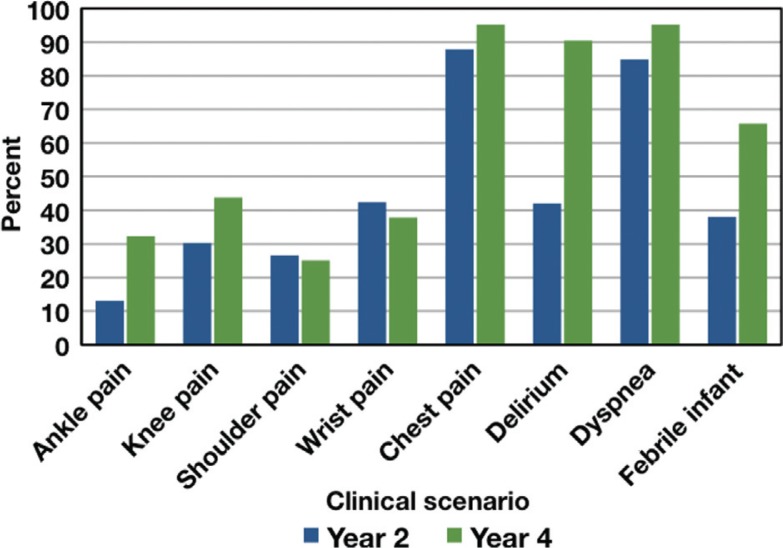
Over a 3-year period, the National Board of Medical Examiners (NBME) MSK subject examination consisting of 75 items was administered to 568 second and fourth year students at a single institution. Students were also asked to rate their confidence in treating a selection of medicine/pediatric and MSK clinical scenarios on a 5-point Likert scale.
Participation rate was 98%. The NBME MSK assessment score was 59.2 ± 10.6 for all second year medical students and 69.7 ± 9.6 for all fourth year medical students. There was a significant increase in NBME scores between the second and fourth years (p<0.0001). Students were more confident in treating internal medicine/pediatric conditions than MSK medicine conditions (p=0.001). Confidence in treating MSK medicine conditions did not improve between the second and fourth years (p=0.41).
To our knowledge, this is the first study to report increased MSK medicine knowledge as measured by a standardized examination after completing medical school core clinical rotations. Despite increased MSK knowledge, low levels of MSK clinical confidence among graduating students were noted. Further research is needed to determine the factors that influence MSK knowledge and clinical confidence in medical students.
尽管肌肉骨骼(MSK)疾病较为普遍,但医学院为学生提供治疗这些疾病所需知识和信心的程度尚不清楚。本研究使用新开发的书面评估工具评估了二年级和四年级医学生的 MSK 知识,并研究了治疗核心 MSK 疾病的临床信心的成熟度。
在 3 年期间,国家医学考试委员会(NBME)的 MSK 科目考试(共 75 题)对一所机构的 568 名二年级和四年级学生进行了测试。学生还被要求在 5 点李克特量表上对一系列内科/儿科和 MSK 临床情况的治疗选择进行信心评分。
参与率为 98%。所有二年级医学生的 NBME MSK 评估得分为 59.2±10.6,所有四年级医学生的得分为 69.7±9.6。二年级和四年级之间的 NBME 分数有显著提高(p<0.0001)。学生治疗内科/儿科疾病的信心强于治疗 MSK 疾病的信心(p=0.001)。二年级和四年级之间治疗 MSK 疾病的信心没有改善(p=0.41)。
据我们所知,这是第一项报告在完成医学核心临床轮转后,通过标准化考试测量 MSK 医学知识增加的研究。尽管 MSK 知识有所增加,但毕业学生的 MSK 临床信心水平仍然较低。需要进一步研究以确定影响医学生 MSK 知识和临床信心的因素。