Department of Pediatric and Congenital Heart Surgery, Cleveland Clinic, Cleveland, Ohio.
Department of Biostatistics, Duke University School of Medicine and Duke Clinical Research Institute, Duke University Medical Center, Durham, NC.
J Thorac Cardiovasc Surg. 2013 Apr;145(4):1046-1057.e1. doi: 10.1016/j.jtcvs.2012.06.029. Epub 2012 Jul 24.
Congenital heart surgery outcomes analysis requires reliable methods of estimating the risk of adverse outcomes. Contemporary methods focus primarily on mortality or rely on expert opinion to estimate morbidity associated with different procedures. We created an objective, empirically based index that reflects statistically estimated risk of morbidity by procedure.
Morbidity risk was estimated using data from 62,851 operations in the Society of Thoracic Surgeons Congenital Heart Surgery Database (2002-2008). Model-based estimates with 95% Bayesian credible intervals were calculated for each procedure's average risk of major complications and average postoperative length of stay. These 2 measures were combined into a composite morbidity score. A total of 140 procedures were assigned scores ranging from 0.1 to 5.0 and sorted into 5 relatively homogeneous categories.
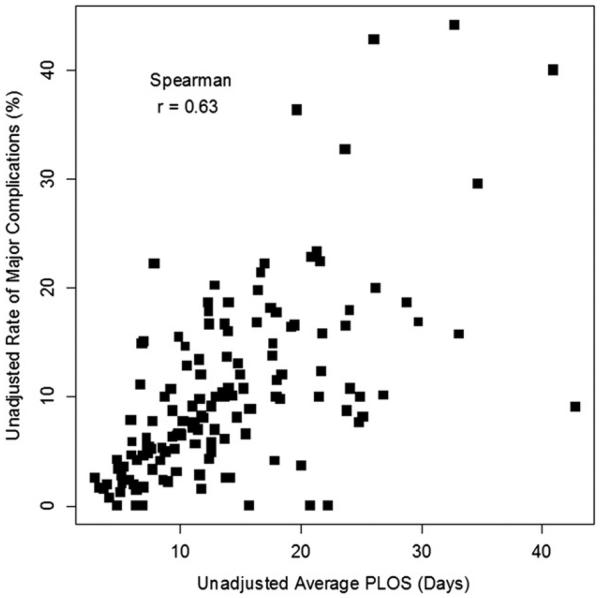
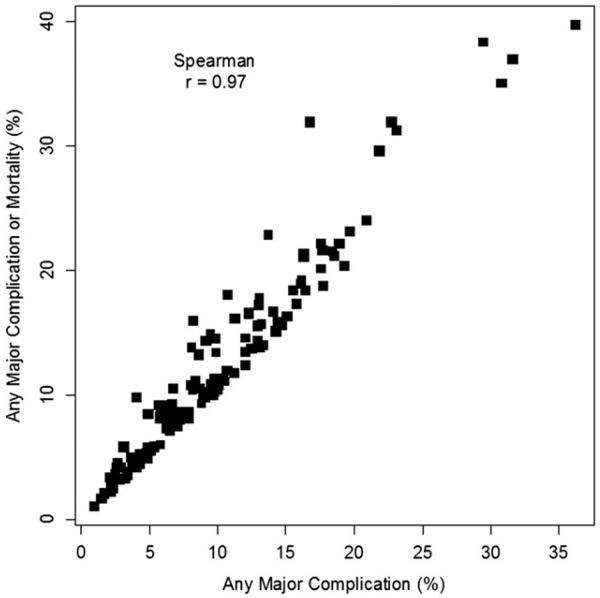
Model-estimated risk of major complications ranged from 1.0% for simple procedures to 38.2% for truncus arteriosus with interrupted aortic arch repair. Procedure-specific estimates of average postoperative length of stay ranged from 2.9 days for simple procedures to 42.6 days for a combined atrial switch and Rastelli operation. Spearman rank correlation between raw rates of major complication and average postoperative length of stay was 0.82 in procedures with n greater than 200. Rate of major complications ranged from 3.2% in category 1 to 30.0% in category 5. Aggregate average postoperative length of stay ranged from 6.3 days in category 1 to 34.0 days in category 5.
Complication rates and postoperative length of stay provide related but not redundant information about morbidity. The Morbidity Scores and Categories provide an objective assessment of risk associated with operations for congenital heart disease, which should facilitate comparison of outcomes across cohorts with differing case mixes.
先天性心脏病手术结果分析需要可靠的方法来估计不良结果的风险。当代方法主要侧重于死亡率,或者依赖专家意见来估计不同手术程序相关的发病率。我们创建了一个客观的、基于经验的指标,该指标反映了按程序估计的发病率的统计风险。
使用 2002-2008 年胸外科医师学会先天性心脏病外科学数据库中的 62851 例手术数据来估计发病率风险。为每个手术的主要并发症平均风险和平均术后住院时间计算基于模型的估计值,并带有 95%的贝叶斯可信区间。这 2 个指标结合在一起形成一个综合发病率评分。共对 140 种手术进行评分,范围从 0.1 到 5.0,并分为 5 个相对同质的类别。
主要并发症的模型估计风险从简单手术的 1.0%到完全性大动脉转位伴主动脉弓中断修复的 38.2%不等。特定手术程序的平均术后住院时间估计值从简单手术的 2.9 天到心房转位和 Rastelli 手术的 42.6 天不等。n 大于 200 的手术中,主要并发症的原始发生率与平均术后住院时间之间的斯皮尔曼等级相关系数为 0.82。主要并发症发生率从第 1 类的 3.2%到第 5 类的 30.0%不等。总平均术后住院时间从第 1 类的 6.3 天到第 5 类的 34.0 天不等。
并发症发生率和术后住院时间提供了有关发病率的相关但不冗余的信息。发病率评分和类别为先天性心脏病手术相关的风险提供了客观评估,这应该有助于在具有不同病例组合的队列之间比较结果。