NIHR Biomedical Research Unit in the Nottingham Digestive Diseases Centre, Nottingham, United Kingdom.
J Neurogastroenterol Motil. 2012 Jul;18(3):258-68. doi: 10.5056/jnm.2012.18.3.258. Epub 2012 Jul 10.
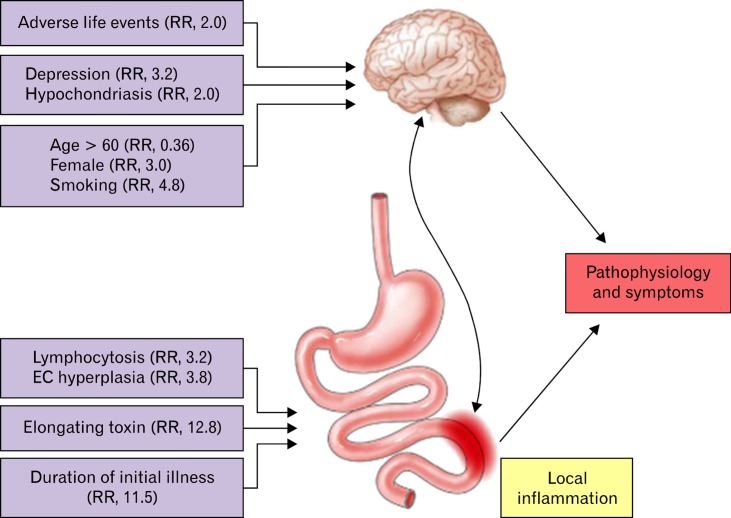
The literature on post-infectious irritable bowel syndrome (IBS) is reviewed with special emphasis on recent new data. Further accounts of this phenomenon continue to be reported following a range of infections including giardiasis as well as viral and bacterial gastroenteritis. Risk factors such as severity of initial illness, female gender together with adverse psychological factors have been confirmed. Recent evidence of a genetic predisposition needs replication. Animal studies suggest activation of mast cells and inflammation driven impairment of serotonin transporter may be important, which are findings supported by some recent human studies in IBS with diarrhoea. Experimentally induced inflammation leads to damage and remodelling of enteric nerves. Similar changes have been reported in IBS patients with increase in nerves expressing transient receptor potential cation channel V1. While changes in microbiota are very likely this area has yet to be explored using modern techniques. Since the prognosis is for slow improvement, treatments should currently target the key symptoms of diarrhoea and abdominal pain. Future therapies aimed at correcting underlying mechanisms including immune activation and serotonin excess are currently being explored and may provide better treatments in the future.
本文回顾了感染后肠易激综合征(IBS)的文献,特别强调了最近的新数据。在一系列感染后,包括贾第虫病以及病毒性和细菌性胃肠炎后,仍有继续报道这种现象。已经确认了一些风险因素,如初始疾病的严重程度、女性性别以及不良的心理因素。最近关于遗传易感性的证据需要进一步证实。动物研究表明,肥大细胞的激活和炎症驱动的 5-羟色胺转运体的损伤可能很重要,这一发现得到了一些最近关于腹泻型肠易激综合征的人类研究的支持。实验性诱导的炎症导致肠神经的损伤和重塑。在 IBS 患者中也报告了类似的变化,这些患者中表达瞬时受体电位阳离子通道 V1 的神经增加。虽然微生物群的变化很可能,但这一领域尚未使用现代技术进行探索。由于预后是缓慢改善,因此目前的治疗方法应针对腹泻和腹痛等关键症状。目前正在探索针对包括免疫激活和 5-羟色胺过多在内的潜在机制的治疗方法,这可能为未来提供更好的治疗方法。