Department of Infectious Disease Epidemiology, Faculty of Epidemiology and Population Health, London School of Hygiene & Tropical Medicine, London WC1E 7HT, UK.
Gut. 2012 Jan;61(1):69-77. doi: 10.1136/gut.2011.238386. Epub 2011 Jun 27.
To estimate, overall and by organism, the incidence of infectious intestinal disease (IID) in the community, presenting to general practice (GP) and reported to national surveillance.
Prospective, community cohort study and prospective study of GP presentation conducted between April 2008 and August 2009.
Eighty-eight GPs across the UK recruited from the Medical Research Council General Practice Research Framework and the Primary Care Research Networks.
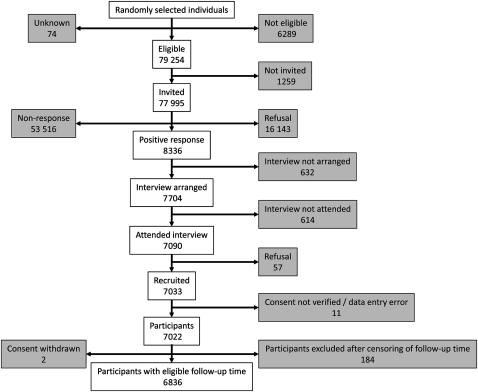
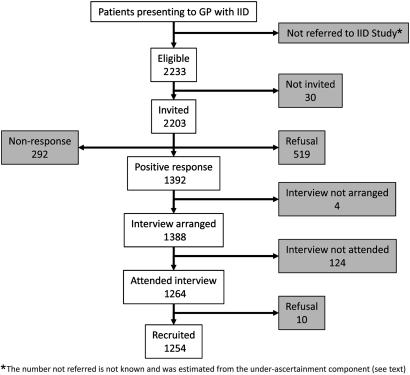
6836 participants registered with the 88 participating practices in the community study; 991 patients with UK-acquired IID presenting to one of 37 practices taking part in the GP presentation study.
IID rates in the community, presenting to GP and reported to national surveillance, overall and by organism; annual IID cases and GP consultations by organism.
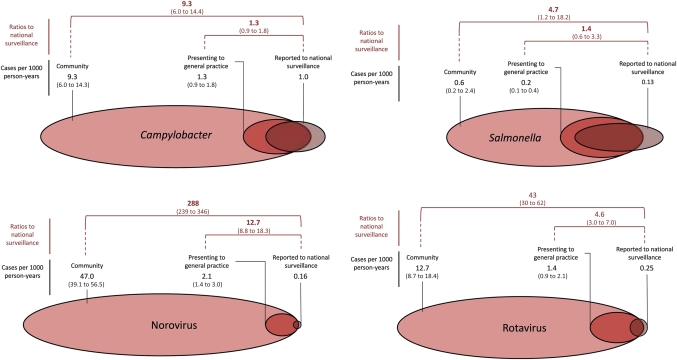
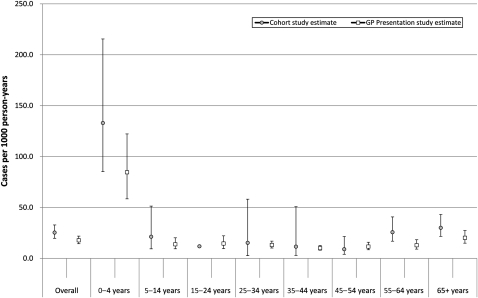
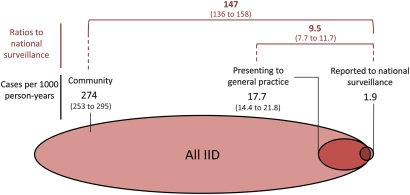
The overall rate of IID in the community was 274 cases per 1000 person-years (95% CI 254 to 296); the rate of GP consultations was 17.7 per 1000 person-years (95% CI 14.4 to 21.8). There were 147 community cases and 10 GP consultations for every case reported to national surveillance. Norovirus was the most common organism, with incidence rates of 47 community cases per 1000 person-years and 2.1 GP consultations per 1000 person-years. Campylobacter was the most common bacterial pathogen, with a rate of 9.3 cases per 1000 person-years in the community, and 1.3 GP consultations per 1000 person-years. We estimate that there are up to 17 million sporadic, community cases of IID and 1 million GP consultations annually in the UK. Of these, norovirus accounts for 3 million cases and 130,000 GP consultations, and Campylobacter is responsible for 500,000 cases and 80,000 GP consultations.
IID poses a substantial community and healthcare burden in the UK. Control efforts must focus particularly on reducing the burden due to Campylobacter and enteric viruses.
总体估计并按病原体分类,估算向全科医生(GP)就诊并向国家监测系统报告的社区传染性肠道疾病(IID)的发病率。
2008 年 4 月至 2009 年 8 月进行的前瞻性社区队列研究和 GP 就诊前瞻性研究。
英国 88 家全科医生,来自医学研究委员会全科医生研究框架和初级保健研究网络。
社区研究中,6836 名登记在参与研究的 88 家实践中的参与者;37 家参与 GP 就诊研究的实践中,有 991 名英国获得性 IID 患者就诊。
社区、向 GP 就诊和向国家监测系统报告的 IID 总体发病率和按病原体分类的发病率;每年按病原体分类的 IID 病例数和 GP 就诊数。
社区IID 的总体发病率为每 1000 人年 274 例(95%可信区间 254 至 296);GP 就诊率为每 1000 人年 17.7 次(95%可信区间 14.4 至 21.8)。向国家监测系统报告的每例病例对应 147 例社区病例和 10 例 GP 就诊。诺如病毒是最常见的病原体,社区发病数为每 1000 人年 47 例,GP 就诊数为每 1000 人年 2.1 次。弯曲杆菌是最常见的细菌病原体,社区发病率为每 1000 人年 9.3 例,GP 就诊率为每 1000 人年 1.3 次。我们估计,英国每年有多达 1700 万例散发性社区IID 病例和 100 万例 GP 就诊。其中,诺如病毒占 300 万例,13 万例 GP 就诊,弯曲杆菌导致 50 万例和 8 万例 GP 就诊。
IID 在英国给社区和医疗保健带来了巨大负担。控制工作必须特别注重降低弯曲杆菌和肠道病毒引起的负担。