Department of Pathogen Biology, Basic Medical College of Zhengzhou University, Zhengzhou, P R China.
BMC Microbiol. 2012 Jul 28;12:156. doi: 10.1186/1471-2180-12-156.
Acinetobacter baumannii, a significant nosocomial pathogen, has evolved resistance to almost all conventional antimicrobial drugs. Bacteriophage therapy is a potential alternative treatment for multidrug-resistant bacterial infections. In this study, one lytic bacteriophage, ZZ1, which infects A. baumannii and has a broad host range, was selected for characterization.
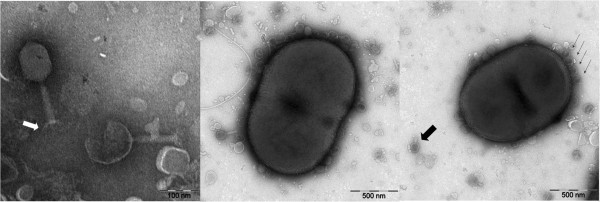
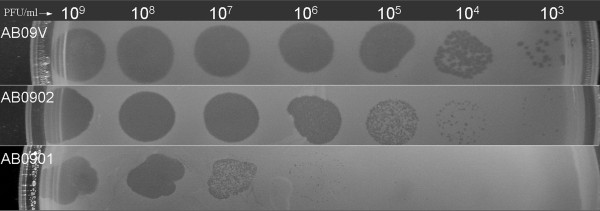
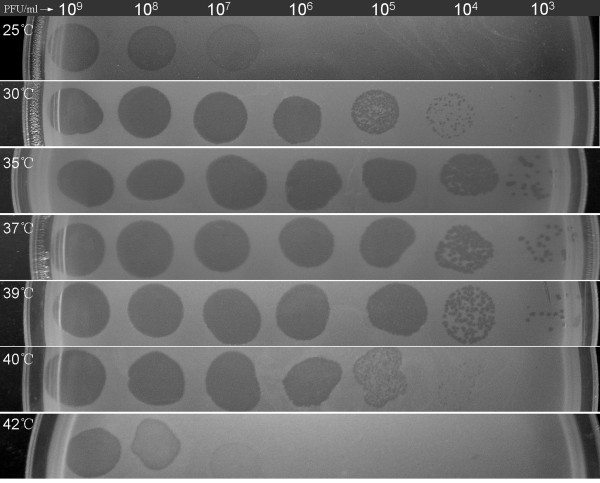
Phage ZZ1 and 3 of its natural hosts, A. baumanni clinical isolates AB09V, AB0902, and AB0901, are described in this study. The 3 strains have different sensitivities to ZZ1, but they have the same sensitivity to antibiotics. They are resistant to almost all of the antibiotics tested, except for polymyxin. Several aspects of the life cycle of ZZ1 were investigated using the sensitive strain AB09V under optimal growth conditions. ZZ1 is highly infectious with a short latent period (9 min) and a large burst size (200 PFU/cell). It exhibited the most powerful antibacterial activity at temperatures ranging from 35°C to 39°C. Moreover, when ZZ1 alone was incubated at different pHs and different temperatures, the phage was stable over a wide pH range (4 to 9) and at extreme temperatures (between 50°C and 60°C). ZZ1 possesses a 100-nm icosahedral head containing double-stranded DNA with a total length of 166,682 bp and a 120-nm long contractile tail. Morphologically, it could be classified as a member of the Myoviridae family and the Caudovirales order. Bioinformatic analysis of the phage whole genome sequence further suggested that ZZ1 was more likely to be a new member of the Myoviridae phages. Most of the predicted ORFs of the phage were similar to the predicted ORFs from other Acinetobacter phages.
The phage ZZ1 has a relatively broad lytic spectrum, high pH stability, strong heat resistance, and efficient antibacterial potential at body temperature. These characteristics greatly increase the utility of this phage as an antibacterial agent; thus, it should be further investigated.
鲍曼不动杆菌是一种重要的医院病原体,几乎对所有常规抗菌药物都产生了耐药性。噬菌体治疗是治疗多重耐药细菌感染的一种潜在替代方法。在本研究中,选择了一种溶菌噬菌体 ZZ1 进行了表征,该噬菌体可以感染鲍曼不动杆菌,并且宿主范围很广。
本研究描述了噬菌体 ZZ1 及其 3 个天然宿主,即鲍曼不动杆菌临床分离株 AB09V、AB0902 和 AB0901。这 3 株菌对 ZZ1 的敏感性不同,但对抗生素的敏感性相同。它们对几乎所有测试的抗生素都有耐药性,除了多粘菌素。在最佳生长条件下,使用敏感菌株 AB09V 研究了 ZZ1 生命周期的几个方面。ZZ1 的潜伏期很短(9 分钟),爆发量很大(每个细胞 200 个 PFU),具有很高的感染力。它在 35°C 到 39°C 的温度范围内表现出最强的抗菌活性。此外,当 ZZ1 单独在不同 pH 值和不同温度下孵育时,噬菌体在很宽的 pH 范围(4 到 9)和极端温度(50°C 到 60°C)下都很稳定。ZZ1 具有一个 100nm 的二十面体头部,其中包含总长度为 166682bp 的双链 DNA 和一个 120nm 长的可收缩尾部。形态上,它可以归类为肌病毒科的成员和长尾病毒目。噬菌体全基因组序列的生物信息学分析进一步表明,ZZ1 更可能是肌病毒科噬菌体的新成员。噬菌体的大多数预测 ORF 与其他不动杆菌噬菌体的预测 ORF 相似。
噬菌体 ZZ1 具有相对较宽的溶菌谱、较高的 pH 稳定性、较强的耐热性和在体温下高效的抗菌潜力。这些特性极大地增加了该噬菌体作为抗菌剂的实用性;因此,应该进一步研究。