Department of Zoology, Oklahoma State University, Stillwater, Oklahoma 74075, USA.
Emerg Infect Dis. 2012 Aug;18(8):1268-73. doi: 10.3201/eid1808.120070.
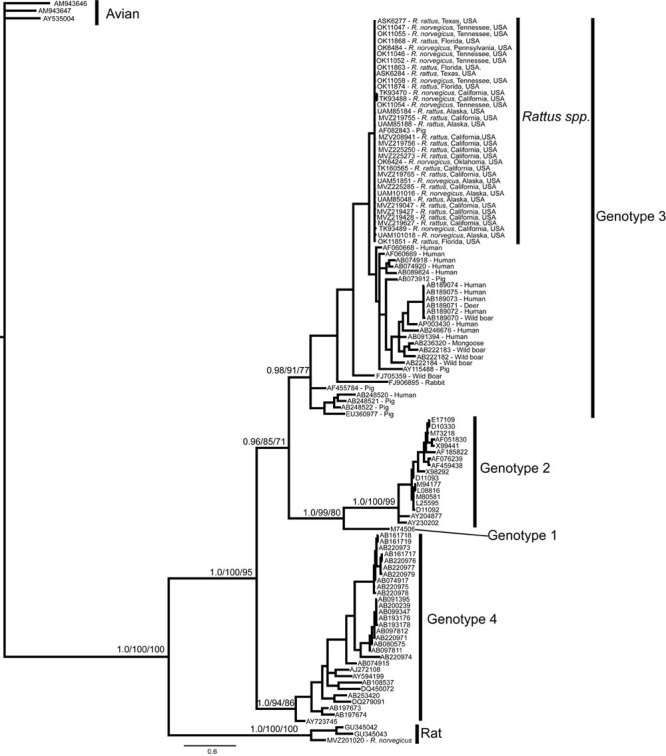
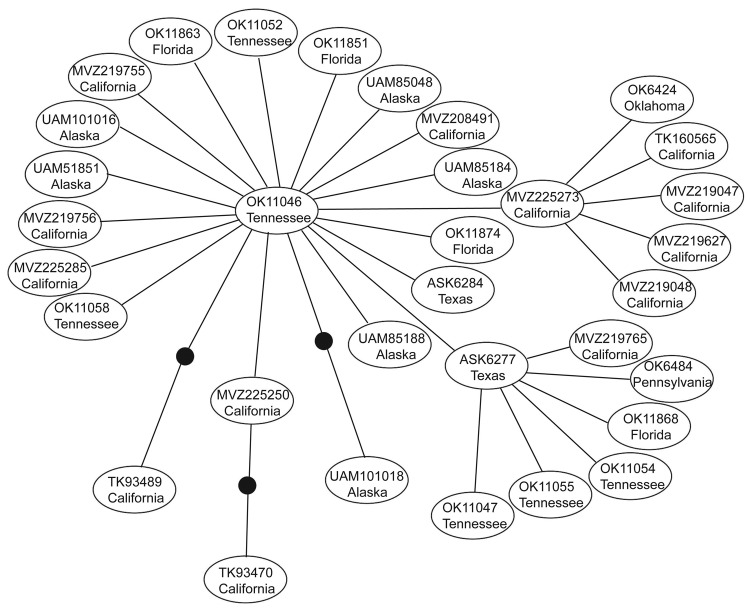
The role of rodents in the epidemiology of zoonotic hepatitis E virus (HEV) infection has been a subject of considerable debate. Seroprevalence studies suggest widespread HEV infection in commensal Rattus spp. rats, but experimental transmission has been largely unsuccessful and recovery of zoonotic genotype 3 HEV RNA from wild Rattus spp. rats has never been confirmed. We surveyed R. rattus and R. norvegicus rats from across the United States and several international populations by using a hemi-nested reverse transcription PCR approach. We isolated HEV RNA in liver tissues from 35 of 446 rats examined. All but 1 of these isolates was relegated to the zoonotic HEV genotype 3, and the remaining sequence represented the recently discovered rat genotype from the United States and Germany. HEV-positive rats were detected in urban and remote localities. Genetic analyses suggest all HEV genotype 3 isolates obtained from wild Rattus spp. rats were closely related.
啮齿动物在人畜共患戊型肝炎病毒(HEV)感染流行病学中的作用一直是一个备受争议的话题。血清流行率研究表明,在共生的 Rattus spp. 大鼠中存在广泛的 HEV 感染,但实验性传播在很大程度上并未成功,也从未从野生 Rattus spp. 大鼠中确认过人畜共患基因型 3 HEV RNA 的恢复。我们通过半巢式逆转录 PCR 方法对来自美国各地和几个国际种群的 R. rattus 和 R. norvegicus 大鼠进行了调查。我们从 446 只大鼠的肝脏组织中分离出了 35 株 HEV RNA。除了 1 株外,所有这些分离株都属于人畜共患的基因型 3,其余序列代表了最近在美国和德国发现的大鼠基因型。在城市和偏远地区都检测到了 HEV 阳性大鼠。遗传分析表明,从野生 Rattus spp. 大鼠中获得的所有基因型 3 HEV 分离株都密切相关。