Department of Radiology, National Hospital Organization Osaka National Hospital, 2-1-14 Hoenzaka, Chuo-ku, Osaka-city, Osaka-prefecture, 540-0006, Japan.
J Radiat Res. 2012 Sep;53(5):791-7. doi: 10.1093/jrr/rrs033. Epub 2012 Jul 10.
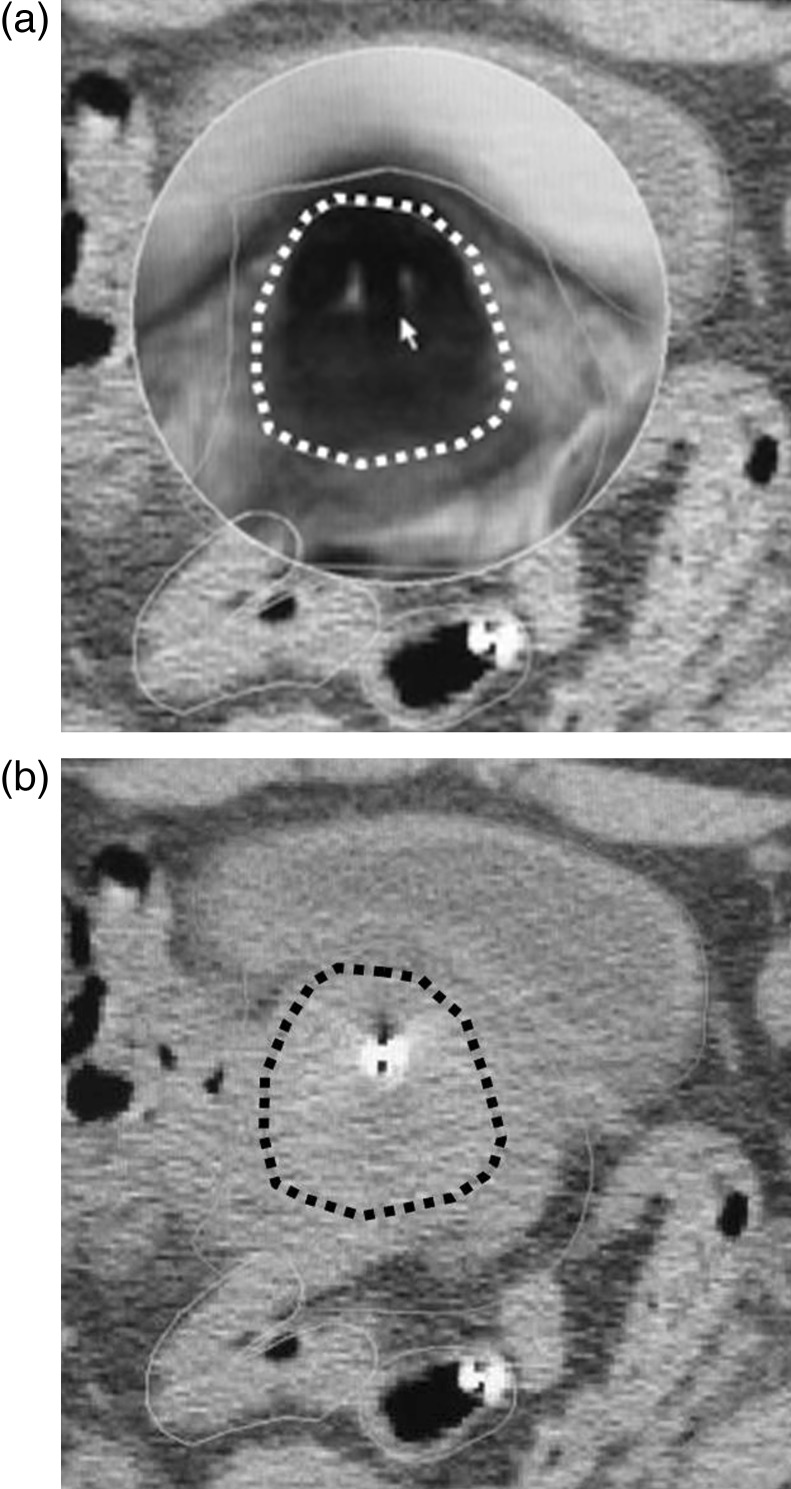
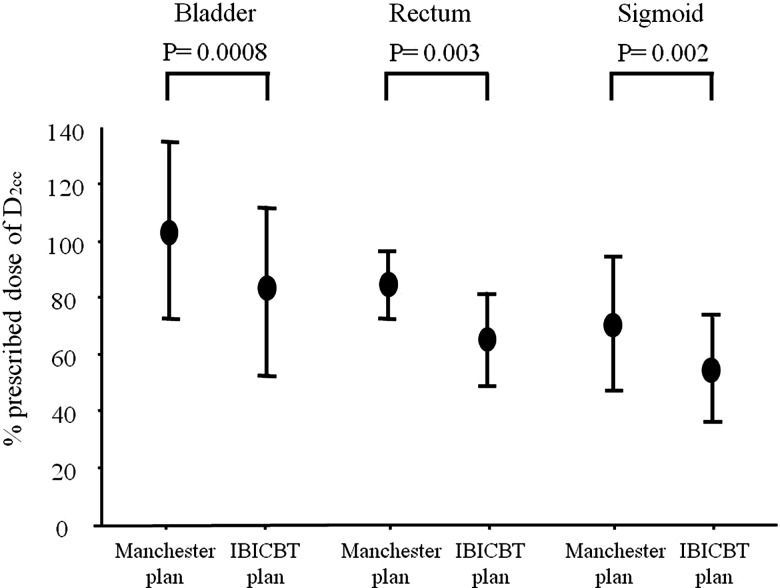
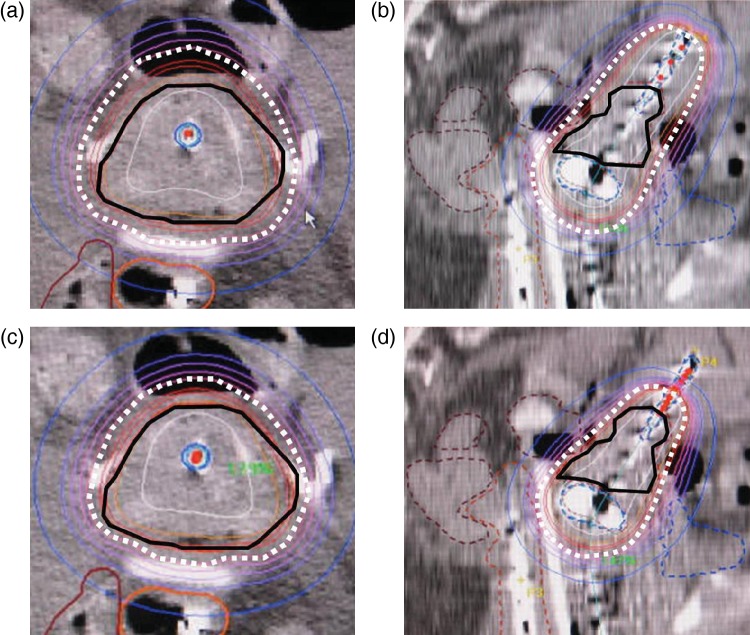
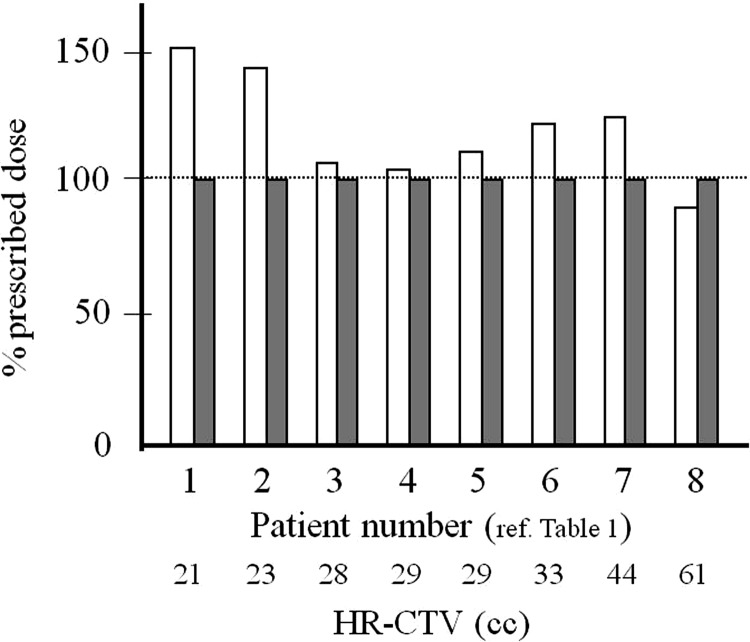
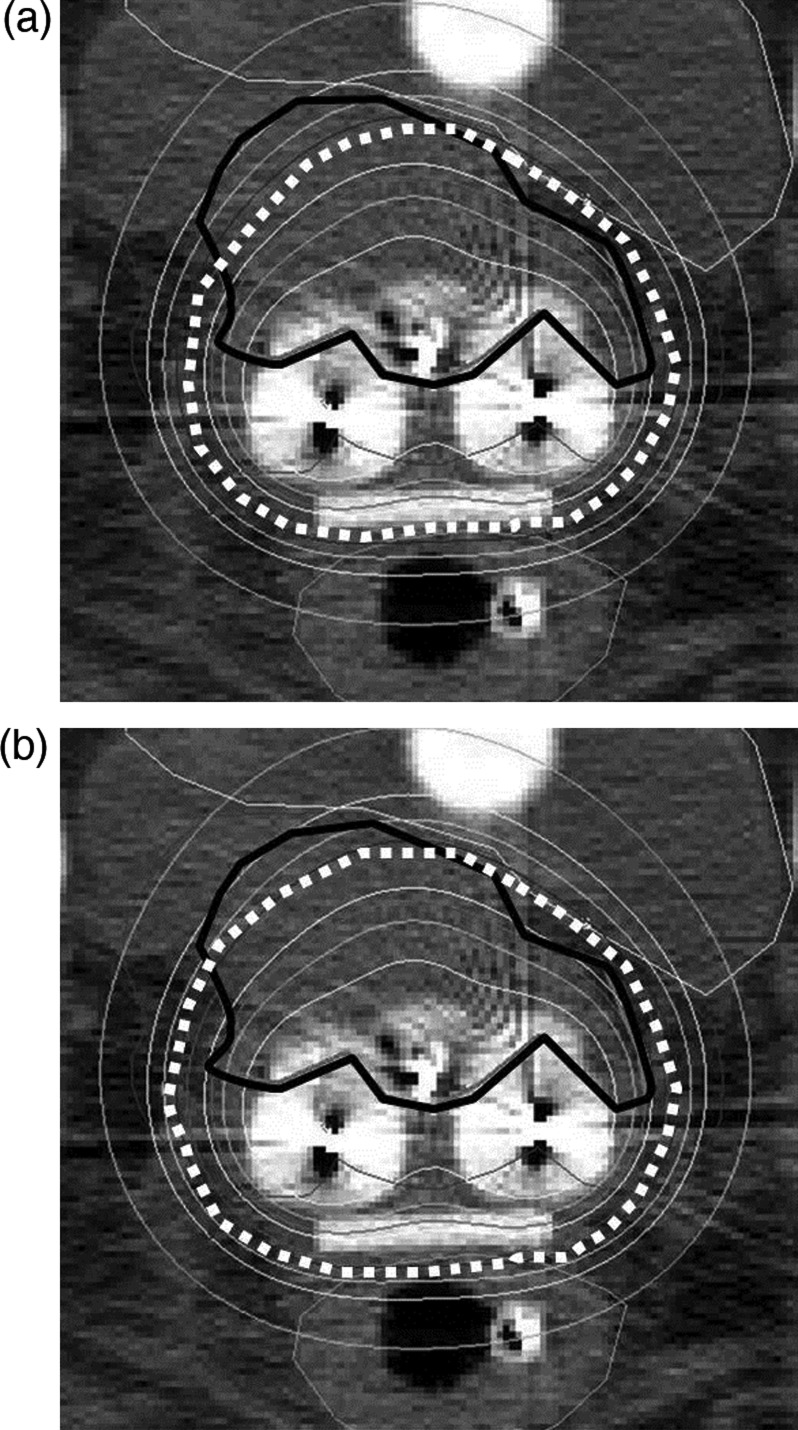
To investigate the feasibility of image-based intracavitary brachytherapy (IBICBT) for uterine cervical cancer, we evaluated the dose-volume histograms (DVHs) for the tumor and organs at risk (OARs) and compared results from the IBICBT plan and the standard Manchester system (Manchester plan) in eight patients as a simulation experiment. We performed magnetic resonance imaging (MRI) and computed tomography (CT) following MRI-adapted applicator insertion, then superimposed MR images on the planning CT images to describe the contours of high-risk clinical target volume (HR CTV) and OARs. The median volume of HR CTV was 29 cm(3) (range, 21-61 cm(3)). Median D90 (HR CTV) and V100 (HR CTV) were 116.1% prescribed doses (PD) (90.0-150.8%) and 96.7% (84.2-100%), respectively, for the Manchester plan. In comparison, we confirmed that the median D90 (HR CTV) was 100% PD in the IBICBT plan for all patients. Mean D(2cc) (bladder) was 101.8% PD for the Manchester plan and 83.2% PD for the IBICBT plan. Mean D(2cc) (rectum) was 80.1% PD for the Manchester plan and 64.2% PD for the IBICBT plan. Mean D(2cc) (sigmoid) was 75% PD for the Manchester plan and 57.5% PD for the IBICBT plan. One patient with a large tumor (HR CTV, 61 cm(3)) showed lower D90 (HR CTV) with the Manchester plan than with the IBICBT plan. The Manchester plan may represent overtreatment for small tumors but insufficient dose distribution for larger tumors. The IBICBT plan could reduce OAR dosage while maintaining adequate tumor coverage.
为了探究基于图像的腔内近距离放疗(IBICBT)治疗宫颈癌的可行性,我们对 8 例患者的肿瘤和危及器官(OAR)的剂量体积直方图(DVH)进行了评估,并将 IBICBT 计划和标准的曼彻斯特系统(Manchester 计划)的结果进行了比较,作为一项模拟实验。我们在 MRI 适配施源器插入后进行了磁共振成像(MRI)和计算机断层扫描(CT),然后将 MRI 图像叠加到计划 CT 图像上,以描述高危临床靶区(HR CTV)和 OAR 的轮廓。HR CTV 的中位体积为 29cm3(范围:21-61cm3)。中位 D90(HR CTV)和 V100(HR CTV)分别为 116.1%处方剂量(PD)(90.0-150.8%)和 96.7%(84.2-100%),这是 Manchester 计划的结果。相比之下,我们确认在所有患者中,IBICBT 计划的 HR CTV 的中位 D90(HR CTV)为 100%PD。对于 Manchester 计划,膀胱的平均 D(2cc)为 101.8%PD,而 IBICBT 计划为 83.2%PD。直肠的平均 D(2cc)为 80.1%PD,Manchester 计划为 64.2%PD,IBICBT 计划为 64.2%PD。乙状结肠的平均 D(2cc)为 75%PD,Manchester 计划为 57.5%PD,IBICBT 计划为 57.5%PD。一位 HR CTV 较大(61cm3)的患者,Manchester 计划的 D90(HR CTV)低于 IBICBT 计划。Manchester 计划可能代表了对小肿瘤的过度治疗,但对大肿瘤的剂量分布不足。IBICBT 计划可以降低 OAR 剂量,同时保持肿瘤的充分覆盖。