Department of Health Studies (MC 2007), University of Chicago, Chicago, IL 60637, USA.
J Abnorm Psychol. 2012 Nov;121(4):971-7. doi: 10.1037/a0028355. Epub 2012 Jul 30.
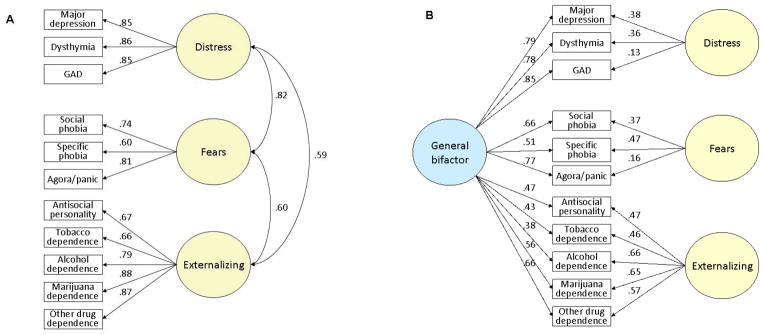
The patterns of comorbidity among prevalent mental disorders in adults lead them to load on "externalizing," "distress," and "fears" factors. These factors are themselves robustly correlated, but little attention has been paid to this fact. As a first step in studying the implications of these interfactor correlations, we conducted confirmatory factor analyses on diagnoses of 11 prevalent Diagnostic and Statistical Manual of Mental Disorders (4th ed.) mental disorders in a nationally representative sample. A model specifying correlated externalizing, distress, and fears factors fit well, but an alternative model was tested in which a "general" bifactor was added to capture what these disorders share in common. There was a modest but significant improvement in fit for the bifactor model relative to the 3-factor oblique model, with all disorders loading strongly on the bifactor. Tests of external validity revealed that the fears, distress, and externalizing factors were differentially associated with measures of functioning and potential risk factors. Nonetheless, the general bifactor accounted for significant independent variance in future psychopathology, functioning, and other criteria over and above the fears, distress, and externalizing factors. These findings support the hypothesis that these prevalent forms of psychopathology have both important common and unique features. Future studies should determine whether this is because they share elements of their etiology and neurobiological mechanisms. If so, the existence of common features across diverse forms of prevalent psychopathology could have important implications for understanding the nature, etiology, and outcomes of psychopathology.
成人常见精神障碍的共病模式导致它们集中在“外化”、“痛苦”和“恐惧”因素上。这些因素本身就有很强的相关性,但很少有人关注这一事实。作为研究这些交互因子相关性影响的第一步,我们对一个全国代表性样本中 11 种常见的《精神障碍诊断与统计手册》(第 4 版)精神障碍的诊断进行了验证性因素分析。一个指定相关外化、痛苦和恐惧因素的模型拟合得很好,但我们也测试了一个替代模型,该模型增加了一个“一般”双因子,以捕捉这些障碍的共同之处。与三因子斜交模型相比,双因子模型的拟合略有但显著改善,所有障碍都强烈地加载在双因子上。外部有效性检验表明,恐惧、痛苦和外化因素与功能和潜在风险因素的测量结果有不同的关联。尽管如此,一般双因子在未来的精神病理学、功能和其他标准方面,除了恐惧、痛苦和外化因素之外,还解释了显著的独立变异。这些发现支持了这样一种假设,即这些常见形式的精神病理学既有重要的共同特征,也有独特的特征。未来的研究应该确定这是否是因为它们共享其病因和神经生物学机制的元素。如果是这样,不同形式的常见精神病理学之间存在共同特征,可能对理解精神病理学的性质、病因和结果具有重要意义。