Division of Insurance Medicine, Department of Clinical Neuroscience, Karolinska Institutet, Stockholm, Sweden.
PLoS One. 2012;7(7):e40952. doi: 10.1371/journal.pone.0040952. Epub 2012 Jul 24.
Evidence based and gender specific knowledge about sickness absence following coronary revascularisation is lacking. The objective was to investigate sickness absence after a first coronary artery bypass grafting (CABG) or percutaneous coronary intervention (PCI) among women and men in a national Swedish study.
All patients 30-63 years of age, who underwent a first CABG (n = 22,985, 16% women) or PCI (40,891, 22% women) in Sweden between 1994 and 2006 were included. Information on sickness absence, co-morbidity, and other patient characteristics was obtained from national registers. Long-term sickness absence (LTSA) was defined as >180 and >90 sick-leave days in the first sick-leave spell following CABG and PCI, respectively. Prevalence ratio (PR) and 95% confidence interval (CI) of LTSA were calculated.
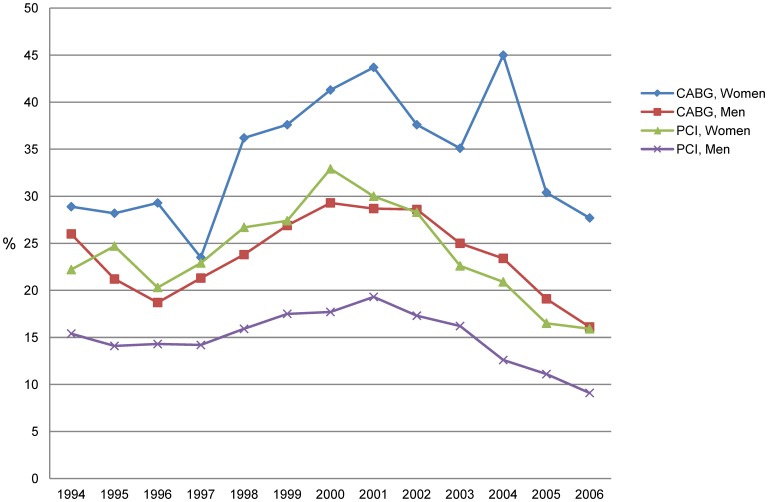
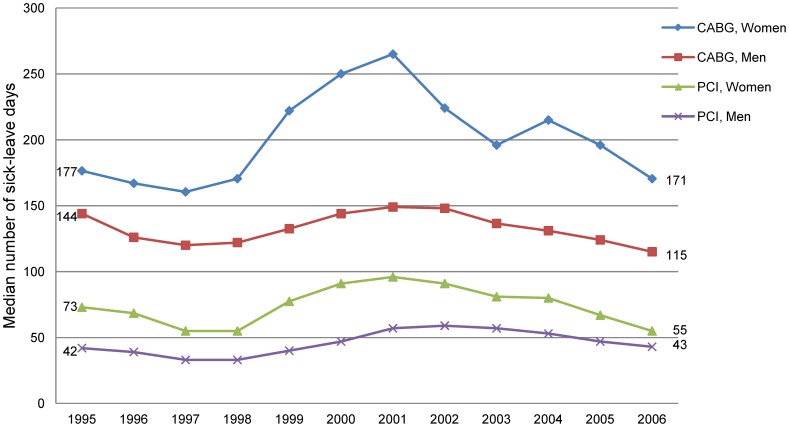
LTSA followed the interventions in 41% and 36% for CABG and PCI patients, respectively. Women had more often LTSA compared with men, (CABG PR = 1.23: 95% CI 1.19-1.28 and PCI PR = 1.19; 95% CI 1.16-1.23). A history of sickness absence the year before the intervention increased the risk for LTSA after the intervention in both genders. Among women, older age, or being self employed or unemployed was associated with a lower risk for LTSA. Among men previous cardiovascular disease, diabetes and low socio-economic position increased the risk. During the observation period, there was no change in sickness absence rates among PCI patients but an increase among CABG patients adjusting for patient characteristics.
This national study covering a 13-year period shows that long-term sickness absence following coronary revascularisation is common in Sweden, especially among women, and is associated with socio-economic position, co-morbidity, and sickness absence during the year before the intervention. Gender specific scientific knowledge about use and effects of sickness absence following coronary revascularisation is warranted for the patients, the treating physicians, the healthcare sector, and the society.
目前缺乏针对冠状动脉血运重建术后缺勤的循证医学和性别特异性知识。本研究旨在通过一项全国性的瑞典研究,调查女性和男性首次冠状动脉旁路移植术(CABG)或经皮冠状动脉介入治疗(PCI)后的缺勤情况。
纳入 1994 年至 2006 年期间在瑞典接受首次 CABG(n=22985,16%为女性)或 PCI(40891,22%为女性)的年龄在 30-63 岁的所有患者。从国家登记处获得关于缺勤、合并症和其他患者特征的信息。长期缺勤(LTSA)定义为 CABG 和 PCI 后首次缺勤期间分别超过 180 天和 90 天。计算 LTSA 的患病率比(PR)和 95%置信区间(CI)。
CABG 和 PCI 患者的 LTSA 发生率分别为 41%和 36%。与男性相比,女性的 LTSA 更为常见(CABG PR=1.23:95%CI 1.19-1.28;PCI PR=1.19;95%CI 1.16-1.23)。干预前一年的缺勤史增加了女性和男性干预后 LTSA 的风险。在女性中,年龄较大、自营职业或失业与 LTSA 的风险降低相关。在男性中,先前的心血管疾病、糖尿病和低社会经济地位增加了这种风险。在观察期间,PCI 患者的缺勤率没有变化,但在调整患者特征后,CABG 患者的缺勤率有所增加。
这项涵盖 13 年的全国性研究表明,瑞典冠状动脉血运重建术后的长期缺勤很常见,尤其是在女性中,与社会经济地位、合并症和干预前一年的缺勤有关。需要针对女性和男性患者、治疗医生、医疗保健部门和社会,开展关于冠状动脉血运重建术后缺勤的使用和影响的性别特异性科学研究。