School of Pharmacy, Bouvé College of Health Sciences, Northeastern University, Boston, Massachusetts, United States of America.
PLoS One. 2012;7(7):e42103. doi: 10.1371/journal.pone.0042103. Epub 2012 Jul 24.
Continued pressure from glycopeptide use has led to non-susceptible strains of Staphylococcus aureus including heterogeneously vancomycin-intermediate S. aureus (hVISA). Infections with hVISA are associated with poor patient outcomes, thus incentivizing novel treatments. Evidence suggests that vancomycin and anti-staphylococcal penicillin susceptibility are inversely related which indicates that the use of this combination may be particularly useful against methicillin-resistant S. aureus with reduced susceptibility to vancomycin, such as hVISA. The aim of this study was to evaluate the potential for synergy between vancomycin and nafcillin against hVISA.
Twenty-five hVISA strains were evaluated for vancomycin and nafcillin minimum inhibitory concentration (MIC) by broth microdilution in duplicate. Potential for synergy was assessed by time-kill at 1/2x MIC in triplicate. Five strains were chosen, representing the range nafcillin MIC's available in the cohort -4, 16, 64, 128, and 256 µg/mL, and were run in an in vitro pharmacokinetic/pharmacodynamic (PK/PD) model in duplicate over 72 hours to evaluate the potential of the combination with simulated human pharmacokinetics. In addition, 4 fully glycopeptide susceptible strains of S. aureus including 2 methicillin-susceptible (MSSA) and 2 methicillin-resistant (MRSA) were run in the PK/PD model for comparison.
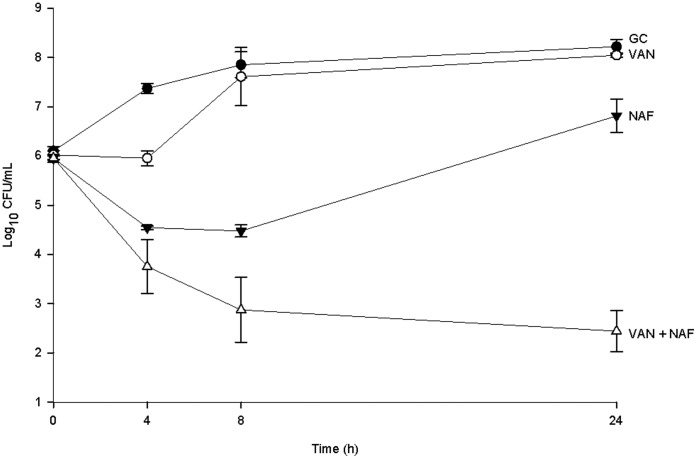
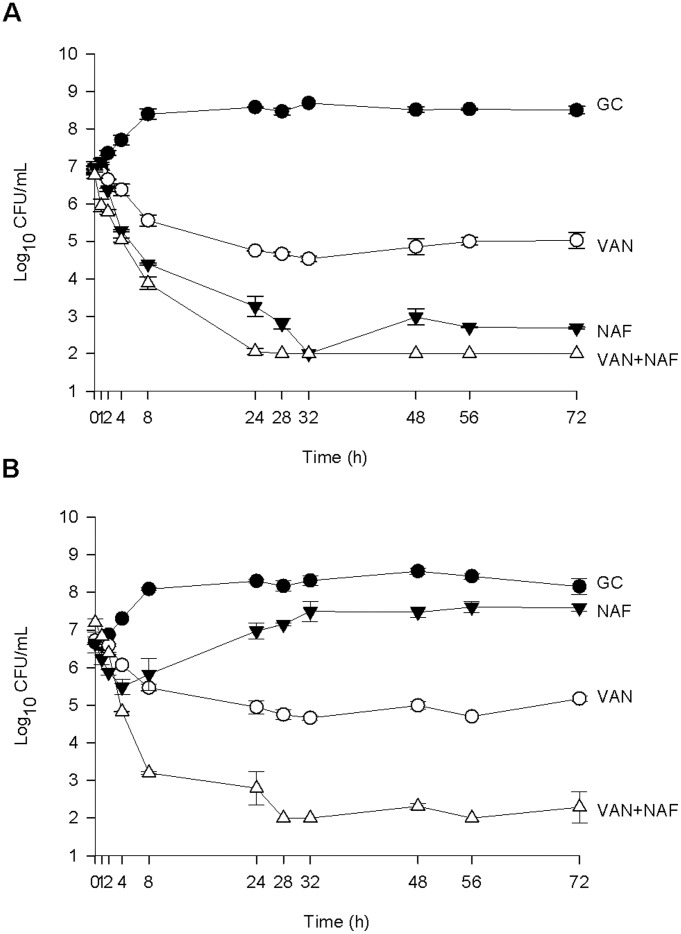
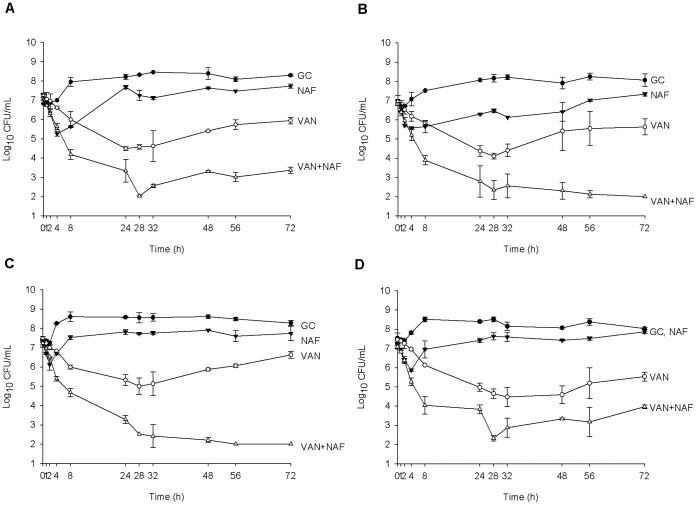
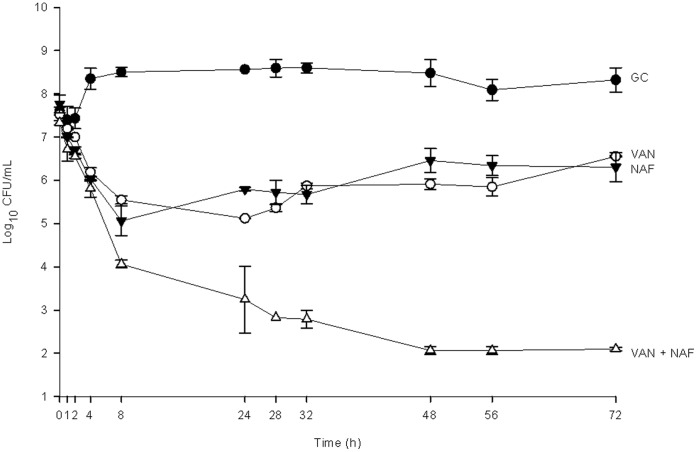
In the time-kill, 92% of strains (23 of 25) displayed synergy with the combination of vancomycin and nafcillin. In the PK/PD model, all five strains of hVISA showed an improvement in overall activity (P≤0.004) and organism burden at 72 hours (P≤0.001) with the combination compared to either drug alone. The combination was also successful against both MRSA and MSSA in overall activity (P≤0.009) and organism burden at 72 hours (P≤0.016), though the magnitude of the effect was diminished against MSSA.
The combination of vancomycin and nafcillin significantly improved antibacterial activity against hVISA, MRSA, and MSSA compared to either drug alone.
由于糖肽类药物的持续使用,导致金黄色葡萄球菌出现了异质性万古霉素中介金黄色葡萄球菌(hVISA)等非敏感性菌株。hVISA 感染与患者预后不良有关,因此需要新的治疗方法。有证据表明,万古霉素和抗葡萄球菌青霉素的敏感性呈负相关,这表明这种联合用药可能对耐甲氧西林金黄色葡萄球菌(MRSA)特别有用,因为这类细菌对万古霉素的敏感性降低,例如 hVISA。本研究旨在评估万古霉素和萘夫西林联合用药对 hVISA 的协同作用潜力。
通过肉汤微量稀释法在重复试验中评估了 25 株 hVISA 菌株的万古霉素和萘夫西林最小抑菌浓度(MIC)。通过在 1/2x MIC 下的时间杀灭试验,以三重复试验评估协同作用的潜力。选择了五个菌株,代表了本研究队列中萘夫西林 MIC 的可用范围-4、16、64、128 和 256 µg/mL,并在重复试验中进行了 72 小时的体外药代动力学/药效学(PK/PD)模型,以评估与模拟人体药代动力学相结合的潜在可能性。此外,还对 4 株完全对糖肽类敏感的金黄色葡萄球菌进行了 PK/PD 模型的运行,包括 2 株耐甲氧西林的金黄色葡萄球菌(MSSA)和 2 株耐甲氧西林的金黄色葡萄球菌(MRSA),以作比较。
在时间杀灭试验中,92%的菌株(25 株中的 23 株)显示出万古霉素和萘夫西林联合用药的协同作用。在 PK/PD 模型中,与单独使用任何一种药物相比,hVISA 的五株菌在 72 小时时,整体活性(P≤0.004)和菌负荷(P≤0.001)均有显著改善。该联合用药方案对 MRSA 和 MSSA 的整体活性(P≤0.009)和 72 小时时的菌负荷(P≤0.016)也有显著效果,尽管对 MSSA 的效果有所减弱。
与单独使用任何一种药物相比,万古霉素和萘夫西林联合用药显著提高了对 hVISA、MRSA 和 MSSA 的抗菌活性。