Yang Jay, Terebelo Howard R, Zonder Jeffrey A
Department of Oncology, Karmanos Cancer Institute and Wayne State University, Detroit, MI 48201, USA.
Adv Hematol. 2012;2012:801495. doi: 10.1155/2012/801495. Epub 2012 Jul 19.
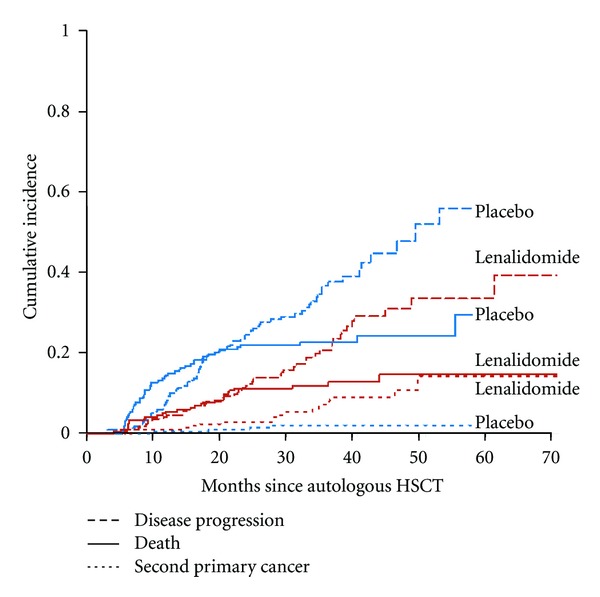
The treatment of myeloma has undergone extraordinary improvements in the past half century. These advances have been accompanied by a concern for secondary primary malignancies (SPMs). It has been known for decades that extended therapy with alkylating chemotherapy agents, such as melphalan, carries an increased risk of therapy-related myelodysplastic syndrome and/or acute myeloid leukemia (t-MDS/AML), with a cumulative risk as high as 10-15%. High-dose chemotherapy with autologous stem cell support became widely accepted for myeloma in the 1990s. Despite the use of high doses of melphalan, the risk of t-MDS/AML with this procedure is estimated to be less than 5%, with much of this risk attributable to pretransplant therapy. Recently, lenalidomide has come under scrutiny for its possible association with SPMs. It is too soon to declare a causal relationship at this time, but there appears to be an increased number of SPMs in reports from several studies using lenalidomide maintenance. Current studies should be amended and future studies planned to better define the risk of SPMs and the risk factors and mechanisms for its development. Patients should be educated regarding this potential concern but the current use of lenalidomide should not generally be altered until further data are available.
在过去的半个世纪里,骨髓瘤的治疗取得了非凡的进展。这些进展伴随着对继发性原发性恶性肿瘤(SPM)的关注。几十年来,人们已经知道,使用诸如美法仑等烷化剂进行延长治疗会增加治疗相关的骨髓增生异常综合征和/或急性髓系白血病(t-MDS/AML)的风险,累积风险高达10%-15%。20世纪90年代,自体干细胞支持下的大剂量化疗在骨髓瘤治疗中被广泛接受。尽管使用了高剂量的美法仑,但该治疗方法导致t-MDS/AML的风险估计低于5%,其中大部分风险归因于移植前治疗。最近,来那度胺因其与SPM可能存在的关联而受到审查。目前宣布因果关系还为时过早,但在几项使用来那度胺维持治疗的研究报告中,SPM的数量似乎有所增加。应修改当前的研究,并规划未来的研究,以更好地确定SPM的风险及其发生的危险因素和机制。应就这一潜在问题对患者进行教育,但在获得更多数据之前,一般不应改变目前来那度胺的使用。