Han Weiqing, Wang Silin, Su Lang, Xu Jianjun, Wei Yiping
Department of Cardiothoracic Surgery, The Second Affiliated Hospital, Jiangxi Medical College, Nanchang University, Nanchang, Jiangxi, China.
Department of Thoracic Surgery, The Second Affiliated Hospital, Jiangxi Medical College, Nanchang University, Nanchang, Jiangxi, China.
Front Oncol. 2024 Feb 20;14:1294383. doi: 10.3389/fonc.2024.1294383. eCollection 2024.
As lung squamous cell carcinoma (LUSC) patients are at increased risk of developing a second primary cancer, this complicates the patient's condition and thus makes prognostic assessment more difficult, posing a significant prognostic challenge for clinicians. Our goal was to assess the prognosis of LUSC patients with a second primary tumor, and provide insights into appropriate therapy and monitoring strategies.
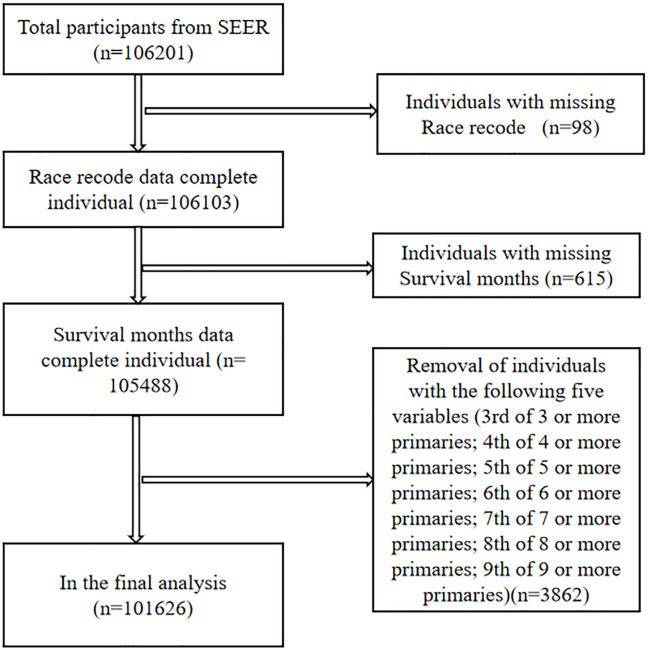
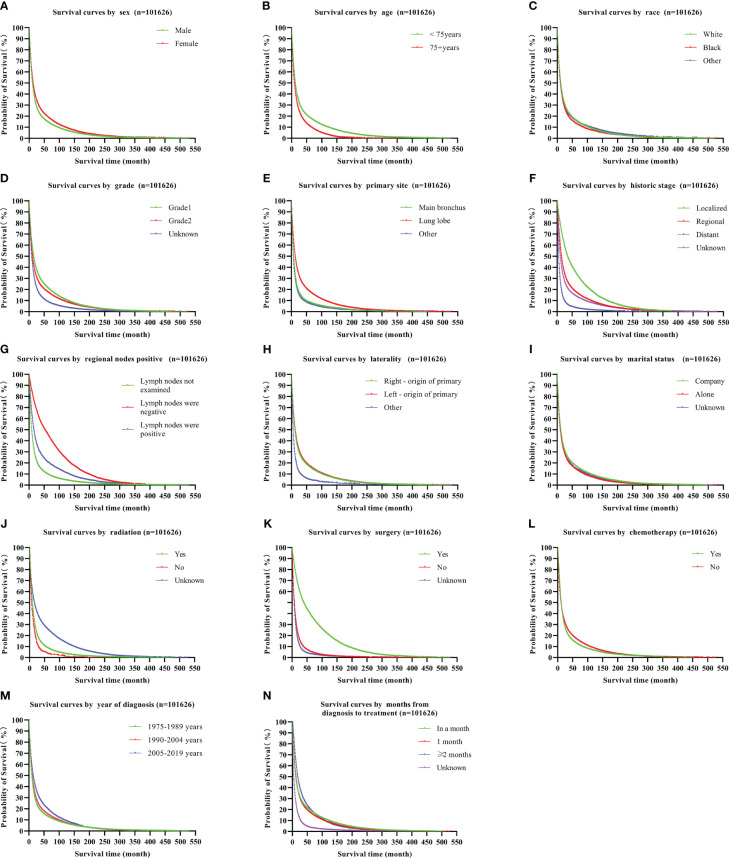
Data was obtained for LUSC patients from the Surveillance, Epidemiology, and End Results (SEER) database. The LUSC patients were divided into three groups (LS-SPM, OT-LUSC and LUSC-only). Univariate and stratified analyses were performed for the baseline and clinical characteristics of the participants. Multiple regression and Kaplan-Meier survival analyses were also performed, followed by a final life table analysis.
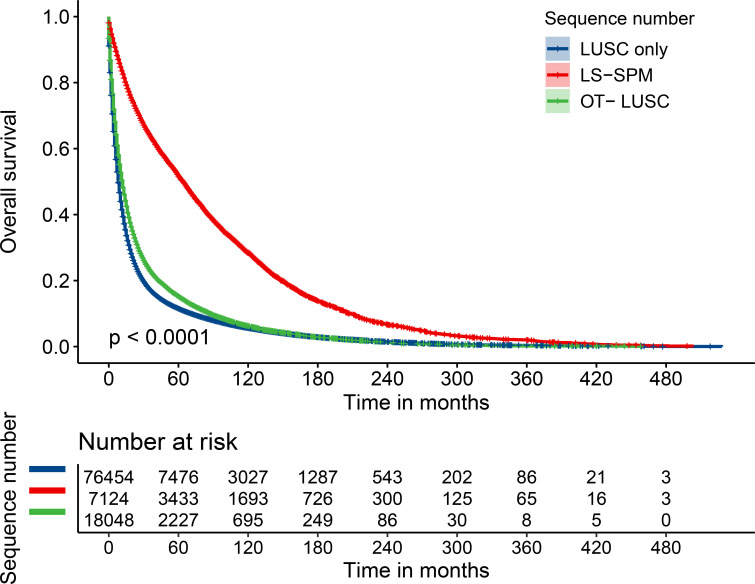
In our sample of 101,626 patients, the HR for OS in the LS-SPM group was 0.40 in univariate analysis. Kaplan-Meier survival curves showed that LS-SPM patients had considerably longer lifespans compared to the other groups. The LS-SPM patients had median and mean survival times of 64 months and 89.11 months. Unadjusted and adjusted multiple regression analyses showed that LS-SPM patients had a superior survival compared to LUSC-only and OT-LUSC groups.
LS-SPM patients have a good prognosis with aggressive therapy and immune monitoring. The present study offers novel insights into the pathophysiological causes and treatments for LS-SPM.
由于肺鳞状细胞癌(LUSC)患者发生第二原发性癌症的风险增加,这使患者病情复杂化,从而使预后评估更加困难,给临床医生带来了重大的预后挑战。我们的目标是评估患有第二原发性肿瘤的LUSC患者的预后,并为适当的治疗和监测策略提供见解。
从监测、流行病学和最终结果(SEER)数据库中获取LUSC患者的数据。将LUSC患者分为三组(LS-SPM、OT-LUSC和仅LUSC组)。对参与者的基线和临床特征进行单因素和分层分析。还进行了多元回归和Kaplan-Meier生存分析,随后进行最终生命表分析。
在我们的101626例患者样本中,单因素分析显示LS-SPM组的总生存期(OS)风险比(HR)为0.40。Kaplan-Meier生存曲线显示,与其他组相比,LS-SPM患者的寿命明显更长。LS-SPM患者的中位生存期和平均生存期分别为64个月和89.11个月。未调整和调整后的多元回归分析表明,与仅LUSC组和OT-LUSC组相比,LS-SPM患者的生存率更高。
LS-SPM患者通过积极治疗和免疫监测预后良好。本研究为LS-SPM的病理生理原因和治疗提供了新的见解。