Department of Otorhinolaryngology, Head and Neck Surgery, Heinrich-Heine-University Duesseldorf, Duesseldorf, Germany.
Clin Transl Allergy. 2012 Aug 1;2(1):13. doi: 10.1186/2045-7022-2-13.
IL-31, a recently discovered member of the gp130/IL-6 cytokine family, is mainly expressed by human mast cells and T helper type 2 cells. IL-31 is a key trigger of atopic dermatitis. Recent studies also suggest a role of IL-31 in the pathogenesis of other allergic diseases including allergic rhinitis. In the present study we studied the release of IL-31 and IL-13 in allergen-challenged allergic rhinitis patients.
Seven seasonal allergic volunteers underwent unilateral nasal provocation with allergen (and a control challenge) with the disc method out of the allergy season. Nasal symptom scores (rhinorrhea, itching, sneezing, obstruction) and bilateral nasal secretions were quantified before and after allergen provocation. IL-13 and IL-31 in nasal secretions and serum were measured by electrochemiluminescent immunoassay or ELISA, respectively.
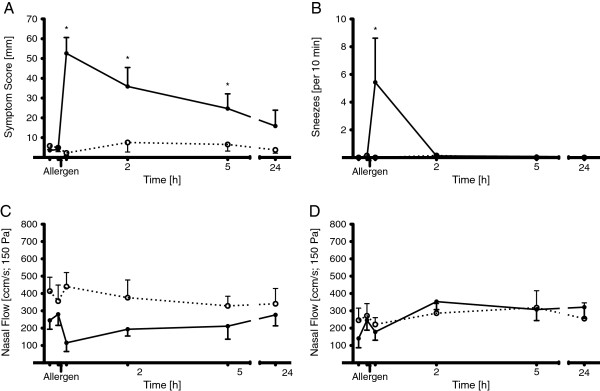
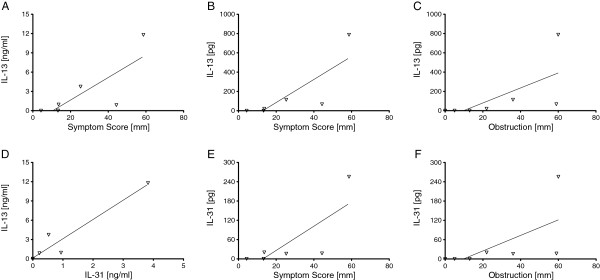
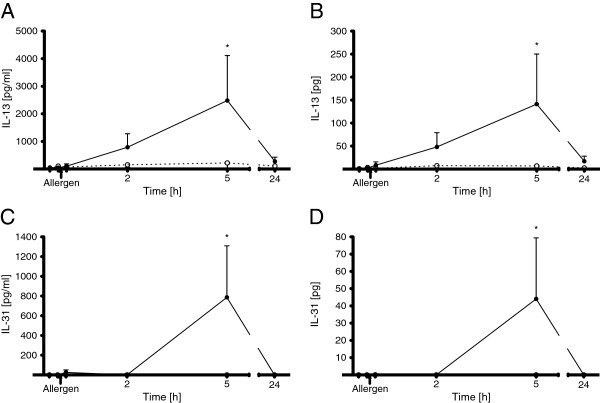
Nasal allergen challenge induced the typical clinical symptoms and physiological changes. IL-31 and IL-13 in nasal secretions increased in four and five, respectively, volunteers at 5 h after allergen but not after control challenge. We observed correlation trends between nasal IL-31 concentrations and IL-13 concentrations (r = 0.9, p = 0.002), and IL-31 contents and symptom scores (r = 0.9, p = 0.013) 5 h after allergen provocation. No IL-31 could be detected contralaterally or systemically in the sera.
The observed local upregulation of IL-31 mainly during the late phase reaction after nasal allergen challenge suggests a role of IL-31 in allergic rhinitis. In which way IL-31 modulates the inflammatory reaction and type 2 responses in allergic rhinitis remains to be investigated.
IL-31 是 gp130/IL-6 细胞因子家族的新成员,主要由人肥大细胞和辅助性 T 细胞 2 型表达。IL-31 是特应性皮炎的关键触发因素。最近的研究还表明,IL-31 在包括过敏性鼻炎在内的其他过敏性疾病的发病机制中起作用。在本研究中,我们研究了变应原激发的变应性鼻炎患者中 IL-31 和 IL-13 的释放。
7 名季节性变应原志愿者在过敏季节之外通过圆盘法进行单侧鼻变应原激发(和对照激发)。在变应原激发前后定量评估鼻症状评分(流涕、瘙痒、打喷嚏、鼻塞)和双侧鼻分泌物。通过电化学发光免疫测定或 ELISA 分别测量鼻分泌物和血清中的 IL-13 和 IL-31。
鼻变应原激发引起了典型的临床症状和生理变化。在变应原激发后 5 小时,4 名和 5 名志愿者的鼻分泌物中分别增加了 IL-31 和 IL-13,但对照激发后没有增加。我们观察到鼻 IL-31 浓度与 IL-13 浓度之间存在相关趋势(r=0.9,p=0.002),以及 IL-31 含量与症状评分之间的相关趋势(r=0.9,p=0.013),在变应原激发后 5 小时。在血清中无法在对侧或系统中检测到 IL-31。
在鼻变应原激发后的晚期反应中观察到的 IL-31 局部上调表明 IL-31 在过敏性鼻炎中起作用。IL-31 以何种方式调节过敏性鼻炎中的炎症反应和 2 型反应仍有待研究。