Department of Psychiatry and Behavioral Sciences, Duke University Medical Center Durham, NC, USA.
Front Integr Neurosci. 2012 Jul 26;6:48. doi: 10.3389/fnint.2012.00048. eCollection 2012.
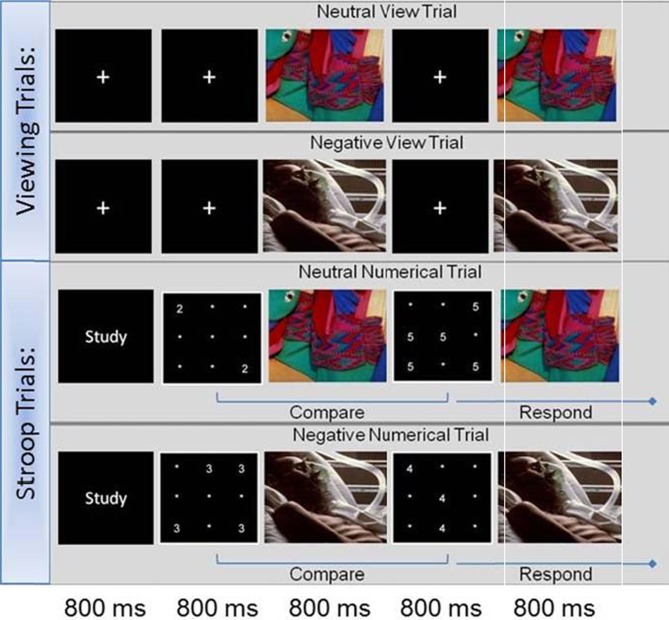
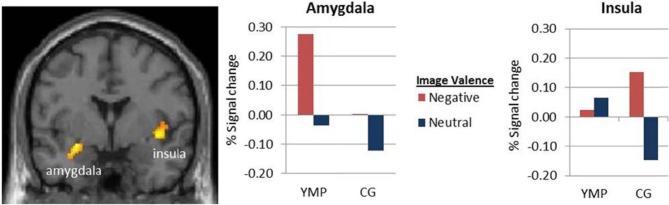
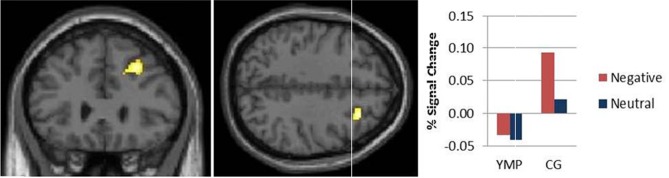
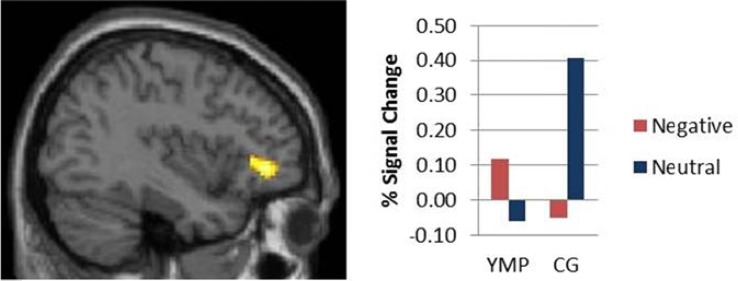
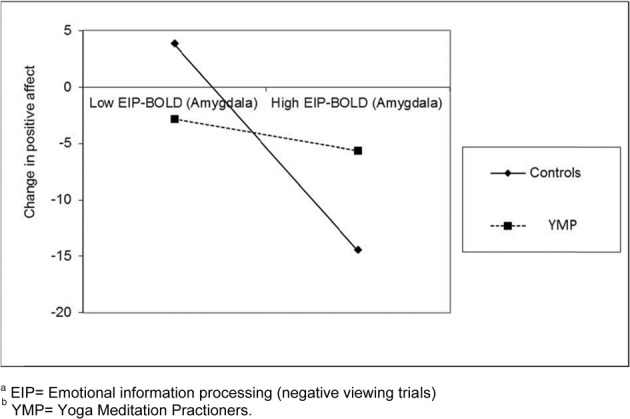
Mindfulness meditation involves attending to emotions without cognitive fixation of emotional experience. Over time, this practice is held to promote alterations in trait affectivity and attentional control with resultant effects on well-being and cognition. However, relatively little is known regarding the neural substrates of meditation effects on emotion and cognition. The present study investigated the neurocognitive correlates of emotion interference on cognition in Yoga practitioners and a matched control group (CG) underwent fMRI while performing an event-related affective Stroop task. The task includes image viewing trials and Stroop trials bracketed by neutral or negative emotional distractors. During image viewing trials, Yoga practitioners exhibited less reactivity in right dorsolateral prefrontal cortex (dlPFC) to negative as compared to neutral images; whereas the CG had the opposite pattern. A main effect of valence (negative > neutral) was observed in limbic regions (e.g., amygdala), of which the magnitude was inversely related to dlPFC activation. Exploratory analyses revealed that the magnitude of amygdala activation predicted decreased self-reported positive affect in the CG, but not among Yoga practitioners. During Stroop trials, Yoga practitioners had greater activation in ventrolateral prefrontal cortex (vlPFC) during Stroop trials when negative, compared to neutral, emotional distractor were presented; the CG exhibited the opposite pattern. Taken together, these data suggest that though Yoga practitioners exhibit limbic reactivity to negative emotional stimuli, such reactivity does not have downstream effects on later mood state. This uncoupling of viewing negative emotional images and affect among Yoga practitioners may be occasioned by their selective implementation of frontal executive-dependent strategies to reduce emotional interference during competing cognitive demands and not during emotional processing per se.
正念冥想包括关注情绪而不固定认知情绪体验。随着时间的推移,这种练习被认为可以促进特质情感和注意力控制的改变,从而对幸福感和认知产生影响。然而,关于冥想对情绪和认知的神经基础知之甚少。本研究调查了瑜伽练习者和匹配对照组(CG)在执行与情绪有关的 Stroop 任务时的 fMRI 神经认知相关性。该任务包括图像观看试验和 Stroop 试验,中间夹有中性或负性情绪干扰物。在图像观看试验中,与中性图像相比,瑜伽练习者的右背外侧前额叶皮层(dlPFC)对负性图像的反应性较小;而 CG 则相反。在边缘区域(如杏仁核)观察到效价(负性>中性)的主要效应,其大小与 dlPFC 激活呈反比。探索性分析表明,杏仁核激活的幅度可以预测 CG 中自我报告的积极情绪的降低,但在瑜伽练习者中则没有。在 Stroop 试验中,当呈现负性而非中性情绪干扰物时,瑜伽练习者在 Stroop 试验中表现出更大的腹外侧前额叶皮层(vlPFC)激活;CG 则相反。总的来说,这些数据表明,尽管瑜伽练习者对负性情绪刺激表现出边缘反应性,但这种反应性对随后的情绪状态没有影响。在瑜伽练习者中,观看负性情绪图像和影响的这种分离可能是由于他们选择性地执行额叶执行依赖策略来减少竞争认知需求期间的情绪干扰,而不是在情绪处理本身期间。