Theory Group, Institut Laue Langevin, 6 Rue Jules Horowitz, 38042 Grenoble Cedex, France.
Sci Rep. 2012;2:547. doi: 10.1038/srep00547. Epub 2012 Jul 31.
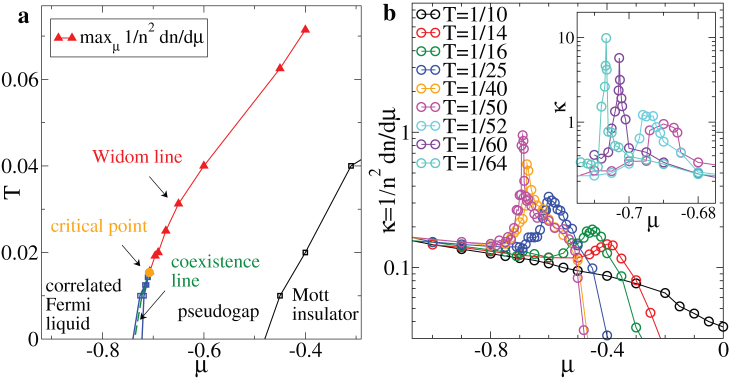
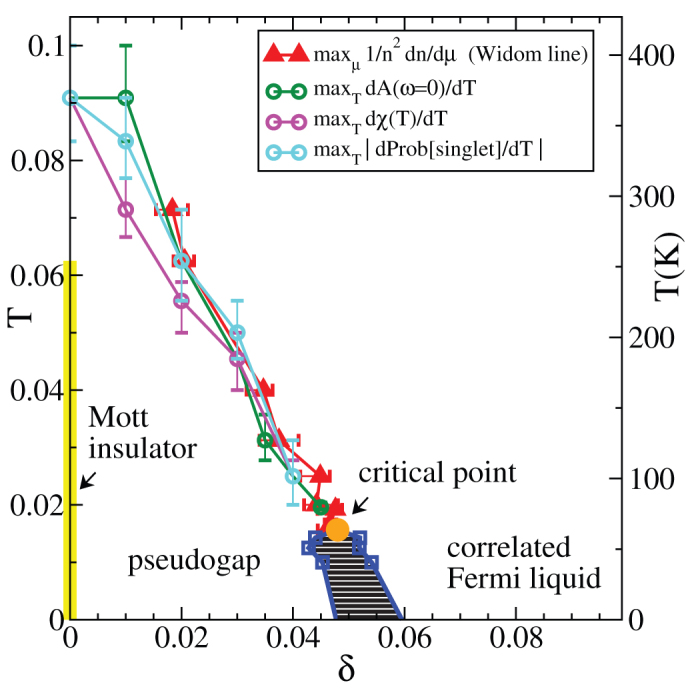
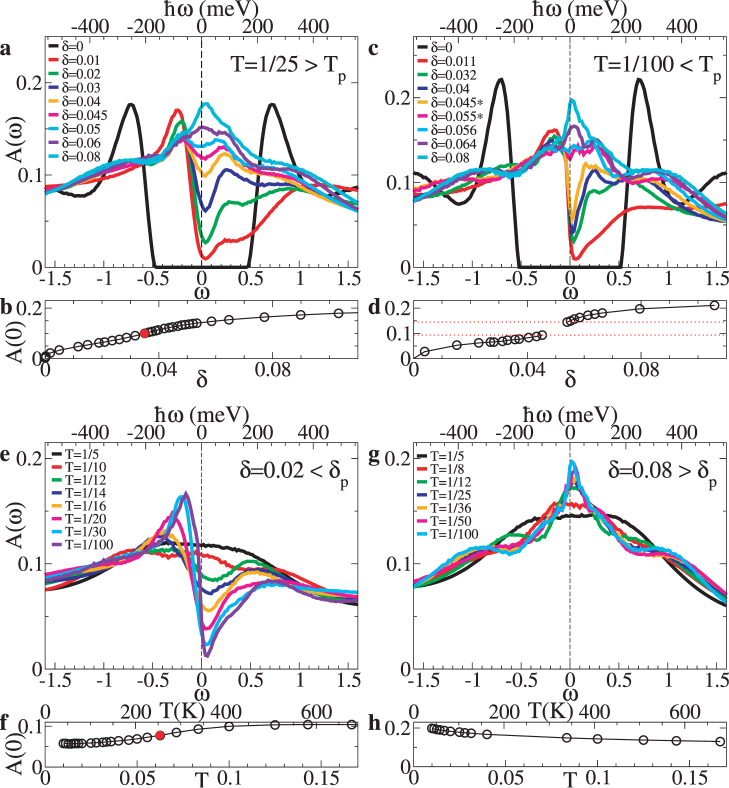
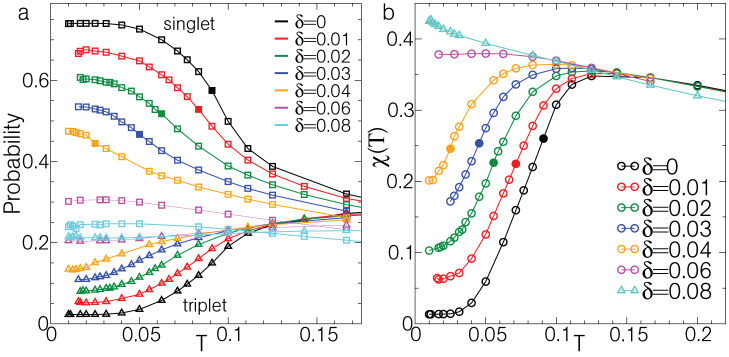
The pseudogap refers to an enigmatic state of matter with unusual physical properties found below a characteristic temperature T* in hole-doped high-temperature superconductors. Determining T* is critical for understanding this state. Here we study the simplest model of correlated electron systems, the Hubbard model, with cluster dynamical mean-field theory to find out whether the pseudogap can occur solely because of strong coupling physics and short nonlocal correlations. We find that the pseudogap characteristic temperature T* is a sharp crossover between different dynamical regimes along a line of thermodynamic anomalies that appears above a first-order phase transition, the Widom line. The Widom line emanating from the critical endpoint of a first-order transition is thus the organizing principle for the pseudogap phase diagram of the cuprates. No additional broken symmetry is necessary to explain the phenomenon. Broken symmetry states appear in the pseudogap and not the other way around.
赝能隙是指在掺杂空穴的高温超导体中,在特征温度 T以下出现的一种具有异常物理性质的神秘物质状态。确定 T对于理解这种状态至关重要。在这里,我们使用集团动态平均场理论研究最简单的关联电子系统模型—— Hubbard 模型,以确定赝能隙是否仅由于强耦合物理和短程非局域相关而出现。我们发现,赝能隙特征温度 T*是在一级相变 Widom 线上方出现的一条沿热力学异常线的不同动力学区域之间的急剧交叉。因此,从一级相变的临界点发出的 Widom 线是铜氧化物赝能隙相图的组织原则。不需要额外的对称破缺来解释这一现象。对称破缺状态出现在赝能隙中,而不是相反。