Department of Radiology, Faculty of Medicine, Juntendo University, 2-1-1 Hongo, Bunkyo-ku, Tokyo 113-8421, Japan.
J Radiat Res. 2013 Jan;54(1):157-65. doi: 10.1093/jrr/rrs064. Epub 2012 Aug 1.
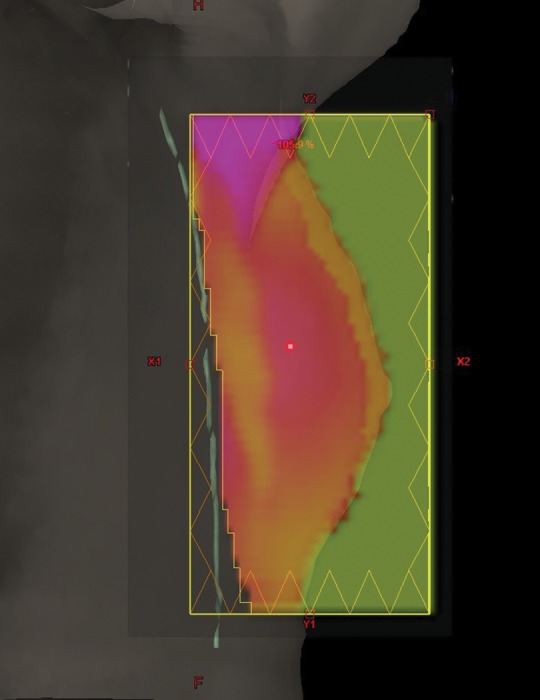
To evaluate the dosimetric impact of respiratory breast motion and daily setup error on whole breast irradiation (WBI) using three irradiation techniques; conventional wedge (CW), field-in-field (FIF) and irregular surface compensator (ISC). WBI was planned for 16 breast cancer patients. The dose indices for evaluated clinical target volume (CTV(evl)), lung, and body were evaluated. For the anterior-posterior (AP) respiratory motion and setup error of a single fraction, the isocenter was moved according to a sine function, and the dose indices were averaged over one period. Furthermore, the dose indices were weighted according to setup error frequencies that have a normal distribution to model systematic and random setup error for the entire treatment course. In all irradiation techniques, AP movement has a significant impact on dose distribution. CTV(evl)D(95) (the minimum relative dose that covers 95 % volume) and V(95) (the relative volume receiving 95 % of the prescribed dose) were observed to significantly decrease from the original ISC plan when simulated for the entire treatment course. In contrast, the D(95), V(95) and dose homogeneity index did not significantly differ from those of the original plans for FIF and CW. With regard to lung dose, the effect of motion was very similar among all three techniques. The dosimetric impact of AP respiratory breast motion and setup error was largest for the ISC technique, and the second greatest effect was observed with the FIF technique. However, these variations are relatively small.
为了评估呼吸乳房运动和日常摆位误差对三种照射技术(常规楔形野照射(CW)、射野内楔形野照射(FIF)和不规则表面补偿器照射(ISC))下全乳照射(WBI)的剂量学影响,我们对 16 例乳腺癌患者进行了 WBI 计划。评估了评估的临床靶区(CTV(evl))、肺和身体的剂量学指标。对于单次照射的前后(AP)呼吸运动和摆位误差,根据正弦函数移动等中心点,并在一个周期内对剂量学指标进行平均。此外,根据具有正态分布的摆位误差频率对剂量学指标进行加权,以模拟整个治疗过程中的系统和随机摆位误差。在所有照射技术中,AP 运动对剂量分布有显著影响。当模拟整个治疗过程时,CTV(evl)D95(覆盖 95%体积的最小相对剂量)和 V95(接受 95%处方剂量的相对体积)明显低于原始 ISC 计划。相比之下,FIF 和 CW 的 D95、V95 和剂量均匀性指数与原始计划没有显著差异。对于肺剂量,三种技术的运动影响非常相似。ISC 技术的 AP 呼吸乳房运动和摆位误差的剂量学影响最大,FIF 技术的影响次之。然而,这些变化相对较小。