Angewandte Physik und Messtechnik LRT2, UniBw-München, Neubiberg, Germany.
PLoS One. 2012;7(7):e41943. doi: 10.1371/journal.pone.0041943. Epub 2012 Jul 30.
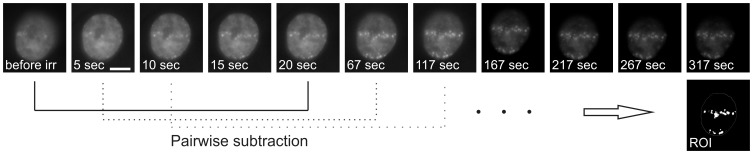
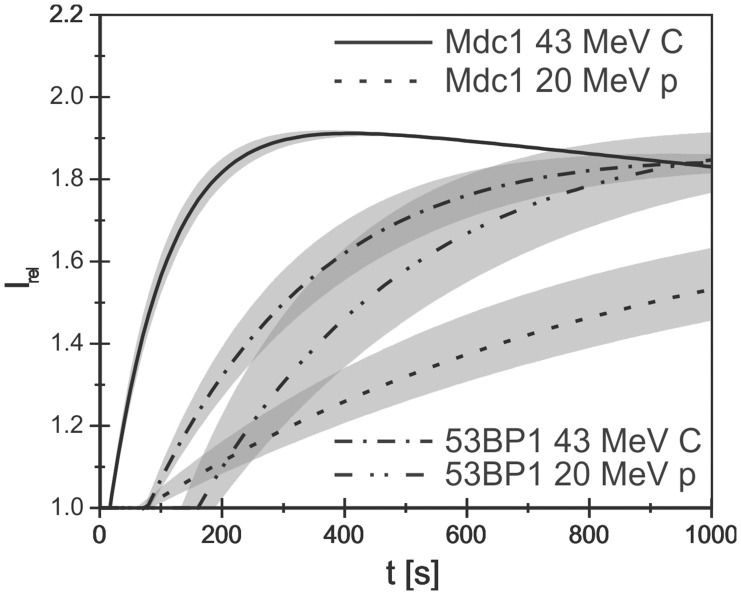
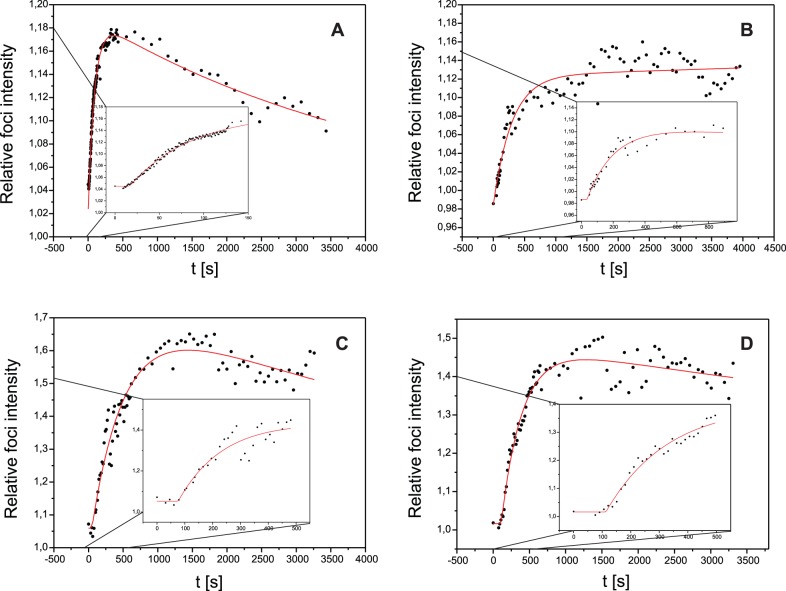
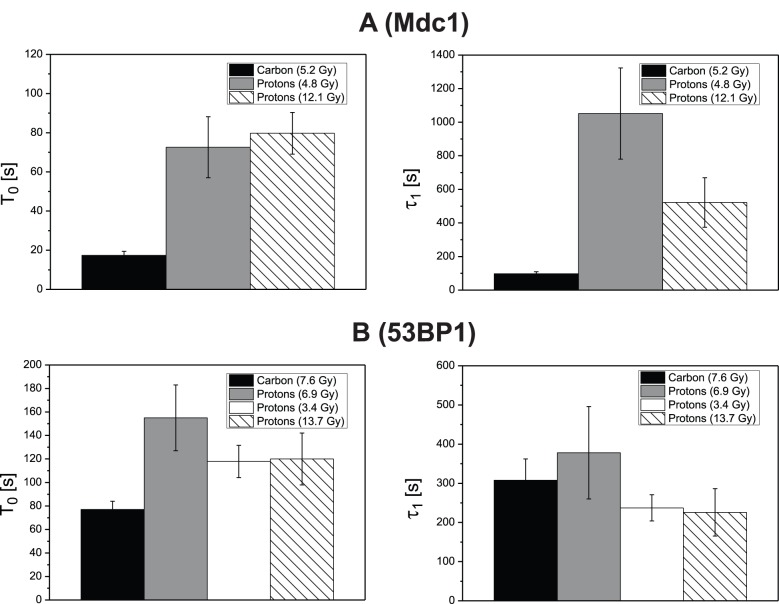
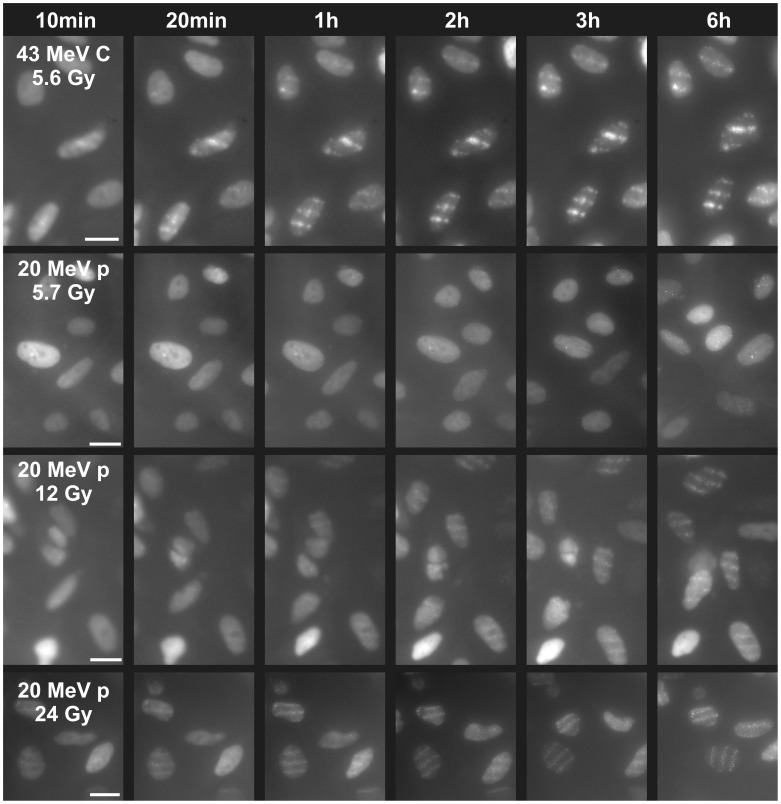
The recruitment kinetics of double-strand break (DSB) signaling and repair proteins Mdc1, 53BP1 and Rad52 into radiation-induced foci was studied by live-cell fluorescence microscopy after ion microirradiation. To investigate the influence of damage density and complexity on recruitment kinetics, which cannot be done by UV laser irradiation used in former studies, we utilized 43 MeV carbon ions with high linear energy transfer per ion (LET = 370 keV/µm) to create a large fraction of clustered DSBs, thus forming complex DNA damage, and 20 MeV protons with low LET (LET = 2.6 keV/µm) to create mainly isolated DSBs. Kinetics for all three proteins was characterized by a time lag period T(0) after irradiation, during which no foci are formed. Subsequently, the proteins accumulate into foci with characteristic mean recruitment times τ(1). Mdc1 accumulates faster (T(0) = 17 ± 2 s, τ(1) = 98 ± 11 s) than 53BP1 (T(0) = 77 ± 7 s, τ(1) = 310 ± 60 s) after high LET irradiation. However, recruitment of Mdc1 slows down (T(0) = 73 ± 16 s, τ(1) = 1050 ± 270 s) after low LET irradiation. The recruitment kinetics of Rad52 is slower than that of Mdc1, but exhibits the same dependence on LET. In contrast, the mean recruitment time τ(1) of 53BP1 remains almost constant when varying LET. Comparison to literature data on Mdc1 recruitment after UV laser irradiation shows that this rather resembles recruitment after high than low LET ionizing radiation. So this work shows that damage quality has a large influence on repair processes and has to be considered when comparing different studies.
利用活细胞荧光显微镜,研究了离子微照射后双链断裂(DSB)信号和修复蛋白 Mdc1、53BP1 和 Rad52 向辐射诱导焦点的募集动力学。为了研究损伤密度和复杂性对募集动力学的影响,我们利用具有高线性能量传递(LET = 370 keV/μm)的 43 MeV 碳离子产生大量的簇状 DSB,从而形成复杂的 DNA 损伤,并用低 LET(LET = 2.6 keV/μm)的 20 MeV 质子产生主要的孤立 DSB。利用该方法,我们对所有三种蛋白的动力学进行了研究,即在照射后有一个无焦点形成的时间滞后期 T(0),随后这些蛋白以特征性的平均募集时间 τ(1)聚集到焦点中。与高 LET 照射相比,Mdc1 的募集速度更快(T(0) = 17 ± 2 s,τ(1) = 98 ± 11 s),而 53BP1 的募集速度较慢(T(0) = 77 ± 7 s,τ(1) = 310 ± 60 s)。然而,在低 LET 照射后,Mdc1 的募集速度会减慢(T(0) = 73 ± 16 s,τ(1) = 1050 ± 270 s)。Rad52 的募集动力学比 Mdc1 慢,但与 LET 呈相同的依赖性。相比之下,53BP1 的平均募集时间 τ(1)在 LET 变化时几乎保持不变。与紫外线激光照射后 Mdc1 募集的文献数据相比,这更类似于高 LET 而非低 LET 电离辐射后的募集。因此,这项工作表明,损伤质量对修复过程有很大影响,在比较不同研究时必须考虑这一点。