Department of Biophysics, GSI Helmholtzzentrum für Schwerionenforschung, 64291, Darmstadt, Germany.
Department of Biology, Technische Universität Darmstadt, 64287, Darmstadt, Germany.
Sci Rep. 2020 Jan 29;10(1):1443. doi: 10.1038/s41598-020-58084-6.
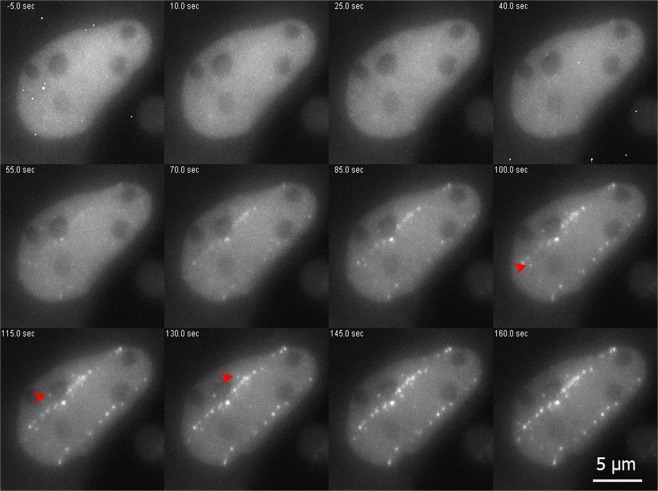
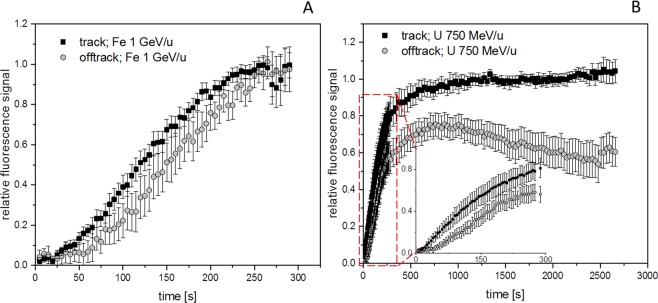
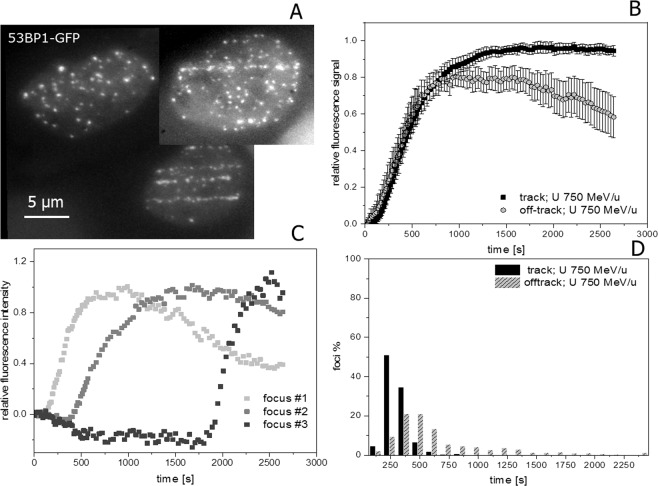
DNA double-strand break (DSB) repair is crucial to maintain genomic stability. The fidelity of the repair depends on the complexity of the lesion, with clustered DSBs being more difficult to repair than isolated breaks. Using live cell imaging of heavy ion tracks produced at a high-energy particle accelerator we visualised simultaneously the recruitment of different proteins at individual sites of complex and simple DSBs in human cells. NBS1 and 53BP1 were recruited in a few seconds to complex DSBs, but in 40% of the isolated DSBs the recruitment was delayed approximately 5 min. Using base excision repair (BER) inhibitors we demonstrate that some simple DSBs are generated by enzymatic processing of base damage, while BER did not affect the complex DSBs. The results show that DSB processing and repair kinetics are dependent on the complexity of the breaks and can be different even for the same clastogenic agent.
DNA 双链断裂 (DSB) 修复对于维持基因组稳定性至关重要。修复的准确性取决于损伤的复杂性,与孤立的断裂相比,聚集的 DSB 更难修复。我们利用高能粒子加速器产生的重离子轨迹的活细胞成像,在人类细胞中可视化了不同蛋白质在复杂和简单 DSB 单个位点的同时募集。NBS1 和 53BP1 在几秒钟内被募集到复杂的 DSB 中,但在 40%的孤立 DSB 中,募集被延迟了大约 5 分钟。我们利用碱基切除修复 (BER) 抑制剂证明,一些简单的 DSB 是由碱基损伤的酶促处理产生的,而 BER 对复杂的 DSB 没有影响。结果表明,DSB 处理和修复动力学取决于断裂的复杂性,即使对于相同的致裂剂,也可能存在差异。