Faculty of Associated Medical Sciences, Chiang Mai University, Chiang Mai, Thailand.
PLoS One. 2012;7(7):e42184. doi: 10.1371/journal.pone.0042184. Epub 2012 Jul 31.
Approximately 4 million of people are co-infected with HIV and Hepatitis B virus (HBV). In resource-limited settings, the majority of HIV-infected patients initiate first-line highly active antiretroviral therapy containing lamivudine (3TC-containing-HAART) and long-term virological response of HBV to lamivudine-containing HAART in co-infected patients is not well known.
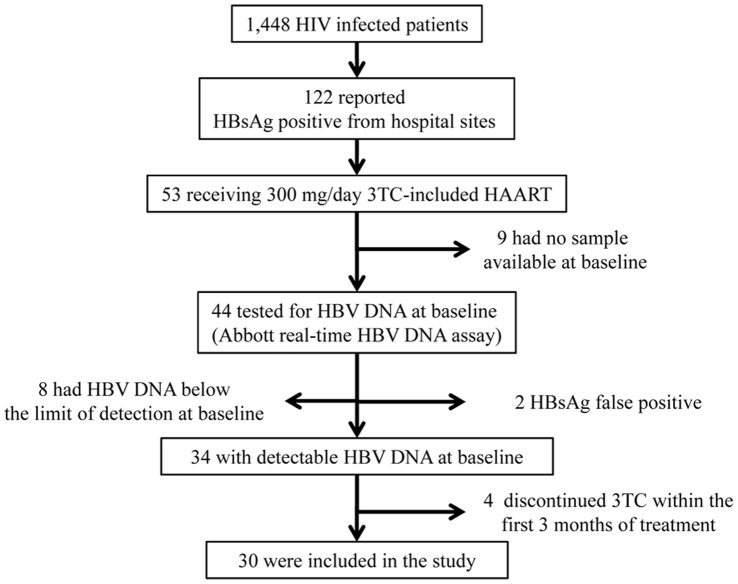
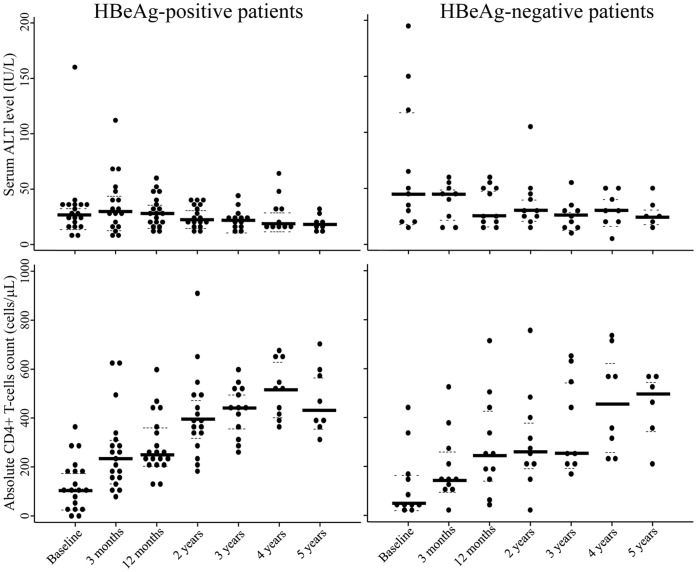
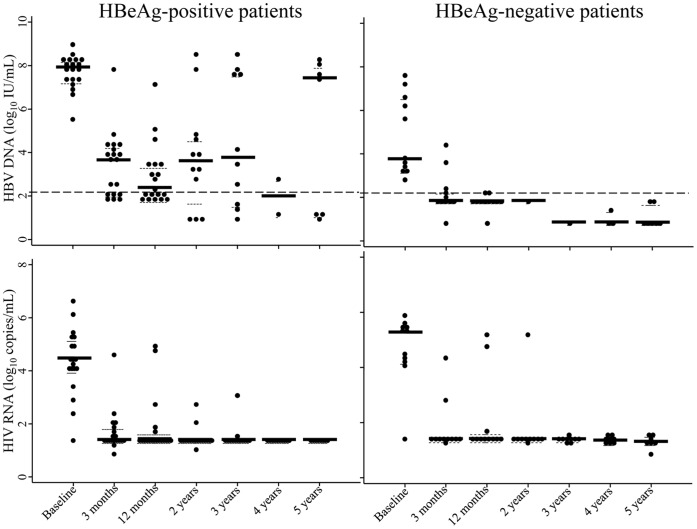
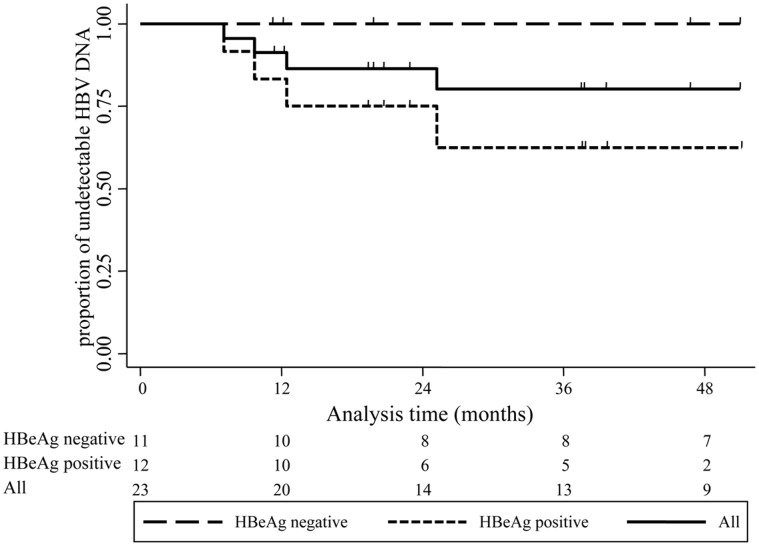
METHODOLOGY/PRINCIPAL FINDING: HIV-HBV co-infected patients enrolled in the PHPT cohort (ClinicalTrials.gov NCT00433030) and initiating a 3TC-containing-HAART regimen were included. HBV-DNA, HIV-RNA, CD4+ T-cell counts and alanine transaminase were measured at baseline, 3 months, 12 months and then every 6 months up to 5 years. Kaplan-Meier analysis was used to estimate the cumulative rates of patients who achieved and maintained HBV-DNA suppression. Of 30 co-infected patients, 19 were positive for HBe antigen (HBeAg). At initiation of 3TC-containing-HAART, median HBV DNA and HIV RNA levels were 7.35 log(10) IU/mL and 4.47 log(10) copies/mL, respectively. At 12 months, 67% of patients achieved HBV DNA suppression: 100% of HBeAg-negative patients and 47% of HBeAg-positive. Seventy-three percent of patients had HIV RNA below 50 copies/mL. The cumulative rates of maintained HBV-DNA suppression among the 23 patients who achieved HBV-DNA suppression were 91%, 87%, and 80% at 1, 2, and 4 years respectively. Of 17 patients who maintained HBV-DNA suppression while still on 3TC, 4 (24%) lost HBsAg and 7 of 8 (88%) HBeAg-positive patients lost HBeAg at their last visit (median duration, 59 months). HBV breakthrough was observed only in HBeAg-positive patients and 6 of 7 patients presenting HBV breakthrough had the rtM204I/V mutations associated with 3TC resistance along with rtL180M and/or rtV173L.
All HBeAg-negative patients and 63% of HBeAg-positive HIV-HBV co-infected patients achieved long-term HBV DNA suppression while on 3TC-containing-HAART. This study provides information useful for the management of co-infected patients in resource-limited countries where the vast majority of co-infected patients are currently receiving 3TC.
约有 400 万人同时感染 HIV 和乙型肝炎病毒(HBV)。在资源有限的环境中,大多数 HIV 感染者接受包含拉米夫定(3TC 类)的一线高效抗逆转录病毒治疗(HAART),但对于 HBV 对包含拉米夫定的 HAART 的长期病毒学反应尚不清楚。
方法/主要发现:本研究纳入了 PHPT 队列(ClinicalTrials.gov NCT00433030)中入组的 HIV-HBV 合并感染患者,并开始接受 3TC 类 HAART 方案。在基线、3 个月、12 个月和之后每 6 个月(最长 5 年)时,测量 HBV-DNA、HIV-RNA、CD4+T 细胞计数和丙氨酸转氨酶。Kaplan-Meier 分析用于估计达到并维持 HBV-DNA 抑制的患者的累积率。在 30 例合并感染患者中,有 19 例 HBeAg 阳性(HBeAg)。在开始 3TC 类 HAART 时,中位 HBV DNA 和 HIV RNA 水平分别为 7.35 log(10)IU/mL 和 4.47 log(10)拷贝/mL。在 12 个月时,67%的患者达到 HBV DNA 抑制:HBeAg 阴性患者 100%,HBeAg 阳性患者 47%。73%的患者 HIV RNA 低于 50 拷贝/mL。在 23 例达到 HBV-DNA 抑制的患者中,HBV-DNA 抑制维持率分别为 91%、87%和 80%,在 1、2 和 4 年时。在 17 例仍在使用 3TC 时维持 HBV-DNA 抑制的患者中,有 4 例(24%)失去 HBsAg,8 例 HBeAg 阳性患者中有 7 例(88%)失去 HBeAg,他们最后一次就诊(中位时间,59 个月)。仅在 HBeAg 阳性患者中观察到 HBV 突破,在 7 例发生 HBV 突破的患者中,有 6 例存在与拉米夫定耐药相关的 rtM204I/V 突变,以及 rtL180M 和/或 rtV173L。
所有 HBeAg 阴性患者和 63%的 HBeAg 阳性 HIV-HBV 合并感染患者在接受包含拉米夫定的 HAART 时达到了长期 HBV DNA 抑制。这项研究提供了在资源有限的国家管理合并感染患者的有用信息,在这些国家中,绝大多数合并感染患者目前正在接受 3TC 治疗。