Department of Biological Engineering, School of Chemical Engineering and Technology, Tianjin University, Tianjin 300072, China.
Microb Cell Fact. 2012 Aug 3;11:101. doi: 10.1186/1475-2859-11-101.
Isobutanol is considered as a leading candidate for the replacement of current fossil fuels, and expected to be produced biotechnologically. Owing to the valuable features, Bacillus subtilis has been engineered as an isobutanol producer, whereas it needs to be further optimized for more efficient production. Since elementary mode analysis (EMA) is a powerful tool for systematical analysis of metabolic network structures and cell metabolism, it might be of great importance in the rational strain improvement.
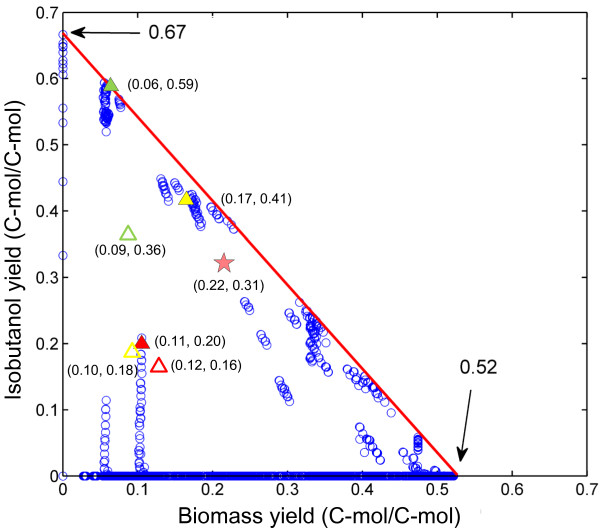
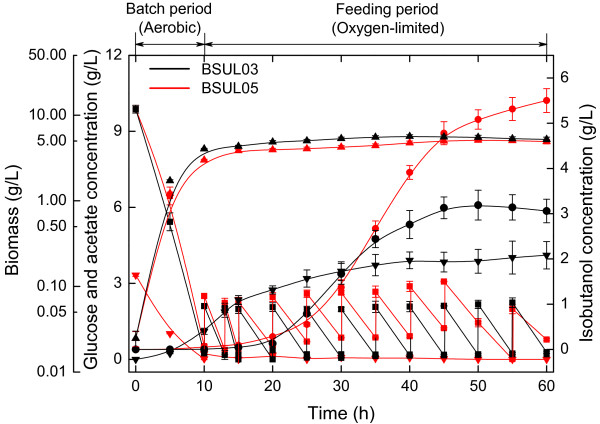
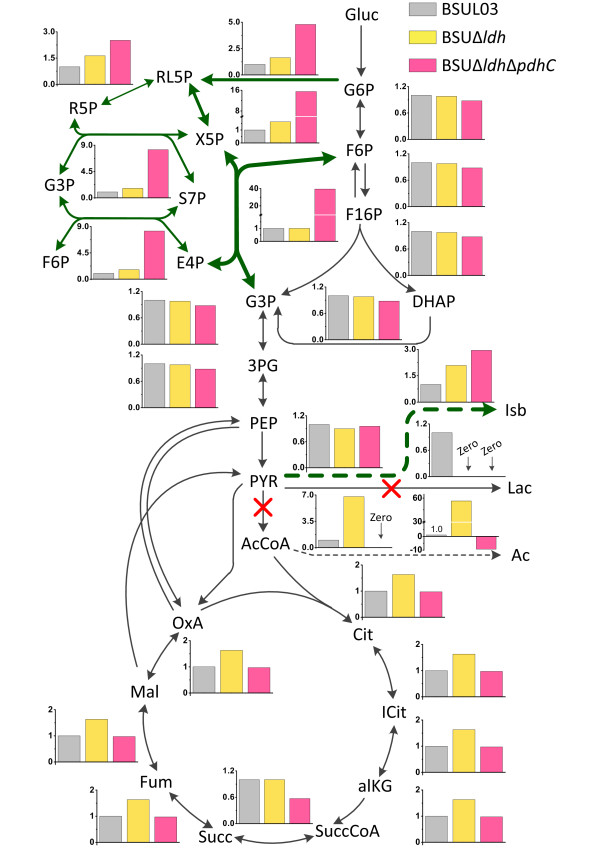
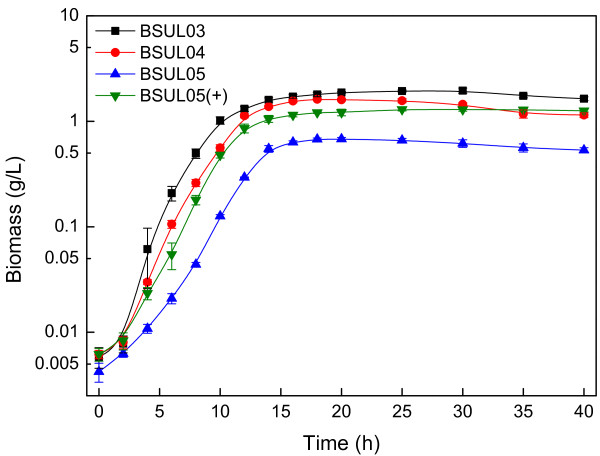
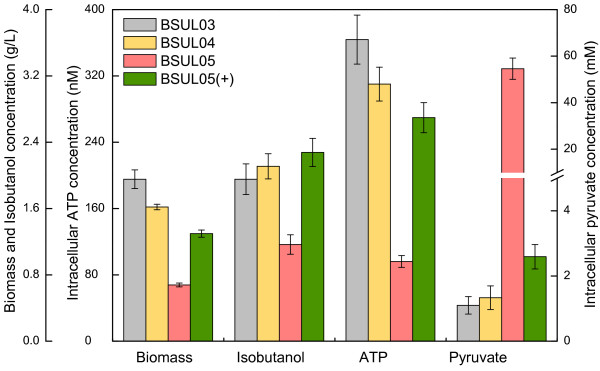
Metabolic network of the isobutanol-producing B. subtilis BSUL03 was first constructed for EMA. Considering the actual cellular physiological state, 239 elementary modes (EMs) were screened from total 11,342 EMs for potential target prediction. On this basis, lactate dehydrogenase (LDH) and pyruvate dehydrogenase complex (PDHC) were predicted as the most promising inactivation candidates according to flux flexibility analysis and intracellular flux distribution simulation. Then, the in silico designed mutants were experimentally constructed. The maximal isobutanol yield of the LDH- and PDHC-deficient strain BSUL05 reached 61% of the theoretical value to 0.36 ± 0.02 C-mol isobutanol/C-mol glucose, which was 2.3-fold of BSUL03. Moreover, this mutant produced approximately 70 % more isobutanol to the maximal titer of 5.5 ± 0.3 g/L in fed-batch fermentations.
EMA was employed as a guiding tool to direct rational improvement of the engineered isobutanol-producing B. subtilis. The consistency between model prediction and experimental results demonstrates the rationality and accuracy of this EMA-based approach for target identification. This network-based rational strain improvement strategy could serve as a promising concept to engineer efficient B. subtilis hosts for isobutanol, as well as other valuable products.
异丁醇被认为是替代当前化石燃料的主要候选物,有望通过生物技术生产。由于具有有价值的特性,枯草芽孢杆菌已被工程化为异丁醇生产菌,但需要进一步优化以提高生产效率。由于基本模式分析(EMA)是系统分析代谢网络结构和细胞代谢的有力工具,因此在理性菌株改良中可能具有重要意义。
首次为 EMA 构建了产异丁醇枯草芽孢杆菌 BSUL03 的代谢网络。考虑到实际的细胞生理状态,从总共有 11342 个 EMs 中筛选出 239 个基本模式(EMs)用于潜在目标预测。在此基础上,根据通量灵活性分析和细胞内通量分布模拟,预测乳酸脱氢酶(LDH)和丙酮酸脱氢酶复合物(PDHC)为最有前途的失活候选物。然后,通过计算机设计了突变体并进行了实验构建。LDH 和 PDHC 缺陷型菌株 BSUL05 的最大异丁醇产率达到理论值的 61%,即 0.36±0.02 C-mol 异丁醇/C-mol 葡萄糖,是 BSUL03 的 2.3 倍。此外,该突变株在分批补料发酵中产生的异丁醇最大产量约为 5.5±0.3 g/L 的最大滴度的 70%。
EMA 被用作指导工具,指导工程化产异丁醇枯草芽孢杆菌的合理改进。模型预测与实验结果的一致性证明了基于 EMA 的方法用于目标识别的合理性和准确性。这种基于网络的理性菌株改良策略可作为一种有前途的概念,用于构建高效的枯草芽孢杆菌宿主生产异丁醇和其他有价值的产品。