Hiroshima City Asa Hospital, Hiroshima, Japan.
Radiat Res. 2012 Sep;178(3):191-201. doi: 10.1667/rr2819.1. Epub 2012 Aug 3.
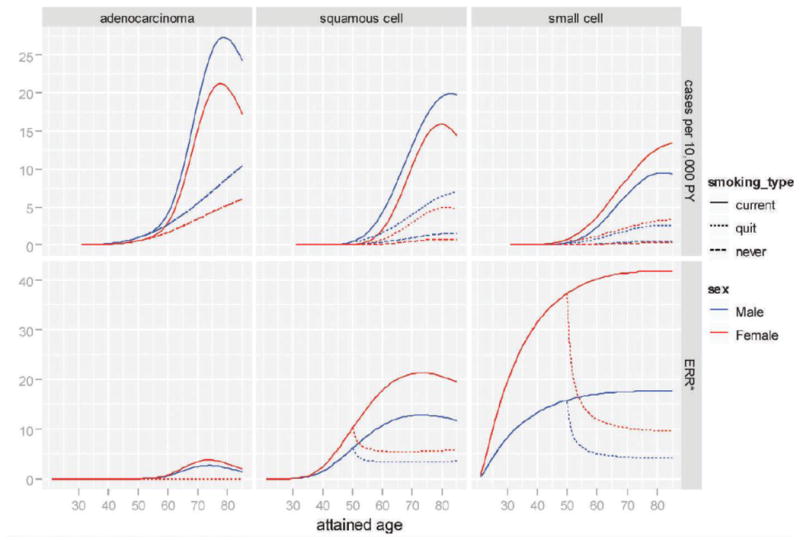
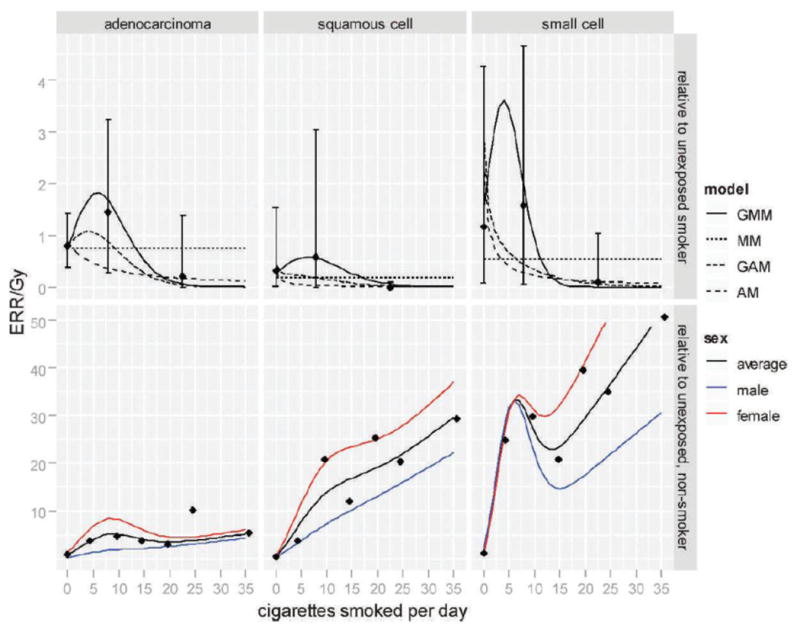
While the risk of lung cancer associated separately with smoking and radiation exposure has been widely reported, it is not clear how smoking and radiation together contribute to the risk of specific lung cancer histological types. With individual smoking histories and radiation dose estimates, we characterized the joint effects of radiation and smoking on type-specific lung cancer rates among the Life Span Study cohort of Japanese atomic bomb survivors. Among 105,404 cohort subjects followed between 1958 and 1999, 1,803 first primary lung cancer incident cases were diagnosed and classified by histological type. Poisson regression methods were used to estimate excess relative risks under several interaction models. Adenocarcinoma (636 cases), squamous-cell carcinoma (330) and small-cell carcinoma (194) made up 90% of the cases with known histology. Both smoking and radiation exposure significantly increased the risk of each major lung cancer histological type. Smoking-associated excess relative risks were significantly larger for small-cell and squamous-cell carcinomas than for adenocarcinoma. The gender-averaged excess relative risks per 1 Gy of radiation (for never-smokers at age 70 after radiation exposure at age 30) were estimated as 1.49 (95% confidence interval 0.1-4.6) for small-cell carcinoma, 0.75 (0.3-1.3) for adenocarcinoma, and 0.27 (0-1.5) for squamous-cell carcinoma. Under a model allowing radiation effects to vary with levels of smoking, the nature of the joint effect of smoking and radiation showed a similar pattern for different histological types in which the radiation-associated excess relative risk tended to be larger for moderate smokers than for heavy smokers. However, in contrast to analyses of all lung cancers as a group, such complicated interactions did not describe the data significantly better than either simple additive or multiplicative interaction models for any of the type-specific analyses.
虽然吸烟和辐射暴露分别与肺癌风险相关已经被广泛报道,但吸烟和辐射共同作用如何导致特定肺癌组织学类型的风险尚不清楚。利用个体吸烟史和辐射剂量估计,我们对来自日本原子弹幸存者寿命研究队列的人群中,辐射和吸烟对特定肺癌组织学类型的联合作用进行了特征描述。在 1958 年至 1999 年期间随访的 105404 例队列研究对象中,诊断并按组织学类型分类了 1803 例首次原发性肺癌发病病例。采用泊松回归方法在几种交互作用模型下估计了超额相对风险。腺癌(636 例)、鳞癌(330 例)和小细胞癌(194 例)构成了已知组织学类型的 90%的病例。吸烟和辐射暴露均显著增加了每种主要肺癌组织学类型的发病风险。小细胞癌和鳞癌的吸烟相关超额相对风险明显大于腺癌。在从不吸烟者中,以年龄 70 岁、年龄 30 岁时接受 1 Gy 辐射为参照,性别平均的每 Gy 辐射的超额相对风险(辐射后 70 岁)估计为小细胞癌 1.49(95%置信区间 0.1-4.6)、腺癌 0.75(0.3-1.3)和鳞癌 0.27(0-1.5)。在允许辐射效应随吸烟水平变化的模型下,吸烟和辐射的联合作用性质显示出不同组织学类型之间相似的模式,即对于中度吸烟者,辐射相关的超额相对风险大于重度吸烟者。然而,与对所有肺癌作为一个整体进行的分析相反,对于任何特定类型的分析,这种复杂的交互作用都没有显著优于简单的相加或相乘交互作用模型来描述数据。