The Genome Institute, Washington University School of Medicine, St. Louis, MO 63108, USA.
BMC Evol Biol. 2012 Aug 3;12:138. doi: 10.1186/1471-2148-12-138.
Proteins convey the majority of biochemical and cellular activities in organisms. Over the course of evolution, proteins undergo normal sequence mutations as well as large scale mutations involving domain duplication and/or domain shuffling. These events result in the generation of new proteins and protein families. Processes that affect proteome evolution drive species diversity and adaptation. Herein, change over the course of metazoan evolution, as defined by birth/death and duplication/deletion events within protein families and domains, was examined using the proteomes of 9 metazoan and two outgroup species.
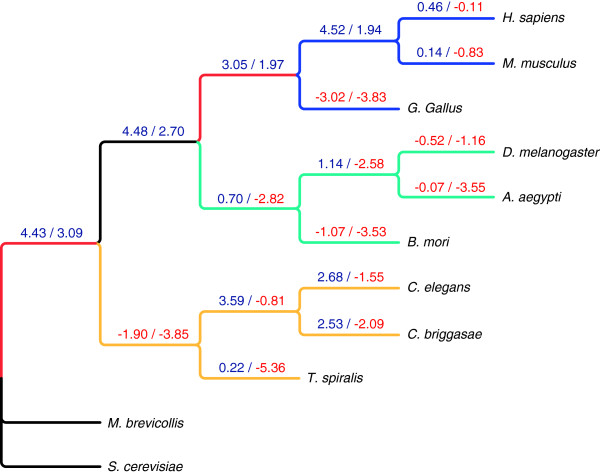
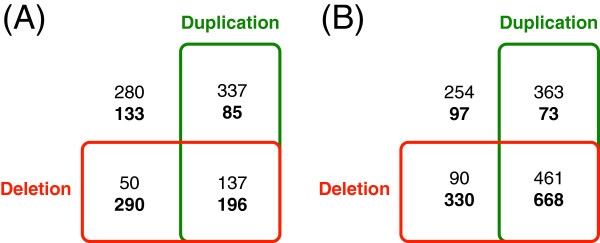
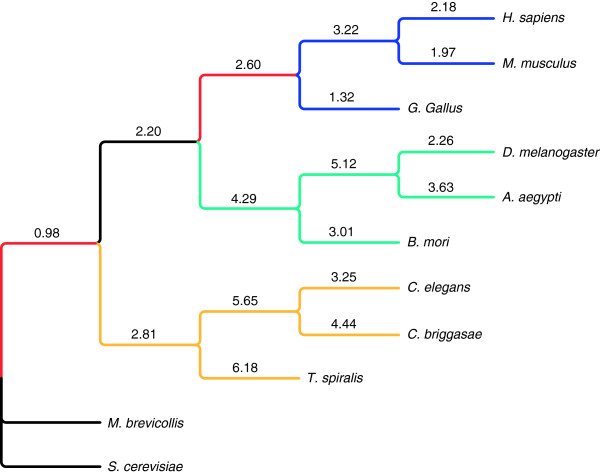
In studying members of the three major metazoan groups, the vertebrates, arthropods, and nematodes, we found that the number of protein families increased at the majority of lineages over the course of metazoan evolution where the magnitude of these increases was greatest at the lineages leading to mammals. In contrast, the number of protein domains decreased at most lineages and at all terminal lineages. This resulted in a weak correlation between protein family birth and domain birth; however, the correlation between domain birth and domain member duplication was quite strong. These data suggest that domain birth and protein family birth occur via different mechanisms, and that domain shuffling plays a role in the formation of protein families. The ratio of protein family birth to protein domain birth (domain shuffling index) suggests that shuffling had a more demonstrable effect on protein families in nematodes and arthropods than in vertebrates. Through the contrast of high and low domain shuffling indices at the lineages of Trichinella spiralis and Gallus gallus, we propose a link between protein redundancy and evolutionary changes controlled by domain shuffling; however, the speed of adaptation among the different lineages was relatively invariant. Evaluating the functions of protein families that appeared or disappeared at the last common ancestors (LCAs) of the three metazoan clades supports a correlation with organism adaptation. Furthermore, bursts of new protein families and domains in the LCAs of metazoans and vertebrates are consistent with whole genome duplications.
Metazoan speciation and adaptation were explored by birth/death and duplication/deletion events among protein families and domains. Our results provide insights into protein evolution and its bearing on metazoan evolution.
蛋白质在生物体内传递着大部分生化和细胞活动。在进化过程中,蛋白质经历正常的序列突变以及涉及结构域复制和/或结构域改组的大规模突变。这些事件导致新蛋白质和蛋白质家族的产生。影响蛋白质组进化的过程驱动着物种多样性和适应性。在此,通过对 9 种后生动物和 2 种外群物种的蛋白质组进行研究,考察了蛋白质家族和结构域内的出生/死亡和复制/缺失事件定义的后生动物进化过程中的变化。
在研究脊椎动物、节肢动物和线虫这三个主要后生动物类群的成员时,我们发现大多数后生动物进化谱系的蛋白质家族数量都在增加,其中哺乳动物谱系的增加幅度最大。相比之下,大多数谱系和所有末端谱系的蛋白质结构域数量都在减少。这导致蛋白质家族的诞生与结构域的诞生之间的相关性很弱;然而,结构域的诞生与结构域成员的复制之间的相关性非常强。这些数据表明,结构域的诞生和蛋白质家族的诞生是通过不同的机制发生的,并且结构域改组在蛋白质家族的形成中起作用。蛋白质家族诞生与蛋白质结构域诞生的比率(结构域改组指数)表明,在线虫和节肢动物中,改组对蛋白质家族的影响比在脊椎动物中更为明显。通过比较旋毛虫和鸡的谱系中的高和低结构域改组指数,我们提出了蛋白质冗余与受结构域改组控制的进化变化之间的联系;然而,不同谱系之间的适应速度相对不变。评估出现在 3 种类生动物谱系最后共同祖先(LCA)的蛋白质家族的功能,支持与生物体适应性相关的结论。此外,后生动物和脊椎动物 LCA 中出现的新蛋白质家族和结构域的爆发与全基因组复制一致。
通过蛋白质家族和结构域内的出生/死亡和复制/缺失事件,探索了后生动物的物种形成和适应。我们的结果为蛋白质进化及其对后生动物进化的影响提供了新的认识。