Laboratório de Microbiologia, Departamento de Doenças Dermatológicas, Infecciosas e Parasitárias, São José do Rio Preto, SP, Brazil.
BMC Infect Dis. 2012 Aug 3;12:176. doi: 10.1186/1471-2334-12-176.
Nosocomial infections caused by Pseudomonas aeruginosa presenting resistance to beta-lactam drugs are one of the most challenging targets for antimicrobial therapy, leading to substantial increase in mortality rates in hospitals worldwide. In this context, P. aeruginosa harboring acquired mechanisms of resistance, such as production of metallo-beta-lactamase (MBLs) and extended-spectrum beta-lactamases (ESBLs) have the highest clinical impact. Hence, this study was designed to investigate the presence of genes codifying for MBLs and ESBLs among carbapenem resistant P. aeruginosa isolated in a Brazilian 720-bed teaching tertiary care hospital.
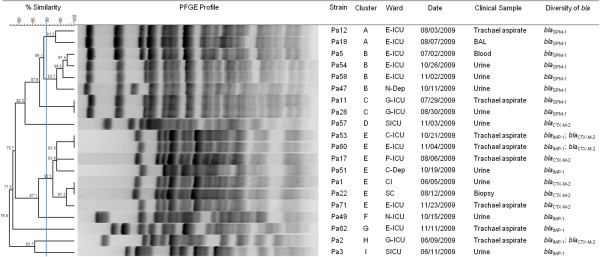
Fifty-six carbapenem-resistant P. aeruginosa strains were evaluated for the presence of MBL and ESBL genes. Strains presenting MBL and/or ESBL genes were submitted to pulsed-field gel electrophoresis for genetic similarity evaluation.
Despite the carbapenem resistance, genes for MBLs (blaSPM-1 or blaIMP-1) were detected in only 26.7% of isolates. Genes encoding ESBLs were detected in 23.2% of isolates. The blaCTX-M-2 was the most prevalent ESBL gene (19.6%), followed by blaGES-1 and blaGES-5 detected in one isolate each. In all isolates presenting MBL phenotype by double-disc synergy test (DDST), the blaSPM-1 or blaIMP-1 genes were detected. In addition, blaIMP-1 was also detected in three isolates which did not display any MBL phenotype. These isolates also presented the blaCTX-M-2 gene. The co-existence of blaCTX-M-2 with blaIMP-1 is presently reported for the first time, as like as co-existence of blaGES-1 with blaIMP-1.
In this study MBLs production was not the major mechanism of resistance to carbapenems, suggesting the occurrence of multidrug efflux pumps, reduction in porin channels and production of other beta-lactamases. The detection of blaCTX-M-2,blaGES-1 and blaGES-5 reflects the recent emergence of ESBLs among antimicrobial resistant P. aeruginosa and the extraordinary ability presented by this pathogen to acquire multiple resistance mechanisms. These findings raise the concern about the future of antimicrobial therapy and the capability of clinical laboratories to detect resistant strains, since simultaneous production of MBLs and ESBLs is known to promote further complexity in phenotypic detection. Occurrence of intra-hospital clonal dissemination enhances the necessity of better observance of infection control practices.
铜绿假单胞菌引起的医院获得性感染对β-内酰胺类药物耐药是抗菌治疗最具挑战性的目标之一,导致全球医院死亡率显著上升。在这种情况下,携带获得性耐药机制的铜绿假单胞菌,如金属β-内酰胺酶(MBLs)和超广谱β-内酰胺酶(ESBLs)的产生,具有最高的临床影响。因此,本研究旨在调查巴西一家 720 张病床的教学型三级保健医院分离的耐碳青霉烯类铜绿假单胞菌中是否存在编码 MBL 和 ESBL 的基因。
评估了 56 株耐碳青霉烯类铜绿假单胞菌是否存在 MBL 和 ESBL 基因。对同时携带 MBL 和/或 ESBL 基因的菌株进行脉冲场凝胶电泳,以评估遗传相似性。
尽管存在碳青霉烯类耐药,但仅在 26.7%的分离株中检测到 MBL 基因(blaSPM-1 或 blaIMP-1)。在 23.2%的分离株中检测到编码 ESBL 的基因。blaCTX-M-2 是最常见的 ESBL 基因(19.6%),其次是在一个分离株中检测到的 blaGES-1 和 blaGES-5。在所有通过双碟协同试验(DDST)表现出 MBL 表型的分离株中,均检测到 blaSPM-1 或 blaIMP-1 基因。此外,在 3 个未表现出任何 MBL 表型的分离株中也检测到 blaIMP-1。这些分离株还携带 blaCTX-M-2 基因。目前首次报道 blaCTX-M-2 与 blaIMP-1 的共存,以及 blaGES-1 与 blaIMP-1 的共存。
在本研究中,MBLs 的产生不是对碳青霉烯类药物耐药的主要机制,这表明存在多药外排泵、孔道减少和其他β-内酰胺酶的产生。blaCTX-M-2、blaGES-1 和 blaGES-5 的检测反映了近期耐抗菌药物铜绿假单胞菌中 ESBLs 的出现,以及该病原体具有获得多种耐药机制的非凡能力。这些发现引起了人们对未来抗菌治疗和临床实验室检测耐药菌株能力的关注,因为同时产生 MBLs 和 ESBLs 已知会使表型检测进一步复杂化。院内克隆传播的发生增强了更好地遵守感染控制实践的必要性。