Division of Allergy, Immunology and Rheumatology, Taichung Veterans General Hospital and Faculty of Medicine, National Yang Ming University, Taiwan.
BMC Med. 2012 Aug 6;10:84. doi: 10.1186/1741-7015-10-84.
Germinal center kinase-like kinase (GLK, also termed MAP4K3), a member of the MAP4K family, may regulate gene transcription, apoptosis and immune inflammation in response to extracellular signals. The enhanced expression of GLK has been shown to correspond with disease severity in patients with systemic lupus erythematosus. We investigated the role of GLK in the pathogenesis of adult-onset Still's disease, which shares some similar clinical characteristics with systemic lupus erythematosus.
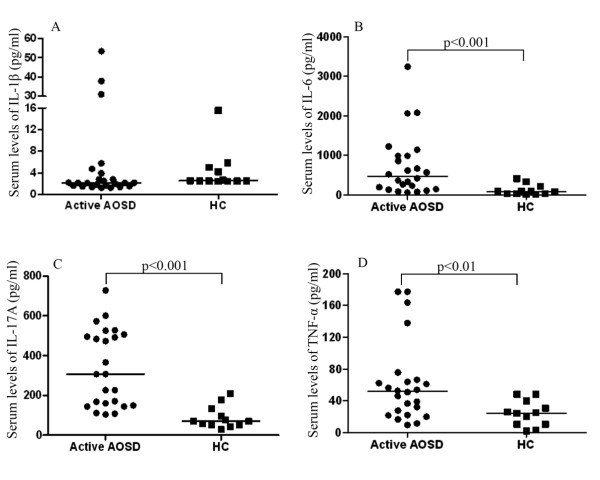
The frequencies of circulating GLK-expressing T-cells in 24 patients with active adult-onset Still's disease and 12 healthy controls were determined by flow cytometry analysis. The expression levels of GLK proteins and transcripts were evaluated in peripheral blood mononuclear cells by immunoblotting and quantitative PCR. Serum levels of T helper (Th)17-related cytokines, including IL-1β, IL-6, IL-17 and TNF-α, were measured by ELISA.
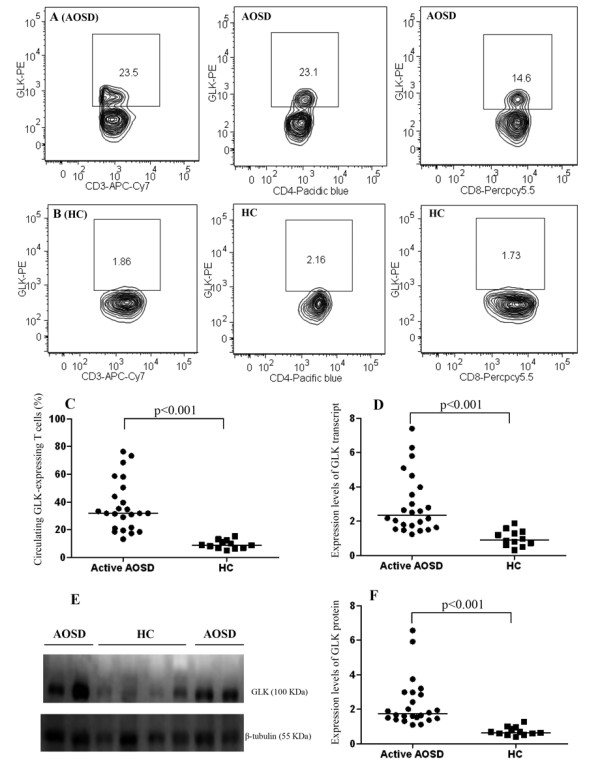
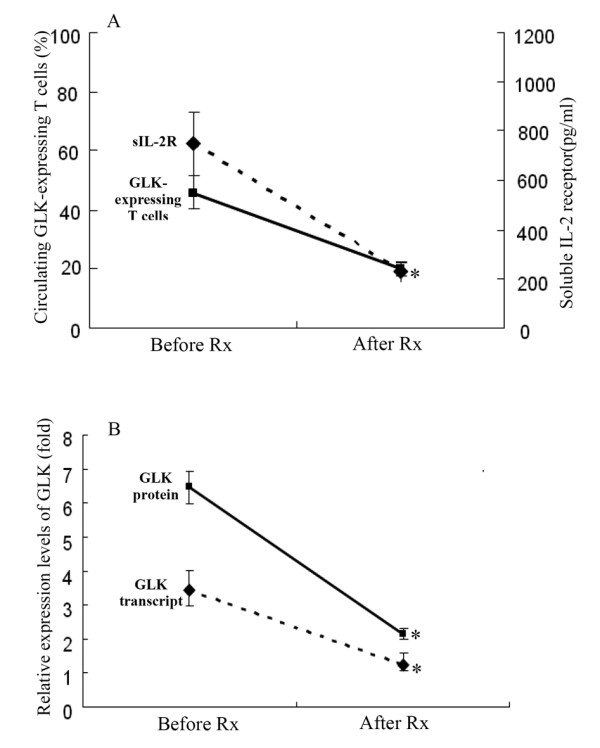
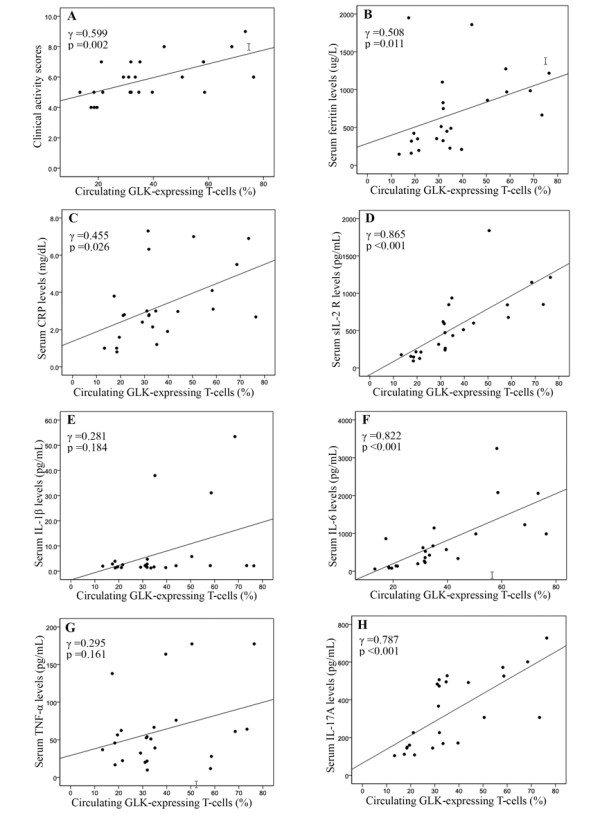
Significantly higher median frequencies of circulating GLK-expressing T-cells were observed in patients with adult-onset Still's disease (31.85%) than in healthy volunteers (8.93%, P <0.001). The relative expression levels of GLK proteins and transcripts were also significantly higher in patients with adult-onset Still's disease (median, 1.74 and 2.35, respectively) compared with those in healthy controls (0.66 and 0.92, respectively, both P <0.001). The disease activity scores were positively correlated with the frequencies of circulating GLK-expressing T-cells (r = 0.599, P <0.005) and the levels of GLK proteins (r = 0.435, P <0.05) or GLK transcripts (r = 0.452, P <0.05) in patients with adult-onset Still's disease. Among the examined Th17-related cytokines, elevated levels of serum IL-6 and IL-17 were positively correlated with the frequencies of circulating GLK-expressing T-cells and the levels of GLK proteins as well as transcripts in patients with adult-onset Still's disease. GLK expression levels decreased significantly after effective therapy in these patients.
Elevated expression levels of GLK and their positive correlation with disease activity in patients with adult-onset Still's disease indicate that GLK may be involved in the pathogenesis and act as a novel activity biomarker of this disease.
生发中心激酶样激酶(GLK,也称为 MAP4K3)是 MAP4K 家族的成员,可响应细胞外信号调节基因转录、细胞凋亡和免疫炎症。研究表明,系统性红斑狼疮患者中 GLK 的表达增强与疾病严重程度相关。我们研究了 GLK 在成人Still 病发病机制中的作用,成人Still 病与系统性红斑狼疮有一些相似的临床特征。
通过流式细胞术分析检测 24 例活动期成人Still 病患者和 12 例健康对照者外周血中表达 GLK 的 T 细胞的频率。通过免疫印迹和定量 PCR 评估外周血单个核细胞中 GLK 蛋白和转录本的表达水平。通过 ELISA 测定血清中辅助性 T 细胞(Th)17 相关细胞因子(包括 IL-1β、IL-6、IL-17 和 TNF-α)的水平。
成人Still 病患者外周血中表达 GLK 的 T 细胞频率明显高于健康志愿者(中位数分别为 31.85%和 8.93%,P<0.001)。成人Still 病患者 GLK 蛋白和转录本的相对表达水平也明显高于健康对照组(中位数分别为 1.74 和 2.35,分别为 0.66 和 0.92,均 P<0.001)。成人Still 病患者的疾病活动评分与循环中表达 GLK 的 T 细胞频率(r=0.599,P<0.005)和 GLK 蛋白(r=0.435,P<0.05)或 GLK 转录本(r=0.452,P<0.05)水平呈正相关。在检查的 Th17 相关细胞因子中,血清 IL-6 和 IL-17 水平升高与成人Still 病患者循环中表达 GLK 的 T 细胞频率以及 GLK 蛋白和转录本水平呈正相关。这些患者经有效治疗后,GLK 表达水平显著下降。
成人Still 病患者 GLK 表达水平升高及其与疾病活动的正相关提示 GLK 可能参与发病机制,并作为该疾病的新型活性生物标志物。