Jiao Yuchen, Killela Patrick J, Reitman Zachary J, Rasheed Ahmed B, Heaphy Christopher M, de Wilde Roeland F, Rodriguez Fausto J, Rosemberg Sergio, Oba-Shinjo Sueli Mieko, Nagahashi Marie Suely Kazue, Bettegowda Chetan, Agrawal Nishant, Lipp Eric, Pirozzi Christopher, Lopez Giselle, He Yiping, Friedman Henry, Friedman Allan H, Riggins Gregory J, Holdhoff Matthias, Burger Peter, McLendon Roger, Bigner Darell D, Vogelstein Bert, Meeker Alan K, Kinzler Kenneth W, Papadopoulos Nickolas, Diaz Luis A, Yan Hai
Ludwig Center for Cancer Genetics and Howard Hughes Medical Institutions, The Johns Hopkins Kimmel Cancer Center, Johns Hopkins Medical Institutions, Baltimore, Maryland, USA.
Oncotarget. 2012 Jul;3(7):709-22. doi: 10.18632/oncotarget.588.
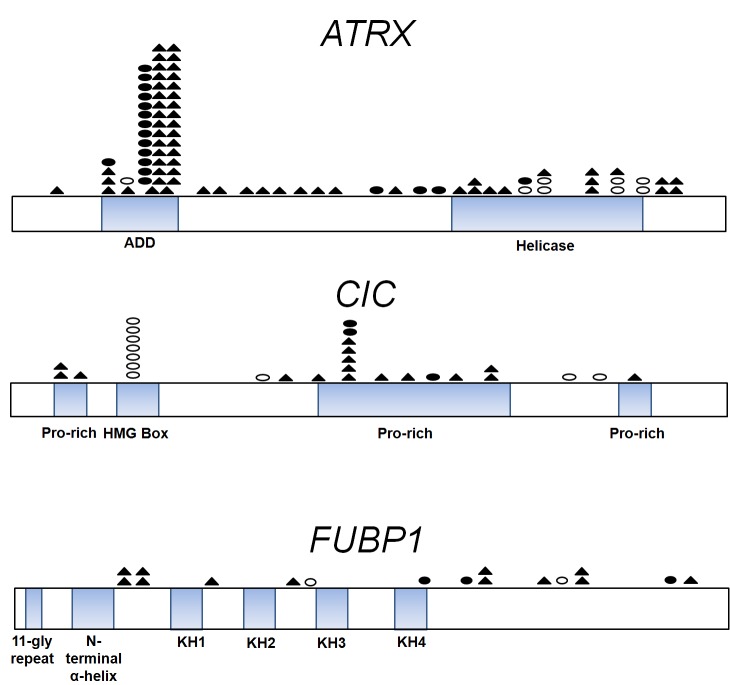
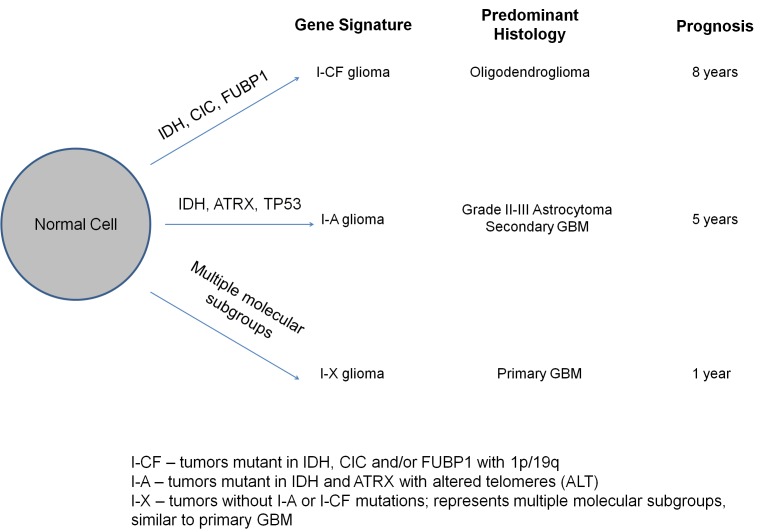
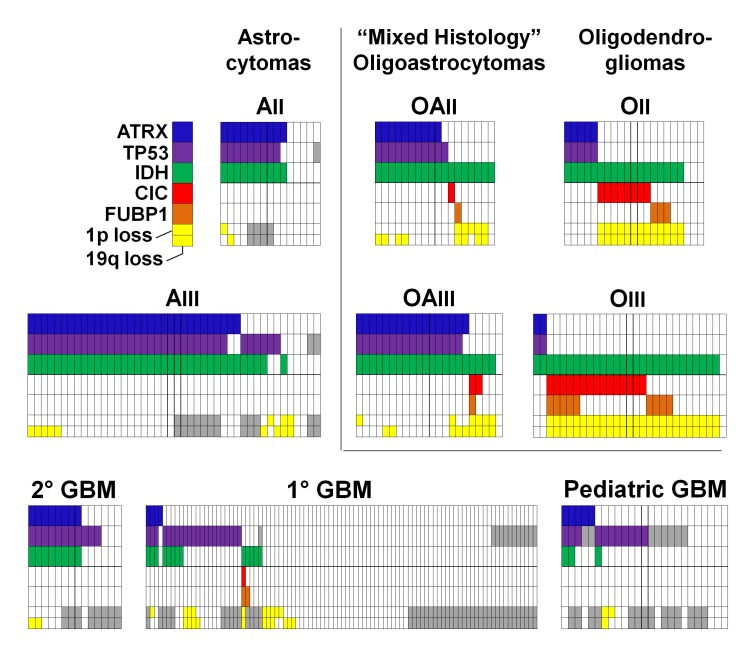
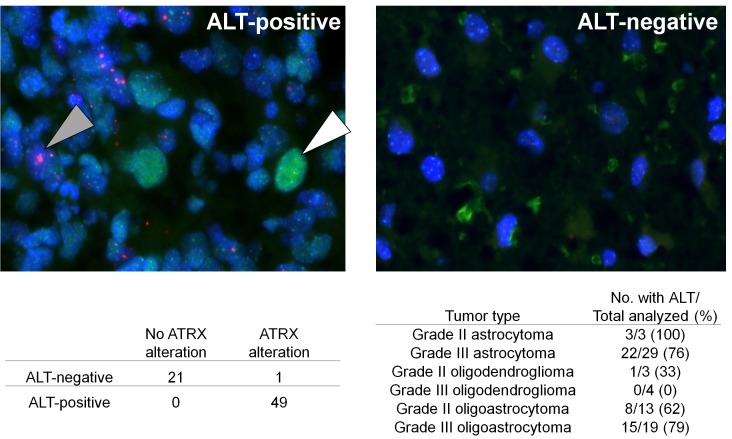
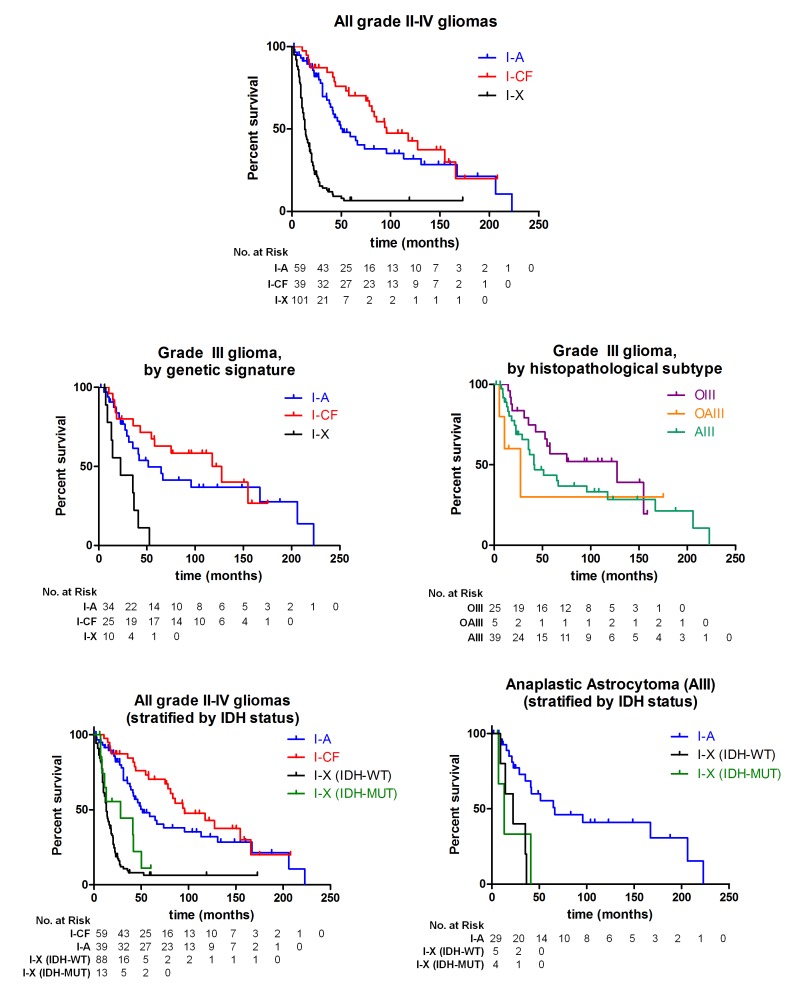
Mutations in the critical chromatin modifier ATRX and mutations in CIC and FUBP1, which are potent regulators of cell growth, have been discovered in specific subtypes of gliomas, the most common type of primary malignant brain tumors. However, the frequency of these mutations in many subtypes of gliomas, and their association with clinical features of the patients, is poorly understood. Here we analyzed these loci in 363 brain tumors. ATRX is frequently mutated in grade II-III astrocytomas (71%), oligoastrocytomas (68%), and secondary glioblastomas (57%), and ATRX mutations are associated with IDH1 mutations and with an alternative lengthening of telomeres phenotype. CIC and FUBP1 mutations occurred frequently in oligodendrogliomas (46% and 24%, respectively) but rarely in astrocytomas or oligoastrocytomas ( more than 10%). This analysis allowed us to define two highly recurrent genetic signatures in gliomas: IDH1/ATRX (I-A) and IDH1/CIC/FUBP1 (I-CF). Patients with I-CF gliomas had a significantly longer median overall survival (96 months) than patients with I-A gliomas (51 months) and patients with gliomas that did not harbor either signature (13 months). The genetic signatures distinguished clinically distinct groups of oligoastrocytoma patients, which usually present a diagnostic challenge, and were associated with differences in clinical outcome even among individual tumor types. In addition to providing new clues about the genetic alterations underlying gliomas, the results have immediate clinical implications, providing a tripartite genetic signature that can serve as a useful adjunct to conventional glioma classification that may aid in prognosis, treatment selection, and therapeutic trial design.
关键染色质修饰因子ATRX的突变以及CIC和FUBP1的突变(它们是细胞生长的有效调节因子)已在胶质瘤的特定亚型中被发现,胶质瘤是最常见的原发性恶性脑肿瘤类型。然而,这些突变在许多胶质瘤亚型中的频率及其与患者临床特征的关联仍知之甚少。在此,我们分析了363例脑肿瘤中的这些基因座。ATRX在II - III级星形细胞瘤(71%)、少突星形细胞瘤(68%)和继发性胶质母细胞瘤(57%)中频繁发生突变,并且ATRX突变与IDH1突变以及端粒替代延长表型相关。CIC和FUBP1突变在少突胶质细胞瘤中频繁出现(分别为46%和24%),但在星形细胞瘤或少突星形细胞瘤中很少见(超过10%)。该分析使我们能够在胶质瘤中定义两种高度复发的基因特征:IDH1/ATRX(I - A)和IDH1/CIC/FUBP1(I - CF)。与I - A胶质瘤患者(51个月)和不具有任何一种特征的胶质瘤患者(13个月)相比,I - CF胶质瘤患者的中位总生存期显著更长(96个月)。这些基因特征区分了临床上不同的少突星形细胞瘤患者群体,这通常是一个诊断挑战,并且即使在个体肿瘤类型中也与临床结果的差异相关。除了为胶质瘤潜在的基因改变提供新线索外,这些结果具有直接的临床意义,提供了一种三方基因特征,可作为传统胶质瘤分类的有用辅助手段,可能有助于预后、治疗选择和治疗试验设计。