William S. Middleton Memorial Veterans Hospital, Madison, WI 53705-2286, United States.
J Affect Disord. 2013 Feb 15;145(1):77-82. doi: 10.1016/j.jad.2012.07.015. Epub 2012 Aug 4.
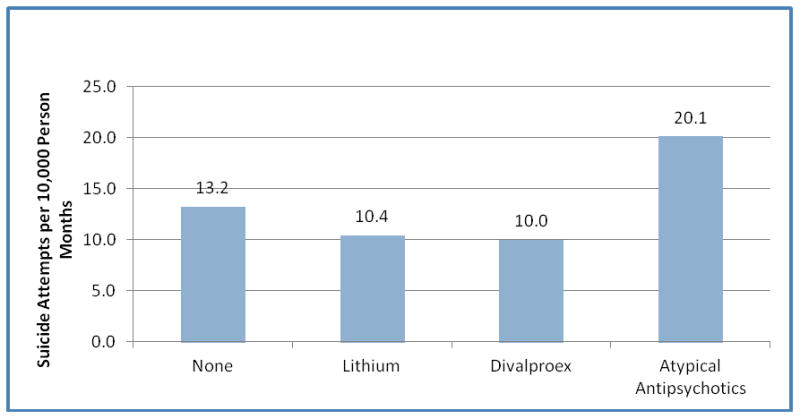
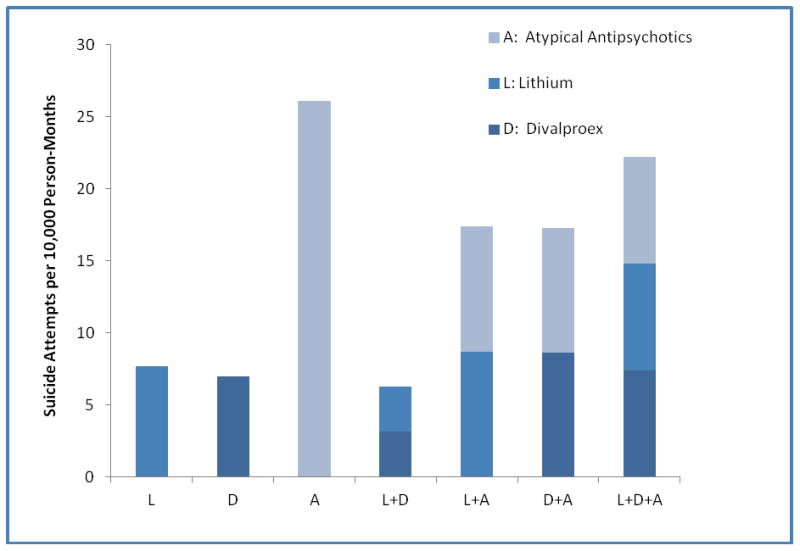
Suicide attempt rates were assessed in 1306 subjects in this 6 year retrospective study of Bipolar disorder. Participants were Veterans from 5 different Veterans Administration Hospitals who met criteria for bipolar type 1 or 2 and who had at least one prescription for lithium or divalproex or both during the study period. This study focused on the impact of atypical antipsychotics on the suicide attempt rate when used in addition to or in place of lithium or divalproex. Medication exposure was calculated using computerized pharmacy records. Suicide attempts were established through chart review including emergency room records, inpatient records, and outpatient records. There were a total of 117 suicide attempts and 2 suicide completions during the study period. Most attempts (59%) occurred when patients were on no medications. Nearly 90% of subjects spent an average of 45 months during the 6 year period on none of the aforementioned medications. The lowest percentage of suicide attempts (15%) occurred while on lithium, 21% while on divalproex and 24% while on atypical antipsychotics. When total months of exposure were taken into account, the lowest attempt rate occurred on lithium plus divalproex (6.3 attempts per 10,000 months of exposure), followed by divalproex alone (7.0 attempts/10,000 months of exposure), and lithium alone (7.7 attempts per 10,000 months of exposure). Patients on atypical antipsychotics alone had an attempt rate of 26.1 attempts per 10,000 months of exposure. In this study, lithium and divalproex provided protection against suicide attempts. Results need to be replicated in future prospective studies and clearly strategies for improving medication compliance among veterans are warranted.
这项为期 6 年的双相情感障碍回顾性研究评估了 1306 名患者的自杀企图率。参与者为来自 5 家不同退伍军人事务部医院的退伍军人,符合 1 型或 2 型双相情感障碍标准,且在研究期间至少有一次锂或丙戊酸盐或两者的处方。本研究重点关注在锂或丙戊酸盐的基础上加用或替代用非典型抗精神病药对自杀企图率的影响。药物暴露情况通过计算机化的药房记录计算。通过图表回顾(包括急诊记录、住院记录和门诊记录)确定自杀企图。在研究期间共发生 117 次自杀企图和 2 次自杀未遂。大多数企图(59%)发生在患者未服用任何药物时。近 90%的受试者在 6 年期间平均有 45 个月未服用上述任何一种药物。自杀企图发生率最低(15%)的是锂治疗组,21%是丙戊酸盐组,24%是在使用非典型抗精神病药时。当考虑总暴露月数时,锂加丙戊酸盐的自杀企图率最低(每 10000 个月暴露 6.3 次企图),其次是单独使用丙戊酸盐(每 10000 个月暴露 7.0 次企图),单独使用锂(每 10000 个月暴露 7.7 次企图)。单独使用非典型抗精神病药的患者自杀企图率为每 10000 个月暴露 26.1 次企图。在这项研究中,锂和丙戊酸盐可预防自杀企图。未来的前瞻性研究需要复制这些结果,并且显然需要制定策略来提高退伍军人的药物依从性。