Department of Neuroscience, Rehabilitation, Ophthalmology, Genetics, Maternal and Child Health (DINOGMI), Section of Psychiatry, University of Genoa, Genoa, Italy.
IRCCS Ospedale Policlinico San Martino, Genoa, Italy.
Acta Psychiatr Scand. 2021 Sep;144(3):259-276. doi: 10.1111/acps.13312. Epub 2021 May 25.
Polypharmacy is common in maintenance treatment of bipolar illness, but proof of greater efficacy compared to monotherapy is assumed rather than well known. We systematically reviewed the evidence from the literature to provide recommendations for clinical management and future research.
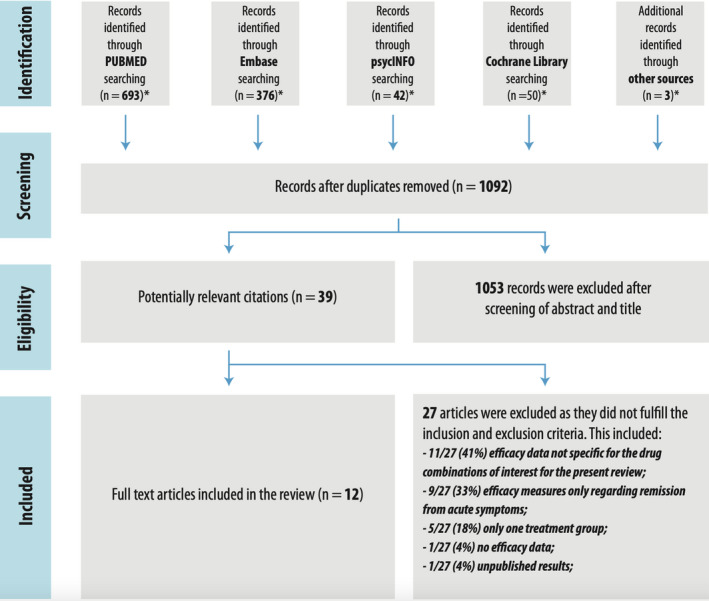
A systematic review was conducted on the use of polypharmacy in bipolar prophylaxis. Relevant papers published in English through 31 December 2019 were identified searching the electronic databases MEDLINE, Embase, PsycINFO, and the Cochrane Library.
Twelve studies matched inclusion criteria, including 10 randomized controlled trials (RCTs). The best drug combination in prevention is represented by lithium + valproic acid which showed a significant effect on time to mood relapses (HR = 0.57) compared to valproic acid monotherapy, especially for manic episodes (HR = 0.51). The effect was significant in terms of time to new drug treatment (HR = 0.51) and time to hospitalization (HR = 0.57). A significant reduction in the frequency of mood relapses was also reported for lithium + valproic acid vs. lithium monotherapy (RR=0.12); however, the trial had a small sample size. Lamotrigine + valproic acid reported significant efficacy in prevention of depressive episodes compared to lamotrigine alone.
The literature to support a generally greater efficacy with polypharmacy in bipolar illness is scant and heterogeneous. Within that limited evidence base, the best drug combination in bipolar prevention is represented by lithium + valproic acid for manic, but not depressive episodes. Clinical practice should focus more on adequate monotherapy before considering polypharmacy.
双相情感障碍的维持治疗中常采用多种药物治疗,但与单药治疗相比,其疗效更好只是假设,而非明确的。我们系统地回顾了文献中的证据,为临床管理和未来研究提供建议。
对双相情感障碍预防中采用多种药物治疗的情况进行了系统评价。通过检索电子数据库 MEDLINE、Embase、PsycINFO 和 Cochrane Library,查找截至 2019 年 12 月 31 日发表的英文文献。
符合纳入标准的研究共有 12 项,包括 10 项随机对照试验(RCT)。预防中最佳的药物组合是锂盐+丙戊酸,与丙戊酸单药治疗相比,其在情绪复发时间(HR=0.57)方面具有显著效果,尤其是对躁狂发作(HR=0.51)。在新药治疗时间(HR=0.51)和住院时间(HR=0.57)方面也具有显著效果。与锂盐单药治疗相比,锂盐+丙戊酸也显著降低了情绪复发的频率(RR=0.12);但该试验样本量较小。与单用拉莫三嗪相比,拉莫三嗪+丙戊酸在预防抑郁发作方面也具有显著疗效。
支持双相情感障碍中采用多种药物治疗通常具有更大疗效的文献很少且存在异质性。在这有限的证据基础上,双相情感障碍预防中最佳的药物组合是锂盐+丙戊酸,对躁狂发作有效,但对抑郁发作无效。临床实践应更注重充分的单药治疗,然后再考虑采用多种药物治疗。