Research and Development of Novel Drugs Unit, Center for Applied Pharmacobiology Research-CIFA, University of Navarre, Pamplona 31080, Spain.
Molecules. 2012 Aug 7;17(8):9451-61. doi: 10.3390/molecules17089451.
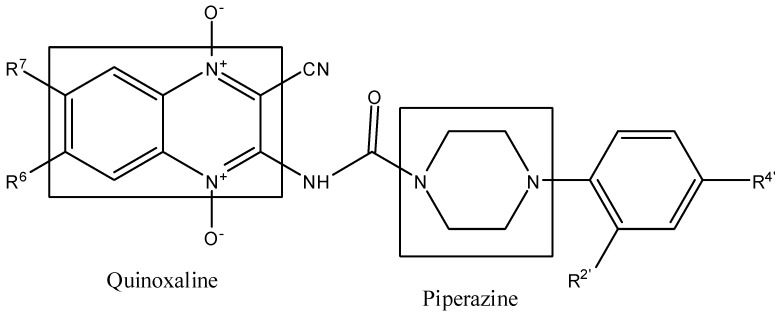
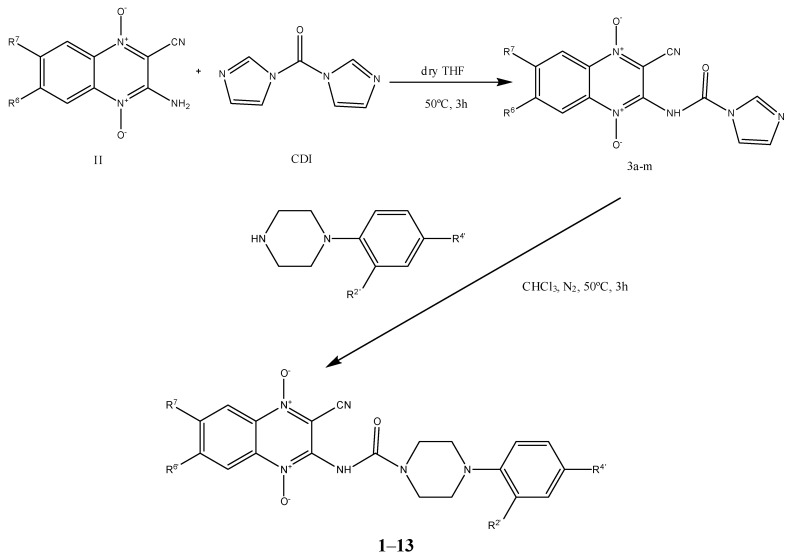
Malaria and leishmaniasis are two of the World's most important tropical parasitic diseases. Thirteen new 2-cyano-3-(4-phenylpiperazine-1-carboxamido) quinoxaline 1,4-dioxide derivatives (CPCQs) were synthesized and evaluated for their in vitro antimalarial and antileishmanial activity against erythrocytic forms of Plasmodium falciparum and axenic forms of Leishmania infantum. Their toxicity against VERO cells (normal monkey kidney cells) was also assessed. None of the tested compounds was efficient against Plasmodium, but two of them showed good activity against Leishmania. Toxicity on VERO was correlated with leishmanicidal properties.
疟疾和利什曼病是世界上两种最重要的热带寄生虫病。合成了 13 种新型 2-氰基-3-(4-苯哌嗪-1-羧酰胺基)喹喔啉 1,4-二氧化物衍生物(CPCQs),并评估了它们对红内期疟原虫和利什曼原虫无细胞形式的体外抗疟和抗利什曼活性。还评估了它们对 VERO 细胞(正常猴肾细胞)的毒性。测试的化合物对疟原虫均无效,但其中两种对利什曼原虫表现出良好的活性。对 VERO 的毒性与杀利什曼原虫活性相关。