Department of Microbiology and Immunology, University of Maryland, Baltimore, Maryland, USA.
mBio. 2012 Aug 7;3(4). doi: 10.1128/mBio.00218-12. Print 2012.
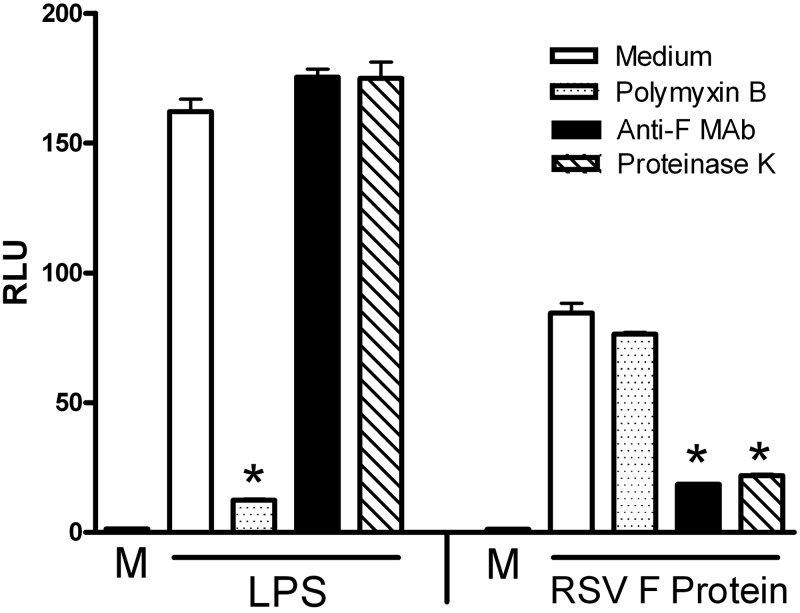
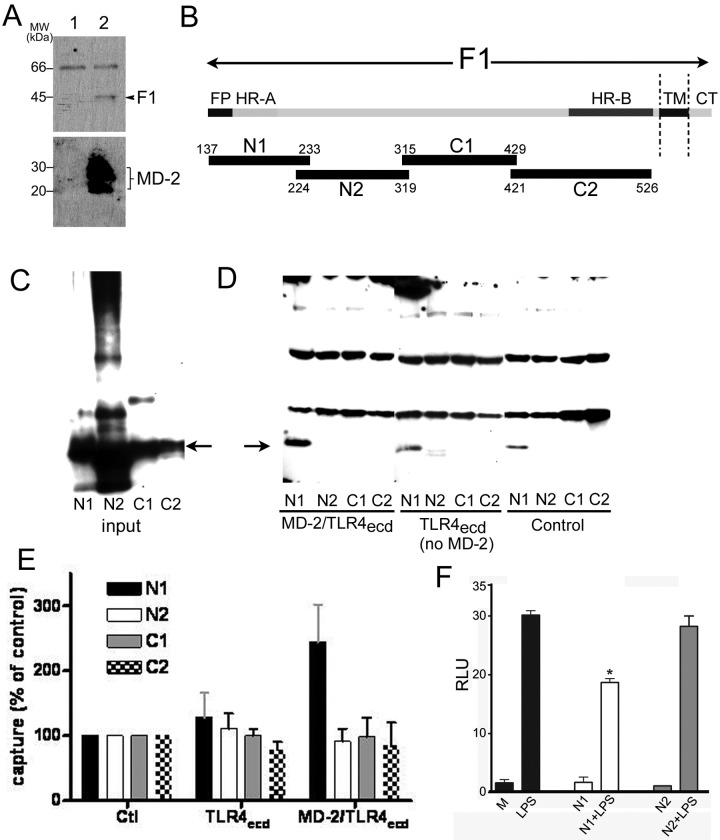
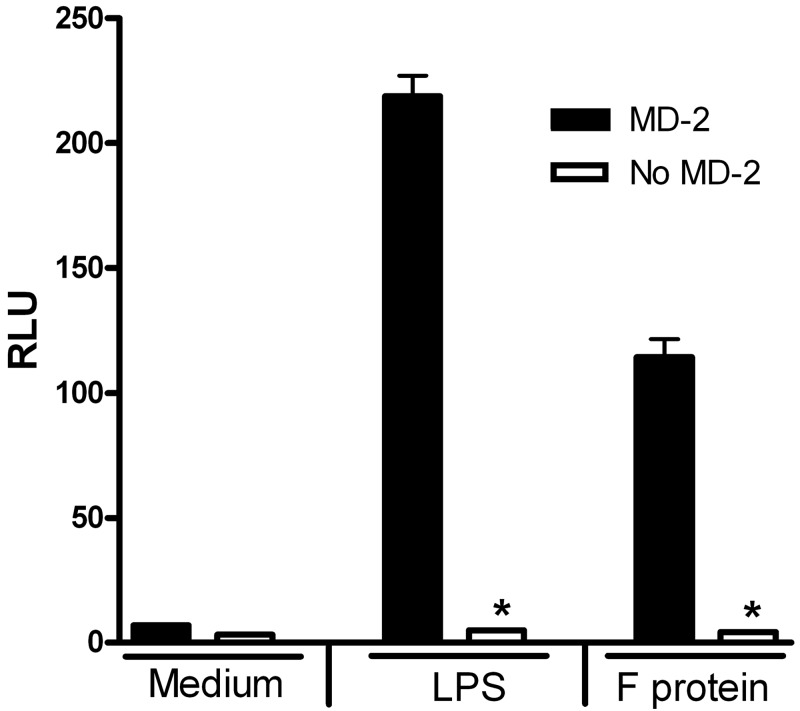
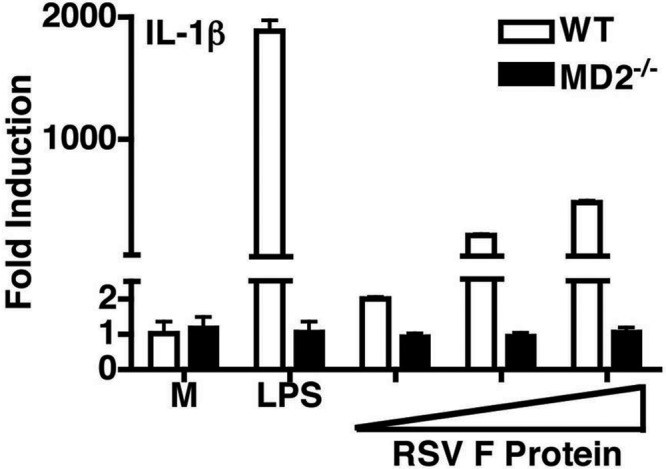
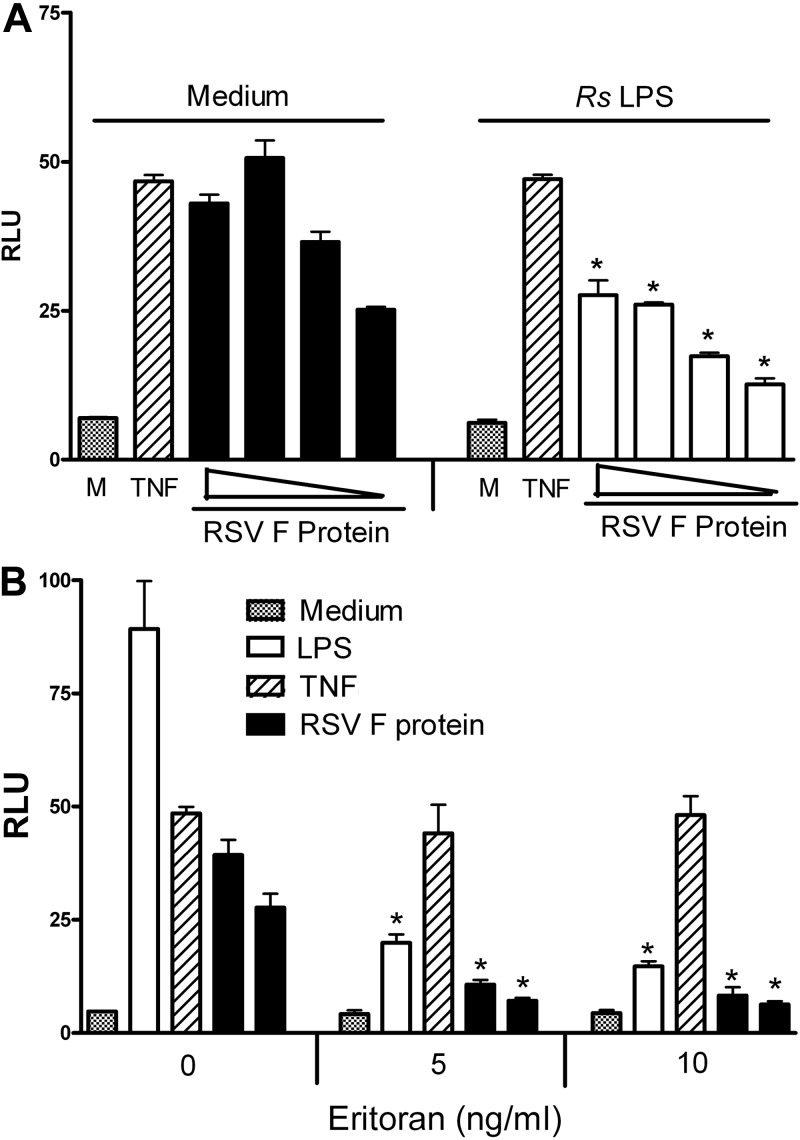
Respiratory syncytial virus (RSV) is a leading cause of infant mortality worldwide. Toll-like receptor 4 (TLR4), a signaling receptor for structurally diverse microbe-associated molecular patterns, is activated by the RSV fusion (F) protein and by bacterial lipopolysaccharide (LPS) in a CD14-dependent manner. TLR4 signaling by LPS also requires the presence of an additional protein, MD-2. Thus, it is possible that F protein-mediated TLR4 activation relies on MD-2 as well, although this hypothesis has not been formally tested. LPS-free RSV F protein was found to activate NF-κB in HEK293T transfectants that express wild-type (WT) TLR4 and CD14, but only when MD-2 was coexpressed. These findings were confirmed by measuring F-protein-induced interleukin 1β (IL-1β) mRNA in WT versus MD-2(-/-) macrophages, where MD-2(-/-) macrophages failed to show IL-1β expression upon F-protein treatment, in contrast to the WT. Both Rhodobacter sphaeroides LPS and synthetic E5564 (eritoran), LPS antagonists that inhibit TLR4 signaling by binding a hydrophobic pocket in MD-2, significantly reduced RSV F-protein-mediated TLR4 activity in HEK293T-TLR4-CD14-MD-2 transfectants in a dose-dependent manner, while TLR4-independent NF-κB activation by tumor necrosis factor alpha (TNF-α) was unaffected. In vitro coimmunoprecipitation studies confirmed a physical interaction between native RSV F protein and MD-2. Further, we demonstrated that the N-terminal domain of the F1 segment of RSV F protein interacts with MD-2. These data provide new insights into the importance of MD-2 in RSV F-protein-mediated TLR4 activation. Thus, targeting the interaction between MD-2 and RSV F protein may potentially lead to novel therapeutic approaches to help control RSV-induced inflammation and pathology.
This study shows for the first time that the fusion (F) protein of respiratory syncytial virus (RSV), a major cause of bronchiolitis and death, particularly in infants and young children, physically interacts with the Toll-like receptor 4 (TLR4) coreceptor, MD-2, through its N-terminal domain. We show that F protein-induced TLR4 activation can be blocked by lipid A analog antagonists. This observation provides a strong experimental rationale for testing such antagonists in animal models of RSV infection for potential use in people.
呼吸道合胞病毒(RSV)是全球婴儿死亡的主要原因。Toll 样受体 4(TLR4)是一种信号受体,可识别结构多样的微生物相关分子模式,它通过 RSV 融合(F)蛋白和 CD14 依赖性的细菌脂多糖(LPS)激活。LPS 对 TLR4 的信号转导还需要另一种蛋白 MD-2 的存在。因此,F 蛋白介导的 TLR4 激活可能也依赖于 MD-2,尽管这一假设尚未得到正式验证。研究发现,无 LPS 的 RSV F 蛋白可在表达野生型(WT)TLR4 和 CD14 的 HEK293T 转染细胞中激活 NF-κB,但只有在共表达 MD-2 时才会发生这种情况。这些发现通过测量 WT 与 MD-2(-/-)巨噬细胞中 F 蛋白诱导的白细胞介素 1β(IL-1β)mRNA 得到了证实,在 F 蛋白处理后,MD-2(-/-)巨噬细胞未能显示出 IL-1β 的表达,而 WT 则可以。Rhodobacter sphaeroides LPS 和合成 E5564(eritoran)(一种通过与 MD-2 中的疏水口袋结合抑制 TLR4 信号转导的 LPS 拮抗剂)可显著降低 RSV F 蛋白在 HEK293T-TLR4-CD14-MD-2 转染细胞中的 TLR4 活性,呈剂量依赖性,而肿瘤坏死因子-α(TNF-α)诱导的 TLR4 非依赖性 NF-κB 激活则不受影响。体外共免疫沉淀研究证实了 RSV F 蛋白与 MD-2 之间的物理相互作用。此外,我们还证明 RSV F 蛋白的 F1 片段的 N 端结构域与 MD-2 相互作用。这些数据为 MD-2 在 RSV F 蛋白介导的 TLR4 激活中的重要性提供了新的见解。因此,靶向 MD-2 和 RSV F 蛋白之间的相互作用可能为控制 RSV 诱导的炎症和病理提供新的治疗方法。