Pirogov Russian National Research Medical University , Moscow.
Acta Naturae. 2012 Apr;4(2):74-9.
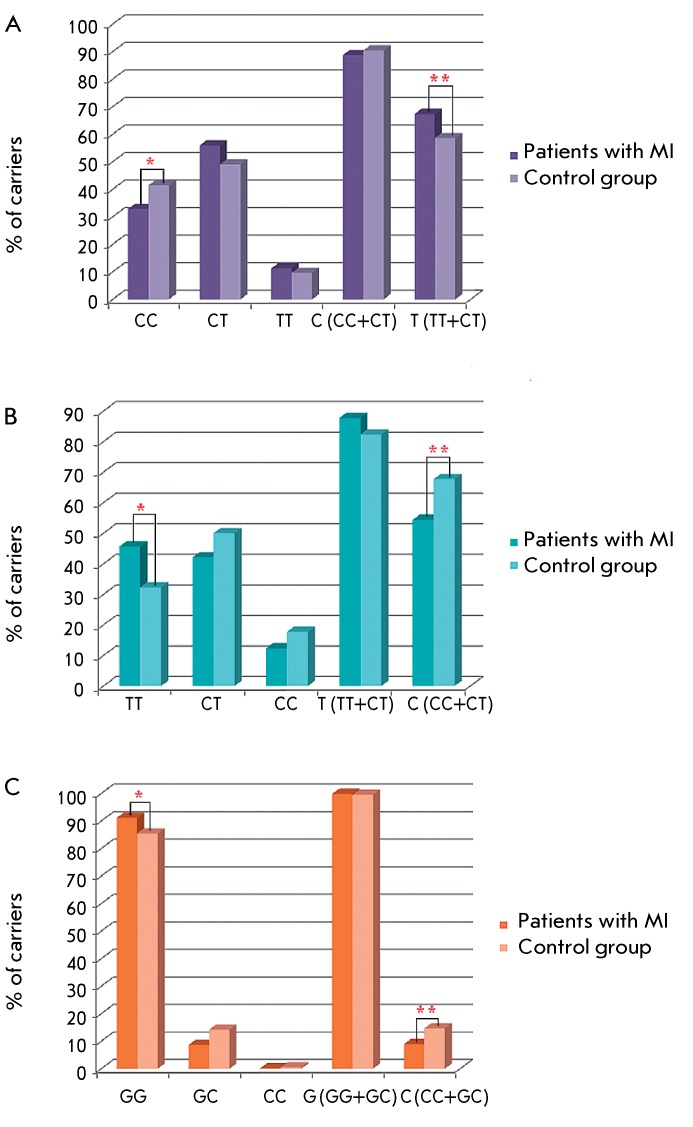
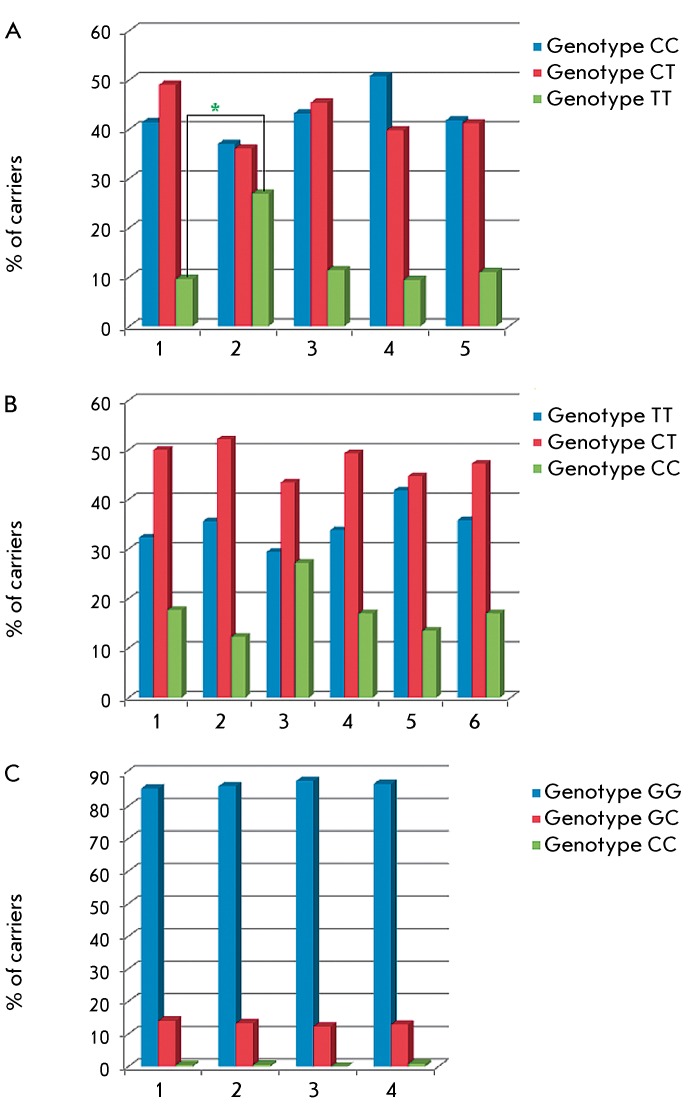
Carriage frequencies of alleles and genotypes of theTGFB1 gene polymorphous loci -509C>T (rs1800469), 869T>C (rs1982073), 915G>C (rs1800471), which affect the level of cytokine TGF-β1 production, were analyzed in the patients of Russian ethnic descent with myocardial infarction (MI) (406 cases) and in the control group of the same ethnic descent (198 controls). Significant association with MI was observed in carriage frequencies of the alleleTGFB1*-509T (p=0.046, OR =1.45, 95% CI: 1.02-2.06), genotypes TGFB1869T/T (p=0.0024, OR =1.75, 95% CI: 1.22-2.51), andTGFB1915G/G (p=0.048, OR=1.76, 95% CI: 1.05-2.97). Linkage disequilibrium analysis for these SNPs has shown that the associations revealed can be considered to be independent. A complex analysis of MI association with combinations of alleles/genotypes of said SNPs indicates their cumulative effect. An analysis of susceptibility to early-onset MI (≤ 50 years old) revealed a positive association of the alleleTGFB1*-509T (p=0.002, OR=2.24, 95% CI: 1.35-3.71) and genotypeTGFB1869T/T (p=0.008, OR=1.93, 95% CI: 1.18-3.15), as well as their additivity. An analysis of susceptibility to recurrent MI revealed an association of the genotypeTGFB1-509T/T (p=0.0078, OR=2.60, 95% CI: 1.28-5.28). The results obtained indicate the important role of theTGFB1gene in susceptibility to MI, including early-onset and recurrent MI, in Russians.
对影响细胞因子 TGF-β1 产生水平的 TGFB1 基因多态性位点 -509C>T(rs1800469)、869T>C(rs1982073)、915G>C(rs1800471)的等位基因和基因型在俄罗斯族心肌梗死 (MI) 患者 (406 例) 中的携带频率进行了分析,并与相同民族的对照组 (198 例对照) 进行了比较。结果显示,TGFB1*-509T 等位基因 (p=0.046,OR=1.45,95%CI:1.02-2.06)、TGFB1869T/T 基因型 (p=0.0024,OR=1.75,95%CI:1.22-2.51) 和 TGFB1915G/G 基因型 (p=0.048,OR=1.76,95%CI:1.05-2.97) 的携带频率与 MI 显著相关。对这些 SNP 的连锁不平衡分析表明,所揭示的关联可以被认为是独立的。对所述 SNP 的等位基因/基因型组合与 MI 相关性的综合分析表明,这些 SNP 具有累积效应。对早发性 MI(≤50 岁)易感性的分析显示,TGFB1*-509T 等位基因 (p=0.002,OR=2.24,95%CI:1.35-3.71) 和 TGFB1869T/T 基因型 (p=0.008,OR=1.93,95%CI:1.18-3.15) 具有阳性相关性,且存在累加效应。对复发性 MI 易感性的分析显示,TGFB1-509T/T 基因型 (p=0.0078,OR=2.60,95%CI:1.28-5.28) 与 MI 相关。研究结果表明,TGFB1 基因在俄罗斯人群中易患 MI(包括早发性和复发性 MI)中起重要作用。