Watanabe Mineaki, Hirata Hirokuni, Arima Masafumi, Hayashi Yumeko, Chibana Kazuyuki, Yoshida Naruo, Ikeno Yoshihiko, Fukushima Yasutsugu, Komura Reiko, Okazaki Kazumi, Sugiyama Kumiya, Fukuda Takeshi
Department of Pulmonary Medicine and Clinical Immunology, Dokkyo University School of Medicine, Tochigi 321-0293, Japan.
Asia Pac Allergy. 2012 Jul;2(3):195-202. doi: 10.5415/apallergy.2012.2.3.195. Epub 2012 Jul 25.
Patients may receive negative results from a specific IgE (sIgE) test such as the ImmunoCAP (CAP) despite a documented history of systemic reaction to a Hymenoptera sting. Thus, further testing may be required using another serological method or venom skin prick tests to confirm allergy diagnosis and correct species.
To evaluate the sensitivity and the specificity of CAP and IMMULITE 3gAllergy (IMMULITE) for detecting sIgE to Paper wasp (WA) and Yellow Jacket (YJ) venoms using patient clinical history as the comparator.
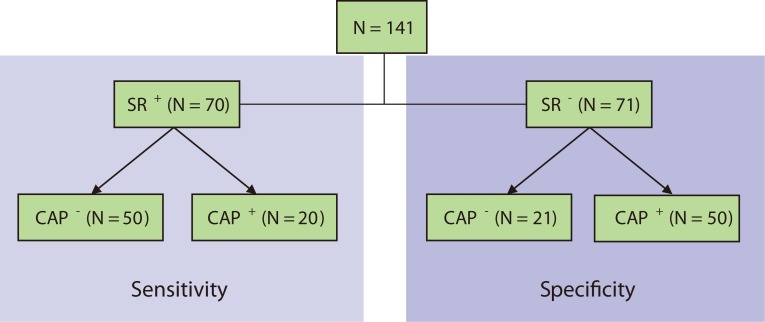
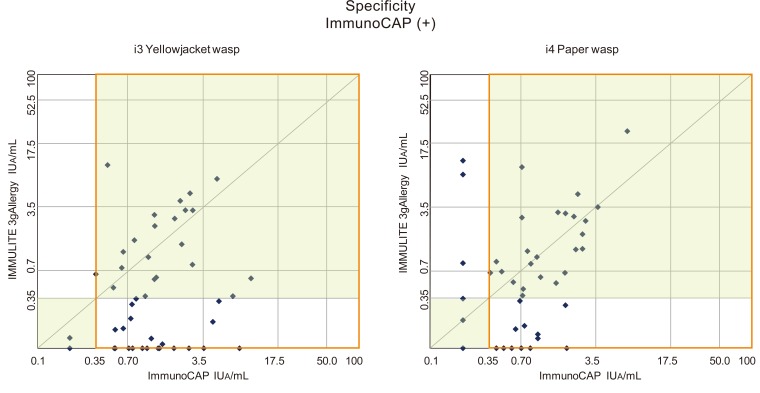
Sera from 70 participants with a history of systemic reactions (SR) to WA and/or YJ stings were tested using CAP and IMMULITE. Fifty participants from this group had negative results on CAP. To assess specificity, sera from 71 participants who had never experienced either a WA or YJ sting were tested using CAP and IMMULITE. Fifty participants from this group tested positive using CAP.
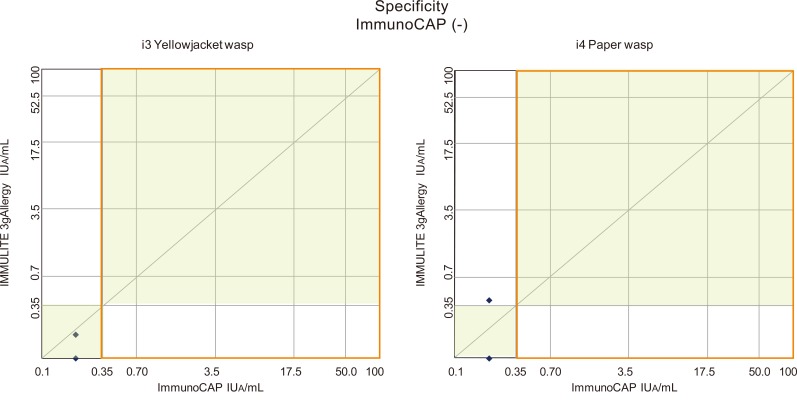
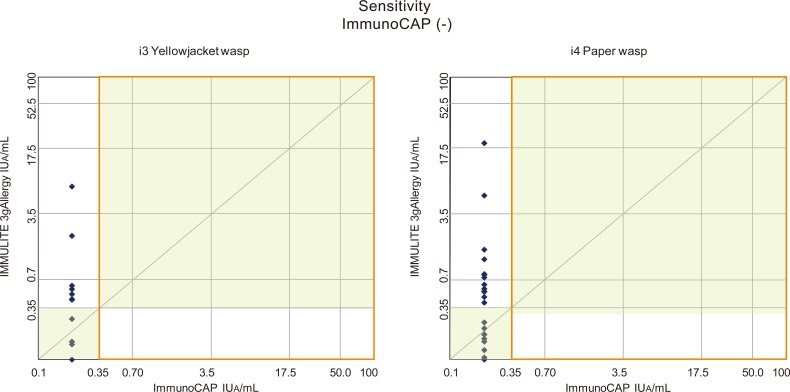
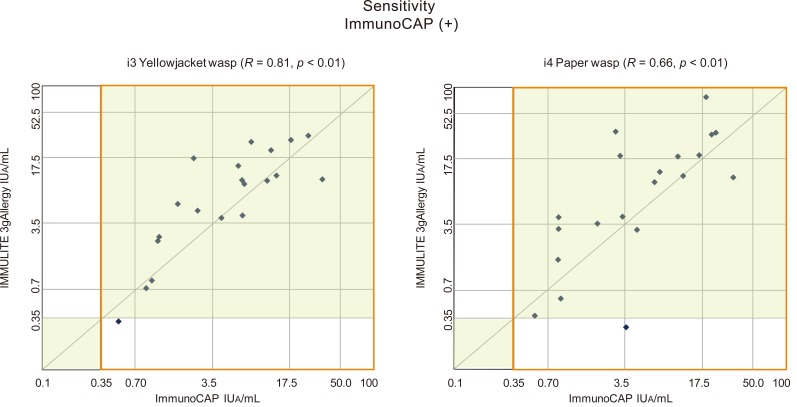
In participants with a history of systemic reaction to a Hymenoptera sting, yet who tested negative for WA and/or YJ sIgE according to CAP, the positivity rate according to IMMULITE was 20-42% using 0.10 IU(A)/mL as the limit of detection (LoD), per the manufacturer's specification. When the LoD for CAP (0.35 IU(A)/mL) was applied to the IMMULITE results, positivity according to IMMULITE was 14-26%. Overall, sensitivity, specificity, and agreement with SR were greater for IMMULITE than for CAP. For YJ: sensitivity (IMMULITE:CAP), 42.8%:28.5%; specificity, 53.5%:39.4%; agreement, 48.2%:34%. For WA, sensitivity (IMMULITE:CAP), 58.6%:28.5%; specificity, 49.3%:47.8%; agreement, 43.9%:38.3%.
The IMMULITE performed well for detecting sIgE to Hymenoptera venom.
尽管有文献记载患者有对膜翅目昆虫叮咬的全身反应病史,但他们可能会从特定的免疫球蛋白E(IgE)检测(如ImmunoCAP检测)中得到阴性结果。因此,可能需要使用另一种血清学方法或毒液皮肤点刺试验进行进一步检测,以确诊过敏并确定正确的种类。
以患者临床病史作为对照,评估ImmunoCAP检测(CAP)和免疫发光法3g过敏检测(IMMULITE)检测对纸黄蜂(WA)和黄夹克黄蜂(YJ)毒液的特异性IgE(sIgE)的敏感性和特异性。
使用CAP和IMMULITE检测了70名有对WA和/或YJ叮咬产生全身反应(SR)病史的参与者的血清。该组中有50名参与者的CAP检测结果为阴性。为评估特异性,使用CAP和IMMULITE检测了71名从未经历过WA或YJ叮咬的参与者的血清。该组中有50名参与者的CAP检测呈阳性。
在有膜翅目昆虫叮咬全身反应病史但根据CAP检测WA和/或YJ sIgE呈阴性的参与者中,根据IMMULITE检测,以制造商规定的0.10 IU(A)/mL作为检测下限(LoD),阳性率为20% - 42%。当将CAP的检测下限(0.35 IU(A)/mL)应用于IMMULITE检测结果时,IMMULITE检测的阳性率为14% - 26%。总体而言,IMMULITE检测的敏感性、特异性以及与全身反应的一致性均高于CAP检测。对于YJ:敏感性(IMMULITE:CAP),42.8%:28.5%;特异性,53.5%:39.4%;一致性,48.2%:34%。对于WA,敏感性(IMMULITE:CAP),58.6%:28.5%;特异性,49.3%:47.8%;一致性,43.9%:38.3%。
IMMULITE在检测膜翅目昆虫毒液的sIgE方面表现良好。