Division of Viral Hepatitis, Centers for Disease Control and Prevention, Atlanta, Georgia 30333, USA.
Clin Infect Dis. 2012 Oct;55(8):1047-55. doi: 10.1093/cid/cis616. Epub 2012 Aug 8.
Little is known about viral hepatitis testing and infection prevalence among persons in private healthcare organizations (HCOs) in the United States.
To determine the frequency of and characteristics associated with viral hepatitis testing and infection prevalence among adults with access to care, we conducted an observational cohort study among 1.25 million adults from 4 US HCOs and included persons with ≥1 clinical encounter during 2006-2008 and ≥12 months of continuous follow-up before 2009. We compared the number of infections identified with the number expected based on adjusted data from the National Health and Nutrition Examination Survey (NHANES).
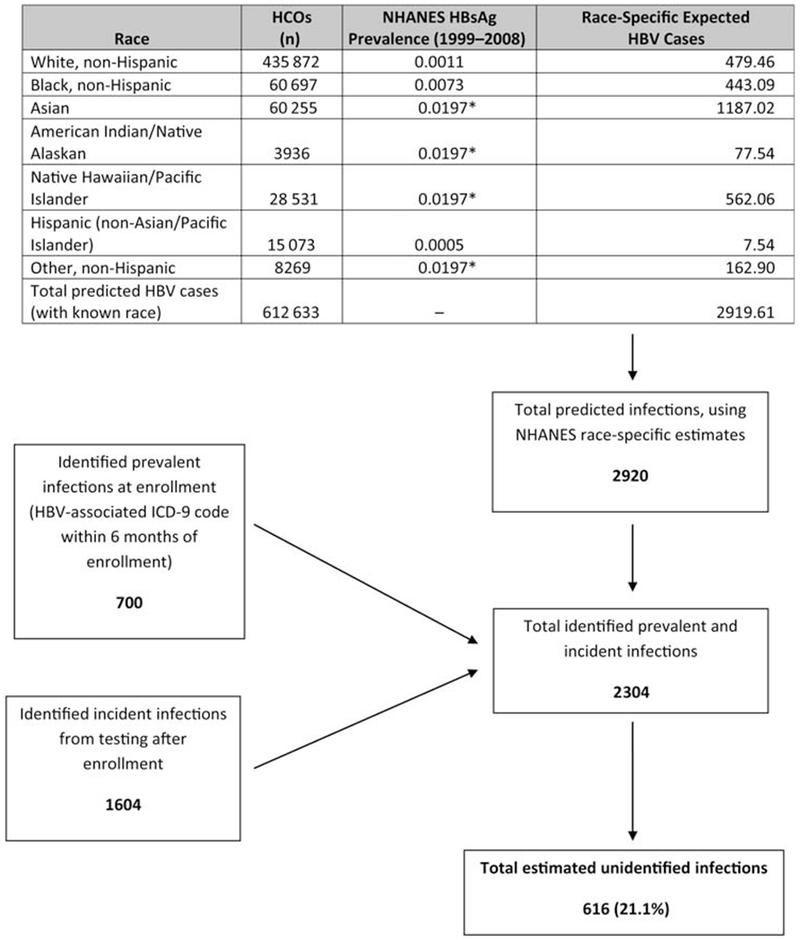
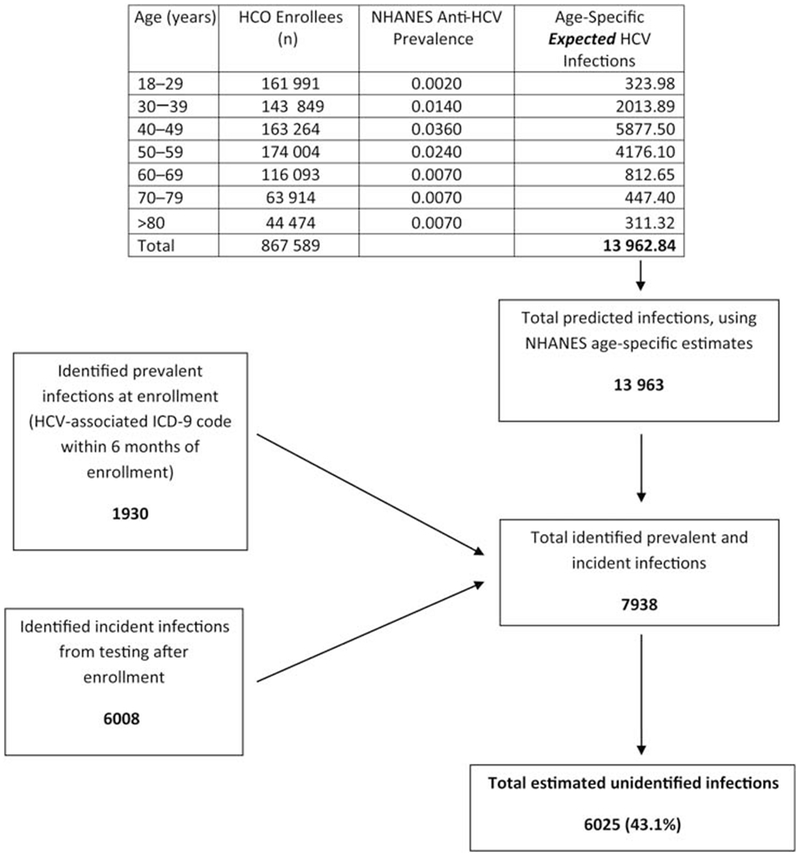
Of 866,886 persons without a previous hepatitis B virus (HBV) diagnosis, 18.8% were tested for HBV infection, of whom 1.4% tested positive; among 865,659 without a previous hepatitis C virus (HCV) diagnosis, 12.7% were tested, of whom 5.5% tested positive. Less than half of those with ≥2 abnormal alanine aminotransferase (ALT) levels were subsequently tested for HBV or HCV. When tested, Asians (adjusted odds ratio [aOR] 6.33 relative to whites) were most likely HBV infected, whereas those aged 50-59 years were most likely HCV infected (aOR 6.04, relative to age <30 years). Based on estimates from NHANES, nearly one-half of HCV and one-fifth of HBV infections in this population were not identified.
Even in this population with access to care and lengthy follow-up, only a fraction of expected viral hepatitis infections were identified. Abnormal ALT levels often but not consistently triggered testing. These findings have implications for the identification and care of 4-5 million US residents with HBV and HCV infection.
在美国,私人医疗保健组织(HCO)中个体的病毒性肝炎检测和感染流行情况鲜为人知。
为了确定获得医疗保健的成年人进行病毒性肝炎检测的频率和相关特征,以及感染流行情况,我们对来自美国 4 家 HCO 的 125 万名成年人进行了一项观察性队列研究,纳入了在 2006-2008 年期间至少有 1 次临床就诊且在 2009 年之前有至少 12 个月连续随访的患者。我们将实际检测出的感染人数与根据国家健康和营养调查(NHANES)的调整后数据预期的感染人数进行了比较。
在 866886 名无乙型肝炎病毒(HBV)既往诊断的患者中,有 18.8%接受了 HBV 感染检测,其中 1.4%检测结果为阳性;在 865659 名无丙型肝炎病毒(HCV)既往诊断的患者中,有 12.7%接受了 HCV 感染检测,其中 5.5%检测结果为阳性。不到一半的丙氨酸氨基转移酶(ALT)水平≥2 次异常的患者随后接受了 HBV 或 HCV 检测。在接受检测的患者中,亚洲人(相对于白人,调整后优势比[aOR]为 6.33)最有可能感染 HBV,而年龄在 50-59 岁的患者最有可能感染 HCV(aOR 为 6.04,相对于年龄<30 岁的患者)。根据 NHANES 的估计,该人群中近一半的 HCV 和五分之一的 HBV 感染未被发现。
即使在这个获得医疗保健且随访时间较长的人群中,也只有预期病毒性肝炎感染的一小部分被发现。异常的 ALT 水平通常会但并非始终会触发检测。这些发现对识别和治疗美国 400-500 万 HBV 和 HCV 感染者具有重要意义。