Department of Orthopaedics, Erasmus MC University Medical Center Rotterdam, The Netherlands.
Front Immunol. 2012 Aug 2;3:231. doi: 10.3389/fimmu.2012.00231. eCollection 2012.
In diseased joints, the catabolic environment results in progressive joint damage. Mesenchymal stem cells (MSCs) can have immunomodulatory effects by secreting anti-inflammatory factors. To exert these effects, MSCs need to be triggered by pro-inflammatory cytokines. To explore the potential of MSCs as a treatment for diseased joints, we studied the effect of synovial fluid (SF) from donors with different joint diseases and donors without joint pathology on the immunomodulatory capacities of human MSCs in vitro. We hypothesized that SF of diseased joints influences the immunomodulatory effects of MSCs.
MSCs were cultured in medium with SF of six osteoarthritis (OA) or six rheumatoid arthritis (RA) donors and three donors without joint pathology were used as control. Gene expressions of IL-6, HGF, TNFa, TGFb1, and indoleamine 2,3-dioxygenase (IDO) were analyzed. l-kynurenine concentration in conditioned medium (CM) by MSCs with SF was determined as a measure of IDO activity by MSCs. Furthermore, the effect of CM with SF on proliferation of activated lymphocytes was analyzed.
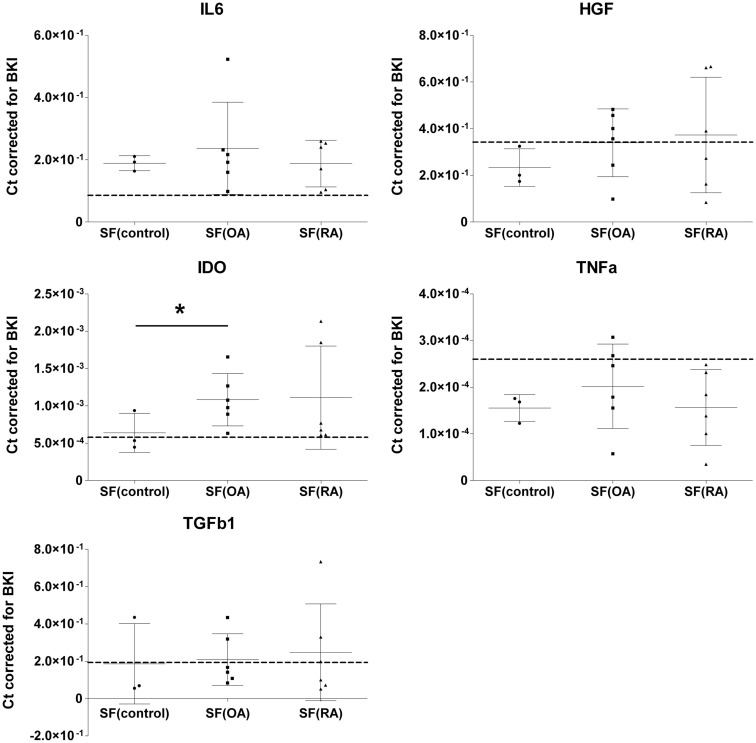
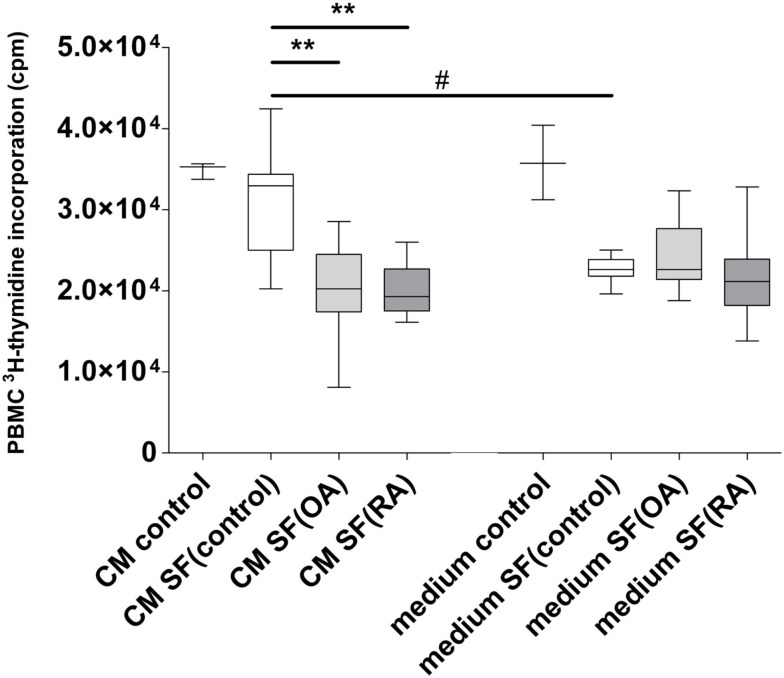
Addition of SF significantly up-regulated the mRNA expression of IL-6 and IDO in MSCs. SF(OA) induced significantly higher expression of IDO than SF(control), although no difference in IDO activity of the MSCs could be shown with a l-kynurenine assay. Medium conditioned by MSCs with SF(OA or RA) suppressed activated lymphocyte proliferation in vitro more than medium conditioned by MSCs without SF or with SF(control).
SF can influence the expression of genes involved in immunomodulation by MSCs and the effect on lymphocyte proliferation. We found indications for disease-specific differences between SFs but the variation between donors, even within one disease group was high. These data warrant further research to examine the potential application of MSC therapy in arthritic joints.
在患病关节中,分解代谢环境导致进行性关节损伤。间充质干细胞 (MSC) 通过分泌抗炎因子具有免疫调节作用。为了发挥这些作用,MSC 需要被前炎性细胞因子触发。为了探索 MSC 作为治疗患病关节的潜力,我们研究了来自不同关节疾病和无关节病理学供体的滑膜液 (SF) 对体外人 MSC 免疫调节能力的影响。我们假设患病关节的 SF 会影响 MSC 的免疫调节作用。
将 MSC 在含有来自 6 名骨关节炎 (OA) 或 6 名类风湿关节炎 (RA) 供体的 SF 和 3 名无关节病理学供体的培养基中培养。分析 IL-6、HGF、TNFa、TGFb1 和吲哚胺 2,3-双加氧酶 (IDO) 的基因表达。通过 MSC 产生的 SF 测定条件培养基 (CM) 中的 l-犬尿氨酸浓度,以作为 MSC 中 IDO 活性的指标。此外,还分析了 SF 对激活淋巴细胞增殖的影响。
添加 SF 可显著上调 MSC 中 IL-6 和 IDO 的 mRNA 表达。SF(OA) 诱导的 IDO 表达明显高于 SF(对照),尽管 l-犬尿氨酸测定未显示 MSC 中 IDO 活性的差异。SF(OA 或 RA) 处理的 MSC 产生的 CM 比无 SF 或 SF(对照)处理的 MSC 产生的 CM 更能抑制体外激活淋巴细胞的增殖。
SF 可以影响 MSC 中参与免疫调节的基因表达以及对淋巴细胞增殖的影响。我们发现 SF 之间存在疾病特异性差异的迹象,但供体之间的差异,即使在同一疾病组内也很高。这些数据需要进一步研究,以检验 MSC 治疗在关节炎关节中的潜在应用。