Kang Dong-Yoon, Park Soyoung, Rhee Chul-Woo, Kim Ye-Jee, Choi Nam-Kyong, Lee Joongyub, Park Byung-Joo
Department of Preventive Medicine, Seoul National University College of Medicine, Korea.
J Prev Med Public Health. 2012 Jul;45(4):219-26. doi: 10.3961/jpmph.2012.45.4.219. Epub 2012 Jul 31.
To evaluate the risk of fractures related with zolpidem in elderly insomnia patients.
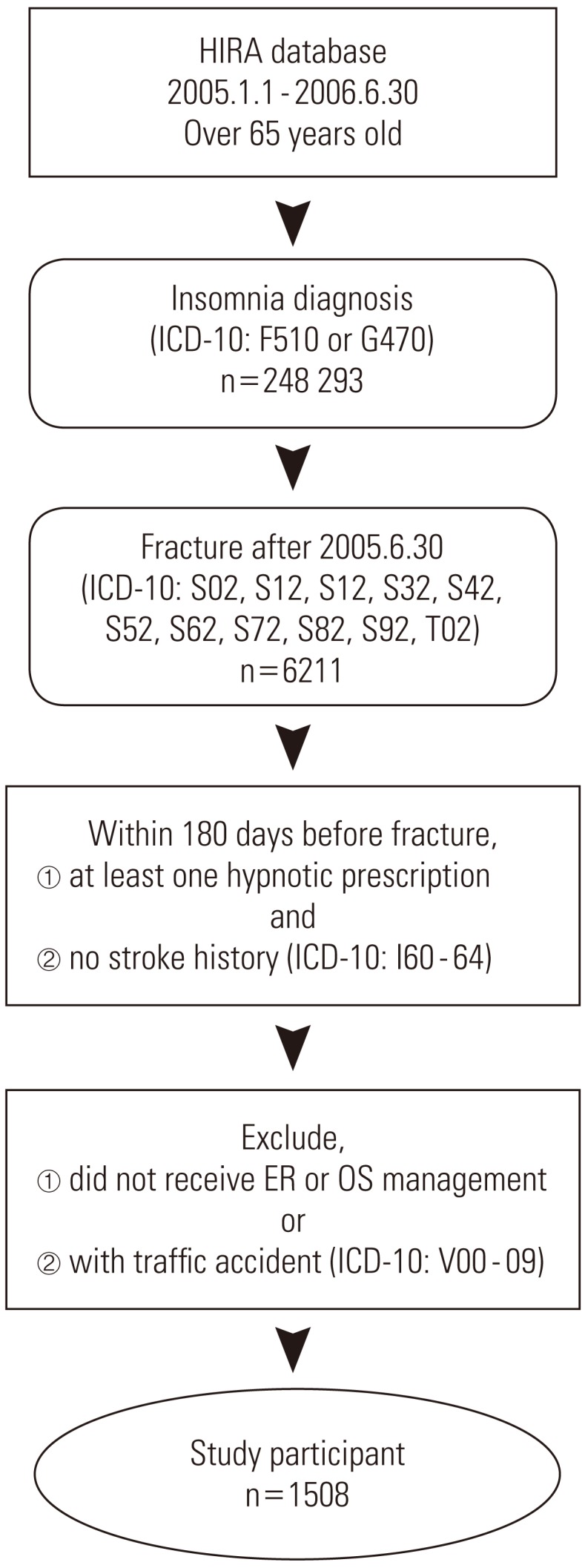
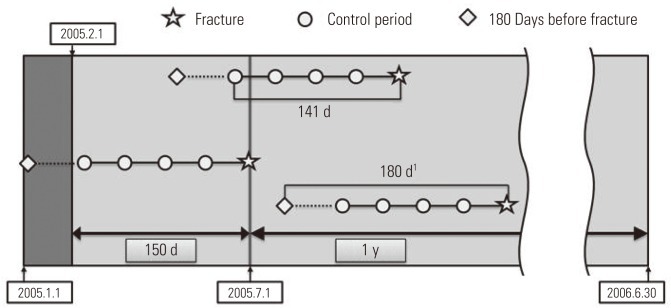
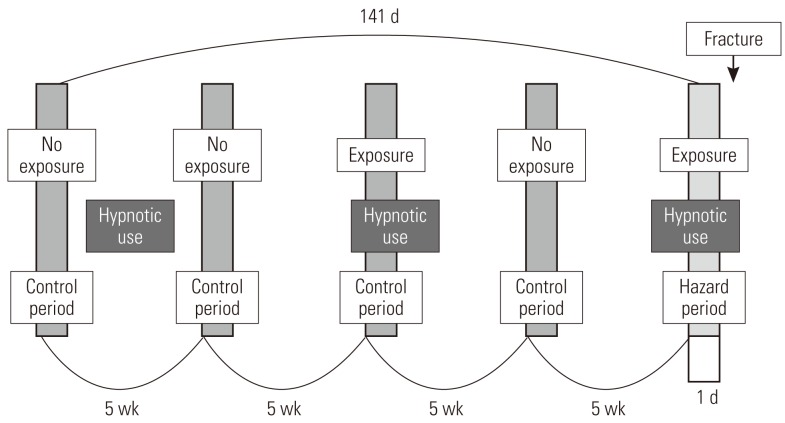
Health claims data on the entire South Korean elderly population from January 2005 to June 2006 were extracted from the Health Insurance Review and Assessment Service database. We applied a case-crossover design. Cases were defined as insomnia patients who had a fracture diagnosis. We set the hazard period of 1 day length prior to the fracture date and four control periods of the same length at 5, 10, 15, and 20 weeks prior to the fracture date. Time independent confounding factors such as age, gender, lifestyle, cognitive function level, mobility, socioeconomic status, residential environment, and comorbidity could be controlled using the case-crossover design. Time dependent confounding factors, especially co-medication of patients during the study period, were adjusted by conditional logistic regression analysis. The odds ratios and their 95% confidence intervals (CIs) were estimated for the risk of fracture related to zolpidem.
One thousand five hundred and eight cases of fracture were detected in insomnia patients during the study period. In our data, the use of zolpidem increased the risk of fracture significantly (adjusted odds ratio [aOR], 1.72; 95% CI, 1.37 to 2.16). However, the association between benzodiazepine hypnotics and the risk of fracture was not statistically significant (aOR, 1.00; 95% CI, 0.83 to 1.21). Likewise, the results were not statistically significant in stratified analysis with each benzodiazepine generic subgroup.
Zolpidem could increase the risk of fracture in elderly insomnia patients. Therefore zolpidem should be prescribed carefully and the elderly should be provided with sufficient patient education.
评估老年失眠患者使用唑吡坦相关的骨折风险。
从健康保险审查与评估服务数据库中提取2005年1月至2006年6月整个韩国老年人群的健康索赔数据。我们采用了病例交叉设计。病例定义为有骨折诊断的失眠患者。我们将骨折日期前1天的时长设定为危险期,并在骨折日期前5、10、15和20周设定四个相同时长的对照期。使用病例交叉设计可以控制年龄、性别、生活方式、认知功能水平、活动能力、社会经济地位、居住环境和合并症等时间独立混杂因素。通过条件逻辑回归分析对时间依存混杂因素,尤其是研究期间患者的联合用药情况进行了调整。估计了与唑吡坦相关的骨折风险的比值比及其95%置信区间(CI)。
研究期间在失眠患者中检测到1508例骨折病例。在我们的数据中,使用唑吡坦显著增加了骨折风险(调整后的比值比[aOR],1.72;95%CI,1.37至2.16)。然而,苯二氮䓬类催眠药与骨折风险之间的关联无统计学意义(aOR,1.00;95%CI,0.83至1.21)。同样,在各苯二氮䓬类通用亚组的分层分析中结果也无统计学意义。
唑吡坦可能会增加老年失眠患者的骨折风险。因此,应谨慎开具唑吡坦处方,并应为老年人提供充分的患者教育。