Department of Chemical Engineering and Russell Berrie Nanotechnology Institute, Technion - Israel Institute of Technology, Haifa, Israel.
Int J Nanomedicine. 2012;7:4135-46. doi: 10.2147/IJN.S32680. Epub 2012 Jul 30.
Hepatocellular carcinoma (HCC) is a common and aggressive form of cancer. Due to a high rate of postoperative recurrence, the prognosis for HCC is poor. Subclinical metastasis is the major cause of tumor recurrence and patient mortality. Currently, there is no reliable prognostic method of invasion.
To investigate the feasibility of fingerprints of volatile organic compounds (VOCs) for the in-vitro prediction of metastasis.
Headspace gases were collected from 36 cell cultures (HCC with high and low metastatic potential and normal cells) and analyzed using nanomaterial-based sensors. Predictive models were built by employing discriminant factor analysis pattern recognition, and the classification success was determined using leave-one-out cross-validation. The chemical composition of each headspace sample was studied using gas chromatography coupled with mass spectrometry (GC-MS).
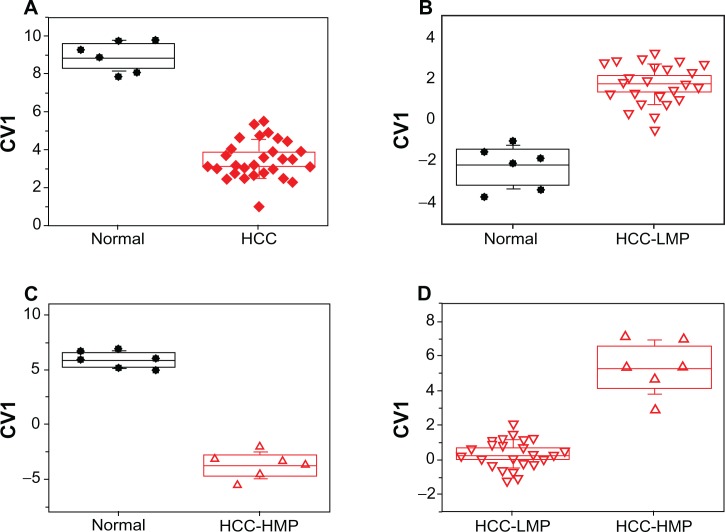
Excellent discrimination was achieved using the nanomaterial-based sensors between (i) all HCC and normal controls; (ii) low metastatic HCC and normal controls; (iii) high metastatic HCC and normal controls; and (iv) high and low HCC. Several HCC-related VOCs that could be associated with biochemical cellular processes were identified through GC-MS analysis.
The presented results constitute a proof-of-concept for the in-vitro prediction of the metastatic potential of HCC from VOC fingerprints using nanotechnology. Further studies on a larger number of more diverse cell cultures are needed to evaluate the robustness of the VOC patterns. These findings could benefit the development of a fast and potentially inexpensive laboratory test for subclinical HCC metastasis.
肝细胞癌(HCC)是一种常见且侵袭性强的癌症。由于术后复发率高,HCC 的预后较差。亚临床转移是肿瘤复发和患者死亡的主要原因。目前,还没有可靠的侵袭性预测方法。
研究利用挥发性有机化合物(VOC)指纹图谱进行体外预测转移的可行性。
从 36 个细胞培养物(高转移性和低转移性 HCC 以及正常细胞)中采集顶空气体,并使用基于纳米材料的传感器进行分析。通过判别因子分析模式识别建立预测模型,并采用留一法交叉验证确定分类成功率。使用气相色谱-质谱联用(GC-MS)研究每个顶空样本的化学成分。
基于纳米材料的传感器在以下方面实现了出色的区分:(i)所有 HCC 和正常对照;(ii)低转移性 HCC 和正常对照;(iii)高转移性 HCC 和正常对照;以及(iv)高转移性和低转移性 HCC。通过 GC-MS 分析鉴定出了一些与生化细胞过程相关的 HCC 相关 VOC,它们可能与 HCC 的转移潜能有关。
本研究结果为利用纳米技术从 VOC 指纹图谱体外预测 HCC 转移潜能提供了概念验证。需要对更多不同类型的细胞培养物进行更大规模的研究,以评估 VOC 模式的稳健性。这些发现可能有助于开发用于 HCC 亚临床转移的快速且具有潜在成本效益的实验室检测方法。