Department of Gastroenterology and Hepatology, University Hospital, Coventry CV2 2DX, UK.
Warwick Medical School, University of Warwick, Coventry CV4 7HL, UK.
Molecules. 2021 Apr 22;26(9):2447. doi: 10.3390/molecules26092447.
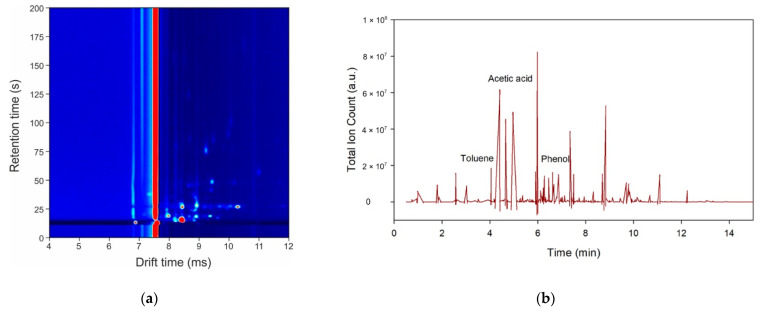
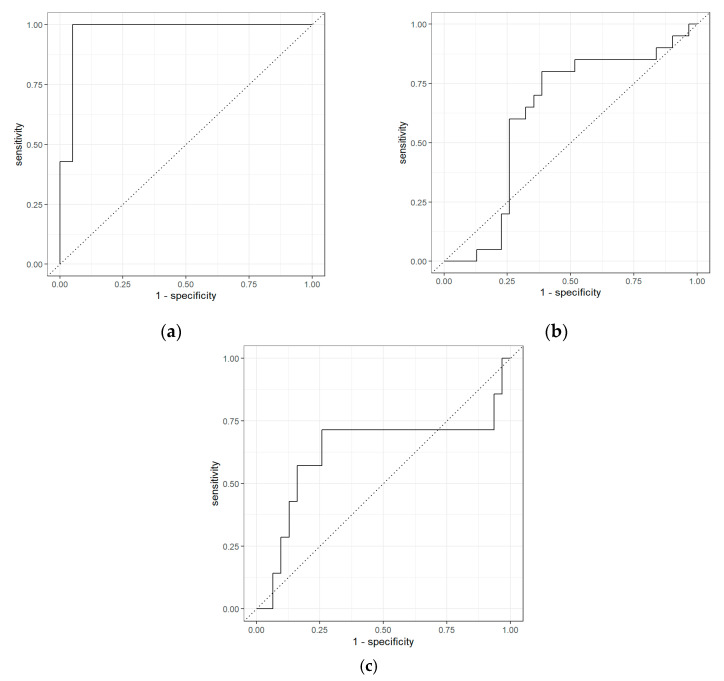
Hepatocellular carcinoma (HCC) biomarkers are lacking in clinical practice. We therefore explored the pattern and composition of urinary volatile organic compounds (VOCs) in HCC patients. This was done in order to assess the feasibility of a potential non-invasive test for HCC, and to enhance our understanding of the disease. This pilot study recruited 58 participants, of whom 20 were HCC cases and 38 were non-HCC cases. The non-HCC cases included healthy individuals and patients with various stages of non-alcoholic fatty liver disease (NAFLD), including those with and without fibrosis. Urine was analysed using gas chromatography-ion mobility spectrometry (GC-IMS) and gas chromatography-time-of-flight mass spectrometry (GC-TOF-MS). GC-IMS was able to separate HCC from fibrotic cases with an area under the curve (AUC) of 0.97 (0.91-1.00), and from non-fibrotic cases with an AUC of 0.62 (0.48-0.76). For GC-TOF-MS, a subset of samples was analysed in which seven chemicals were identified and tentatively linked with HCC. These include 4-methyl-2,4-(-hydroxyphenyl)pent-1-ene (2TMS derivative), 2-butanone, 2-hexanone, benzene, 1-ethyl-2-methyl-, 3-butene-1,2-diol, 1-(2-furanyl)-, bicyclo(4.1.0)heptane, 3,7,7-trimethyl-, [1S-(1a,3β,6a)]-, and sulpiride. Urinary VOC analysis using both GC-IMS and GC-TOF-MS proved to be a feasible method of identifying HCC cases, and was also able to enhance our understanding of HCC pathogenesis.
肝细胞癌 (HCC) 缺乏生物标志物。因此,我们探索了 HCC 患者尿液中挥发性有机化合物 (VOC) 的模式和组成。目的是评估 HCC 潜在非侵入性检测的可行性,并加深对该疾病的认识。这项初步研究招募了 58 名参与者,其中 20 名是 HCC 病例,38 名是非 HCC 病例。非 HCC 病例包括健康个体以及不同阶段非酒精性脂肪性肝病 (NAFLD) 的患者,包括有和没有纤维化的患者。使用气相色谱-离子迁移谱 (GC-IMS) 和气相色谱-飞行时间质谱 (GC-TOF-MS) 分析尿液。GC-IMS 能够将 HCC 与纤维化病例区分开来,曲线下面积 (AUC) 为 0.97(0.91-1.00),与非纤维化病例的 AUC 为 0.62(0.48-0.76)。对于 GC-TOF-MS,分析了一部分样本,其中鉴定出七种化学物质,并与 HCC 初步关联。这些包括 4-甲基-2,4-(-羟基苯基)戊-1-烯 (2TMS 衍生物)、2-丁酮、2-己酮、苯、1-乙基-2-甲基-、3-丁烯-1,2-二醇、1-(2-呋喃基)-、二环[4.1.0]庚烷、3,7,7-三甲基-、[1S-(1a,3β,6a)]-、和舒必利。使用 GC-IMS 和 GC-TOF-MS 进行尿液 VOC 分析被证明是一种识别 HCC 病例的可行方法,并且还能够加深我们对 HCC 发病机制的理解。