Department of Child and Adolescent Psychiatry, New York University Langone Medical Center.
J Consult Clin Psychol. 2013 Feb;81(1):113-28. doi: 10.1037/a0029648. Epub 2012 Aug 13.
The study compared the efficacy of 2 behavioral interventions to ameliorate organization, time management, and planning (OTMP) difficulties in 3rd- to 5th-grade children with attention-deficit/hyperactivity disorder (ADHD).
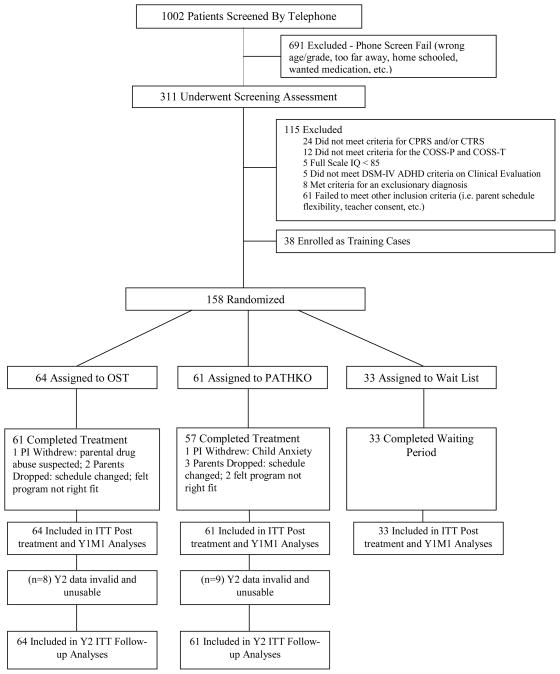
In a dual-site randomized controlled trial, 158 children were assigned to organizational skills training (OST; N = 64); PATHKO, a performance-based intervention that precluded skills training (N = 61); or a wait-list control (WL, N = 33). Treatments were 20 individual clinic-based sessions over 10-12 weeks. OST involved skills building provided primarily to the child. PATHKO trained parents and teachers to reinforce children contingently for meeting end-point target goals. Primary outcomes were the Children's Organizational Skills Scales (COSS-Parent, COSS-Teacher). Other relevant functional outcomes were assessed. Percentage of participants no longer meeting inclusion criteria for OTMP impairments informed on clinical significance. Assessments occurred at post-treatment, 1-month post-treatment, and twice in the following school year.
OST was superior to WL on the COSS-P (Cohen's d = 2.77; p < .0001), COSS-T (d = 1.18; p < .0001), children's COSS self-ratings, academic performance and proficiency, homework, and family functioning. OST was significantly better than PATHKO only on the COSS-P (d = 0.63; p < .005). PATHKO was superior to WL on most outcomes but not on academic proficiency. Sixty percent of OST and PATHKO participants versus 3% of controls no longer met OTMP inclusion criteria. Significant maintenance effects were found for both treatments.
Two distinct treatments targeting OTMP problems in children with ADHD generated robust, sustained functional improvements. The interventions show promise of clinical utility in children with ADHD and organizational deficits.
本研究比较了两种行为干预措施在改善 3 至 5 年级注意力缺陷/多动障碍(ADHD)儿童的组织、时间管理和计划(OTMP)困难方面的疗效。
在一项双站点随机对照试验中,将 158 名儿童分为组织技能训练组(OST;n=64)、基于表现的干预组 PATHKO(n=61),或等待名单对照组(WL;n=33)。治疗方法为 10-12 周内 20 次个体诊所治疗。OST 主要涉及为儿童提供技能培养。PATHKO 培训家长和教师,根据儿童是否达到终点目标来对其进行强化。主要结局指标为儿童组织技能量表(COSS-家长、COSS-教师)。还评估了其他相关的功能结局。不再符合 OTMP 损伤纳入标准的参与者比例提供了临床意义信息。评估在治疗后、治疗后 1 个月和随后的学年进行两次。
OST 在 COSS-P(Cohen's d = 2.77;p <.0001)、COSS-T(d = 1.18;p <.0001)、儿童 COSS 自评、学业成绩和熟练度、家庭作业和家庭功能方面均优于 WL。OST 仅在 COSS-P 方面显著优于 PATHKO(d = 0.63;p <.005)。PATHKO 在大多数结局上优于 WL,但在学业熟练程度上没有优势。OST 和 PATHKO 组的 60%参与者与对照组的 3%参与者不再符合 OTMP 纳入标准。两种治疗方法都有显著的维持效果。
两种针对 ADHD 儿童 OTMP 问题的不同干预措施产生了强大、持续的功能改善。这些干预措施显示了在 ADHD 和组织缺陷儿童中具有临床应用的潜力。