School of Biochemistry and Immunology, Trinity Biomedical Sciences Institute, Trinity College Dublin, Dublin, Ireland.
Front Immunol. 2012 Aug 7;3:247. doi: 10.3389/fimmu.2012.00247. eCollection 2012.
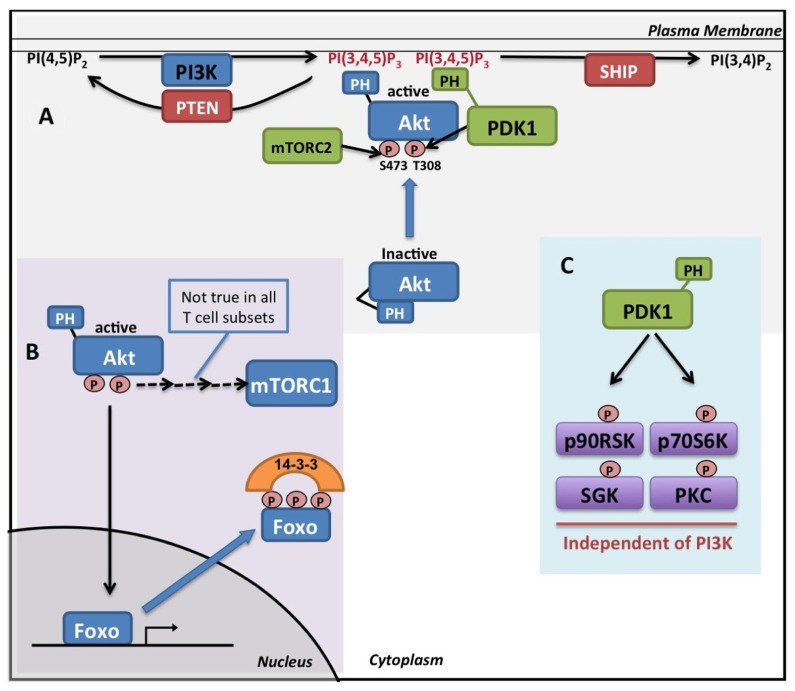
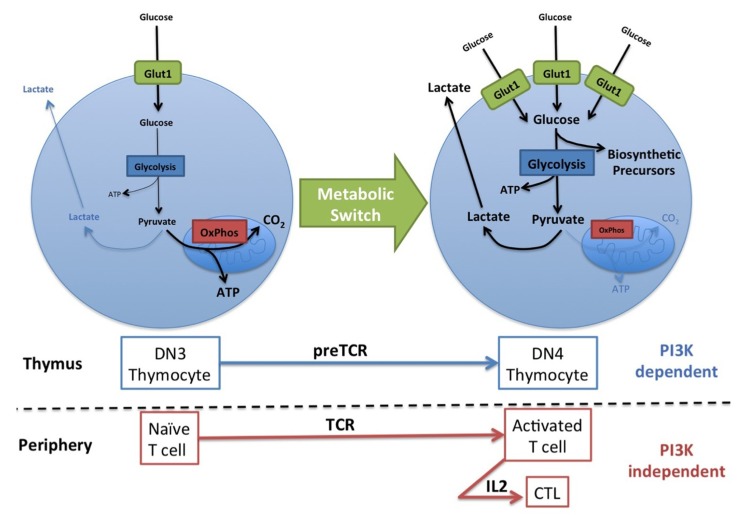
Naïve T cells are relatively quiescent cells that only require energy to prevent atrophy and for survival and migration. However, in response to developmental or extrinsic cues T cells can engage in rapid growth and robust proliferation, produce of a range of effector molecules and migrate through peripheral tissues. To meet the significantly increased metabolic demands of these activities, T cells switch from primarily metabolizing glucose to carbon dioxide through oxidative phosphorylation to utilizing glycolysis to convert glucose to lactate (termed aerobic glycolysis). This metabolic switch allows glucose to be used as a source of carbon to generate biosynthetic precursors for the production of protein, DNA, and phospholipids, and is crucial for T cells to meet metabolic demands. Phosphoinositide 3-kinases (PI3K) are a family of inositol lipid kinases linked with a broad range of cellular functions in T lymphocytes that include cell growth, proliferation, metabolism, differentiation, survival, and migration. Initial research described a critical role for PI3K signaling through Akt (also called protein kinase B) for the increased glucose uptake and glycolysis that accompanies T cell activation. This review article relates this original research with more recent data and discusses the evidence for and against a role for PI3K in regulating the metabolic switch to aerobic glycolysis in T cells.
幼稚 T 细胞是相对静止的细胞,仅需要能量来防止萎缩和存活以及迁移。然而,响应于发育或外在信号,T 细胞可以进行快速生长和旺盛增殖,产生一系列效应分子并迁移到外周组织中。为了满足这些活动显著增加的代谢需求,T 细胞从主要通过氧化磷酸化将葡萄糖代谢为二氧化碳转变为利用糖酵解将葡萄糖转化为乳酸(称为有氧糖酵解)。这种代谢转换允许葡萄糖用作生成蛋白质、DNA 和磷脂生物合成前体的碳源,对于 T 细胞满足代谢需求至关重要。磷酸肌醇 3-激酶(PI3K)是一类与 T 淋巴细胞中广泛的细胞功能相关的肌醇脂质激酶,包括细胞生长、增殖、代谢、分化、存活和迁移。最初的研究描述了 PI3K 信号通过 Akt(也称为蛋白激酶 B)对 T 细胞激活伴随的葡萄糖摄取和糖酵解增加的关键作用。本文综述了这一原始研究与最近数据的关系,并讨论了 PI3K 在调节 T 细胞向有氧糖酵解的代谢转换中的作用的证据。