Department of Research and Evaluation, Kaiser Permanente Southern California, Pasadena, CA, USA.
Diabetes Care. 2013 Jan;36(1):56-62. doi: 10.2337/dc12-0741. Epub 2012 Aug 13.
The International Association of Diabetes in Pregnancy Study Groups (IADPSG) criteria for diagnosis of gestational diabetes mellitus (GDM) identifies women and infants at risk for adverse outcomes, which are also strongly associated with maternal overweight, obesity, and excess gestational weight gain.
We conducted a retrospective study of 9,835 women who delivered at ≥20 weeks' gestation; had a prenatal, 2-h, 75-g oral glucose tolerance test; and were not treated with diet, exercise, or antidiabetic medications during pregnancy. Women were classified as having GDM based on IADPSG criteria and were categorized into six mutually exclusive prepregnancy BMI/GDM groups: normal weight ± GDM, overweight ± GDM, and obese ± GDM.
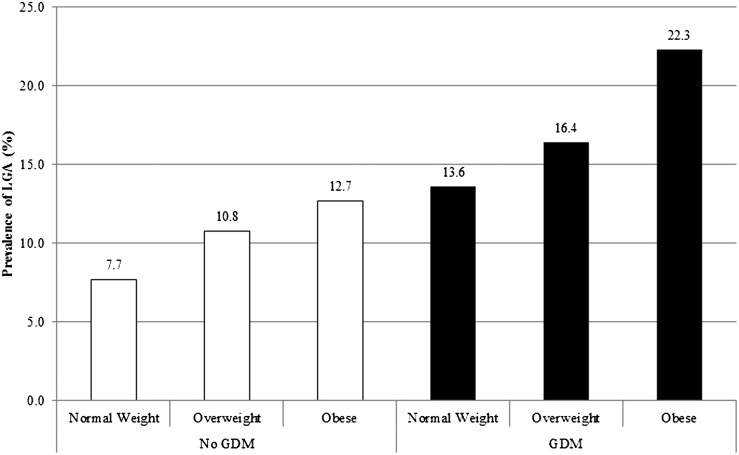
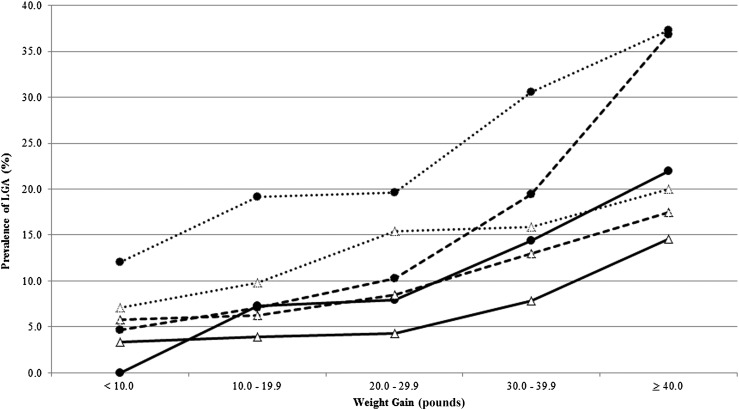
Overall, 5,851 (59.5%) women were overweight or obese and 1,892 (19.2%) had GDM. Of those with GDM, 1,443 (76.3%) were overweight or obese. The prevalence of large-for-gestational-age (LGA) infants was significantly higher for overweight and obese women without GDM compared with their normal-weight counterparts. Among women without GDM, 21.6% of LGA infants were attributable to maternal overweight and obesity, and the combination of being overweight or obese and having GDM accounted for 23.3% of LGA infants. Increasing gestational weight gain was associated with a higher prevalence of LGA in all groups.
Prepregnancy overweight and obesity account for a high proportion of LGA, even in the absence of GDM. Interventions that focus on maternal overweight/obesity and gestational weight gain, regardless of GDM status, have the potential to reach far more women at risk for having an LGA infant.
国际妊娠糖尿病研究组织(IADPSG)的妊娠糖尿病(GDM)诊断标准确定了存在不良结局风险的妇女和婴儿,这些不良结局也与母亲超重、肥胖和过多的妊娠体重增加密切相关。
我们对 9835 名在 20 周以上分娩的妇女进行了回顾性研究;她们进行了产前、2 小时、75 克口服葡萄糖耐量试验;并且在怀孕期间没有接受饮食、运动或抗糖尿病药物治疗。根据 IADPSG 标准,将妇女分类为患有 GDM,并分为六个相互排斥的孕前 BMI/GDM 组:正常体重±GDM、超重±GDM 和肥胖±GDM。
总体而言,5851 名(59.5%)妇女超重或肥胖,1892 名(19.2%)患有 GDM。在患有 GDM 的妇女中,1443 名(76.3%)超重或肥胖。与正常体重的妇女相比,无 GDM 的超重和肥胖妇女的巨大儿(LGA)婴儿的患病率明显更高。在没有 GDM 的妇女中,21.6%的 LGA 婴儿归因于母亲超重和肥胖,超重或肥胖以及患有 GDM 的组合占 LGA 婴儿的 23.3%。妊娠体重增加与所有组中 LGA 的患病率增加有关。
孕前超重和肥胖占 LGA 的很大比例,即使没有 GDM 也是如此。无论 GDM 状态如何,以母亲超重/肥胖和妊娠体重增加为重点的干预措施有可能接触到更多存在 LGA 婴儿风险的妇女。