Department of Biology, Behavioural Physiology, Humboldt-Universität zu Berlin, Invalidenstrasse 43, Berlin 10115, Germany.
Front Zool. 2012 Aug 15;9(1):19. doi: 10.1186/1742-9994-9-19.
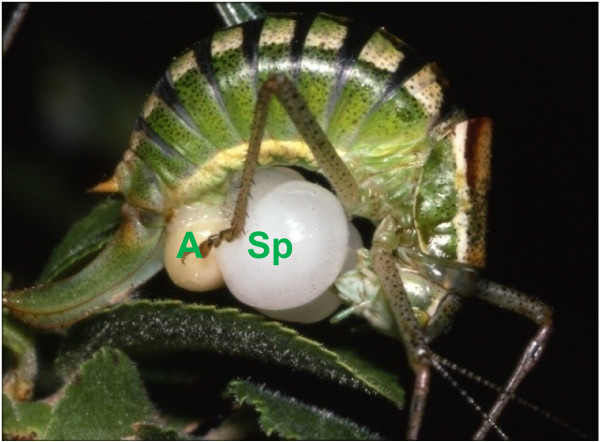
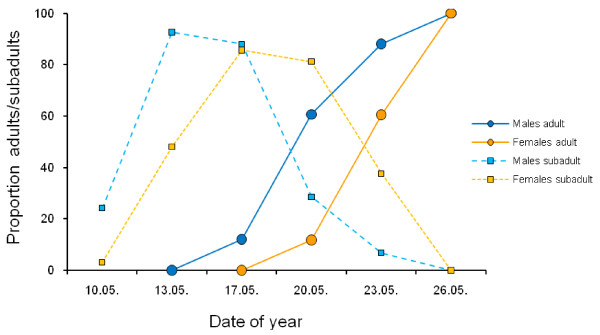
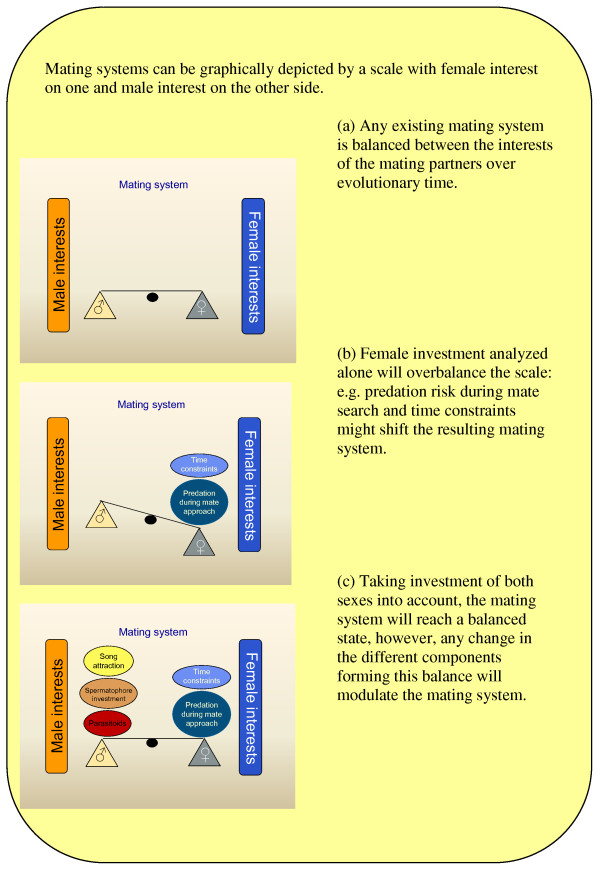
Sexual selection is a major force driving evolution and is intertwined with ecological factors. Differential allocation of limited resources has a central role in the cost of reproduction. In this paper, I review the costs and benefits of mating in tettigoniids, focussing on nuptial gifts, their trade-off with male calling songs, protandry and how mate density influences mate choice. Tettigoniids have been widely used as model systems for studies of mating costs and benefits; they can provide useful general insights. The production and exchange of large nuptial gifts by males for mating is an important reproductive strategy in tettigoniids. As predicted by sexual selection theory spermatophylax size is condition dependent and is constrained by the need to invest in calling to attract mates also. Under some circumstances, females benefit directly from the nuptial gifts by an increase in reproductive output. However, compounds in the nuptial gift can also benefit the male by prolonging the period before the female remates. There is also a trade-off between adult male maturation and mating success. Where males mature before females (protandry) the level of protandry varies in the direction predicted by sperm competition theory; namely, early male maturation is correlated with a high level of first inseminations being reproductively successful. Lastly, mate density in bushcrickets is an important environmental factor influencing the behavioural decisions of individuals. Where mates are abundant, individuals are more choosey of mates; when they are scarce, individuals are less choosey. This review reinforces the view that tettigoniids provide excellent models to test and understand the economics of matings in both sexes.
性选择是推动进化的主要力量,与生态因素交织在一起。有限资源的差异分配在生殖成本中起着核心作用。在本文中,我回顾了直翅目昆虫交配的成本和收益,重点关注了求偶礼物、它们与雄性求偶鸣叫的权衡、雌雄同体和配偶密度如何影响配偶选择。直翅目昆虫已被广泛用作交配成本和收益研究的模型系统;它们可以提供有用的普遍见解。雄性为交配而产生和交换大型求偶礼物是直翅目昆虫的重要生殖策略。正如性选择理论所预测的,精子叶的大小取决于条件,并受到需要投资于鸣叫以吸引配偶的限制。在某些情况下,雌性直接从求偶礼物中受益,从而增加繁殖产量。然而,求偶礼物中的化合物也可以通过延长雌性再次交配的时间来使雄性受益。成年雄性成熟度和交配成功率之间也存在权衡。当雄性比雌性更早成熟(雌雄同体)时,雌雄同体的程度与精子竞争理论所预测的方向一致;即,早期雄性成熟与第一次授精的高生殖成功率相关。最后,蟋蟀的配偶密度是影响个体行为决策的重要环境因素。当配偶充足时,个体对配偶的选择更加挑剔;当配偶稀缺时,个体的选择就不那么挑剔了。这篇综述强化了这样一种观点,即直翅目昆虫为检验和理解两性交配的经济学提供了极好的模型。