Center for Molecular Systems Biology, University of Turin, Turin, Candiolo I-10060, Italy.
BMC Genomics. 2012 Aug 16;13:400. doi: 10.1186/1471-2164-13-400.
In the last few years several studies have shown that Transposable Elements (TEs) in the human genome are significantly associated with Transcription Factor Binding Sites (TFBSs) and that in several cases their expansion within the genome led to a substantial rewiring of the regulatory network. Another important feature of the regulatory network which has been thoroughly studied is the combinatorial organization of transcriptional regulation. In this paper we combine these two observations and suggest that TEs, besides rewiring the network, also played a central role in the evolution of particular patterns of combinatorial gene regulation.
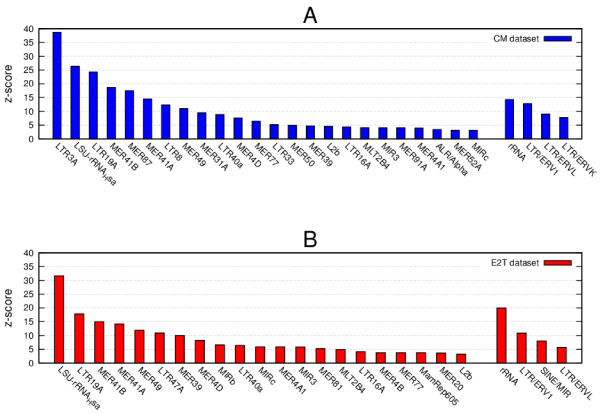
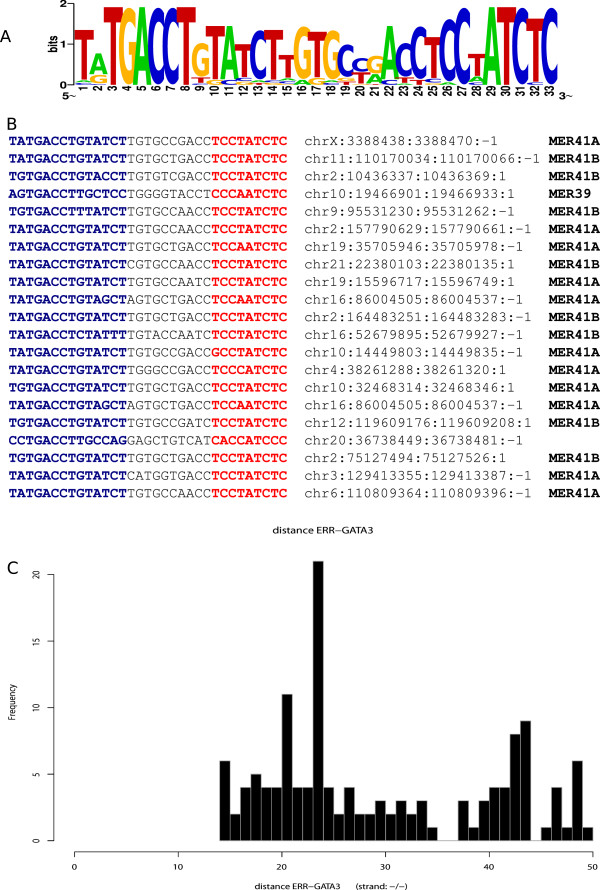
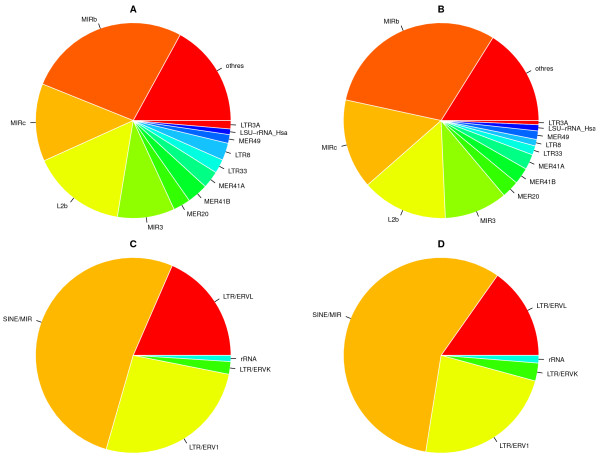
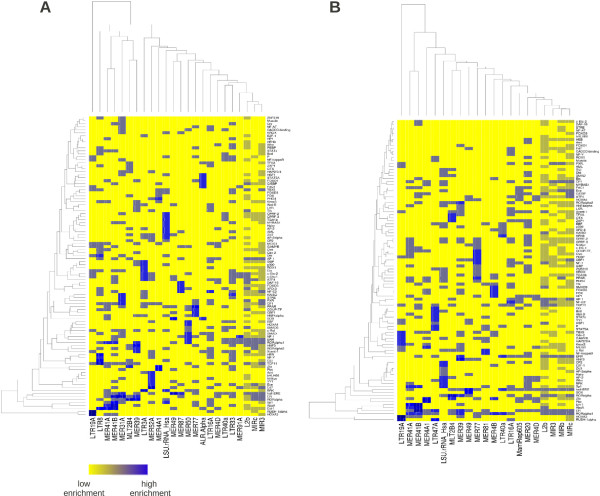
To address this issue we searched for TEs overlapping Estrogen Receptor α (ERα) binding peaks in two publicly available ChIP-seq datasets from the MCF7 cell line corresponding to different modalities of exposure to estrogen. We found a remarkable enrichment of a few specific classes of Transposons. Among these a prominent role was played by MIR (Mammalian Interspersed Repeats) transposons. These TEs underwent a dramatic expansion at the beginning of the mammalian radiation and then stabilized. We conjecture that the special affinity of ERα for the MIR class of TEs could be at the origin of the important role assumed by ERα in Mammalians. We then searched for TFBSs within the TEs overlapping ChIP-seq peaks. We found a strong enrichment of a few precise combinations of TFBS. In several cases the corresponding Transcription Factors (TFs) were known cofactors of ERα, thus supporting the idea of a co-regulatory role of TFBS within the same TE. Moreover, most of these correlations turned out to be strictly associated to specific classes of TEs thus suggesting the presence of a well-defined "transposon code" within the regulatory network.
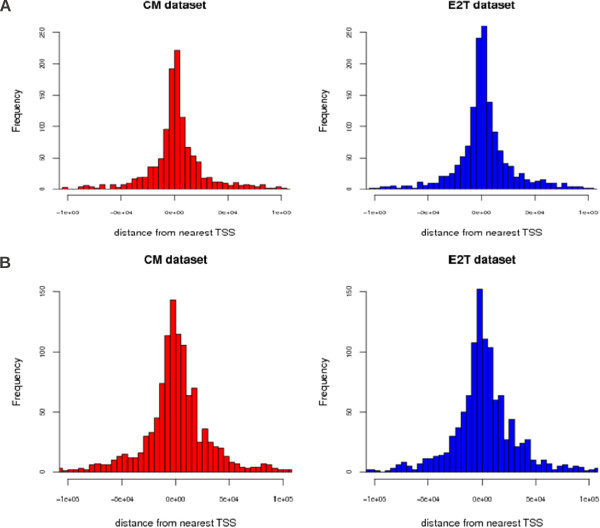
In this work we tried to shed light into the role of Transposable Elements (TEs) in shaping the regulatory network of higher eukaryotes. To test this idea we focused on a particular transcription factor: the Estrogen Receptor α (ERα) and we found that ERα preferentially targets a well defined set of TEs and that these TEs host combinations of transcriptional regulators involving several of known co-regulators of ERα. Moreover, a significant number of these TEs turned out to be conserved between human and mouse and located in the vicinity (and thus candidate to be regulators) of important estrogen-related genes.
在过去的几年中,多项研究表明人类基因组中的转座元件(TEs)与转录因子结合位点(TFBSs)显著相关,并且在某些情况下,它们在基因组中的扩张导致了调控网络的重大重构。另一个已被深入研究的调控网络的重要特征是转录调控的组合组织。在本文中,我们结合了这两个观察结果,并提出 TEs 除了重构网络外,还在特定的组合基因调控模式的进化中发挥了核心作用。
为了解决这个问题,我们在两个公开的 MCF7 细胞系的 ChIP-seq 数据集(对应于雌激素暴露的不同模式)中搜索与雌激素受体 α(ERα)结合峰重叠的 TEs。我们发现少数特定类别的转座子明显富集。其中,MIR(哺乳动物间隔重复)转座子起着突出的作用。这些 TEs 在哺乳动物辐射的早期经历了剧烈的扩张,然后稳定下来。我们推测 ERα 对 MIR 类 TEs 的特殊亲和力可能是 ERα 在哺乳动物中扮演重要角色的起源。然后,我们在与 ChIP-seq 峰重叠的 TEs 内搜索 TFBS。我们发现几个精确的 TFBS 组合强烈富集。在几种情况下,相应的转录因子(TFs)是 ERα 的已知共因子,因此支持 TFBS 在同一 TE 内的共调控作用的想法。此外,这些相关性中的大多数与特定类别的 TEs 严格相关,因此表明在调控网络中存在明确的“转座子代码”。
在这项工作中,我们试图阐明转座元件(TEs)在塑造高等真核生物调控网络中的作用。为了验证这一想法,我们专注于一个特定的转录因子:雌激素受体 α(ERα),并发现 ERα 优先靶向一组定义明确的 TEs,而这些 TEs 包含涉及多个已知 ERα 共调节剂的转录调节剂组合。此外,这些 TEs 中有相当数量在人类和小鼠之间保守,并且位于附近(因此候选为调节剂)与雌激素相关的重要基因。