Community and Conservation Ecology Group, Centre for Ecological and Evolutionary Studies, University of Groningen, Groningen, The Netherlands.
PLoS One. 2012;7(8):e42060. doi: 10.1371/journal.pone.0042060. Epub 2012 Aug 8.
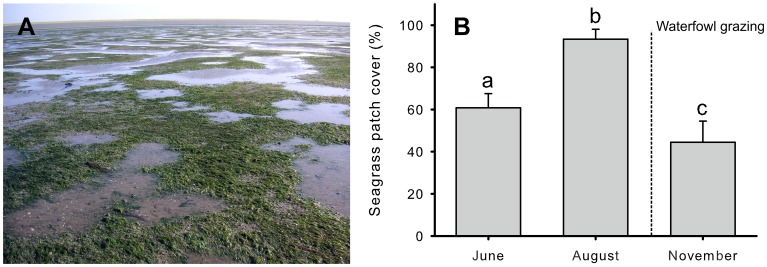
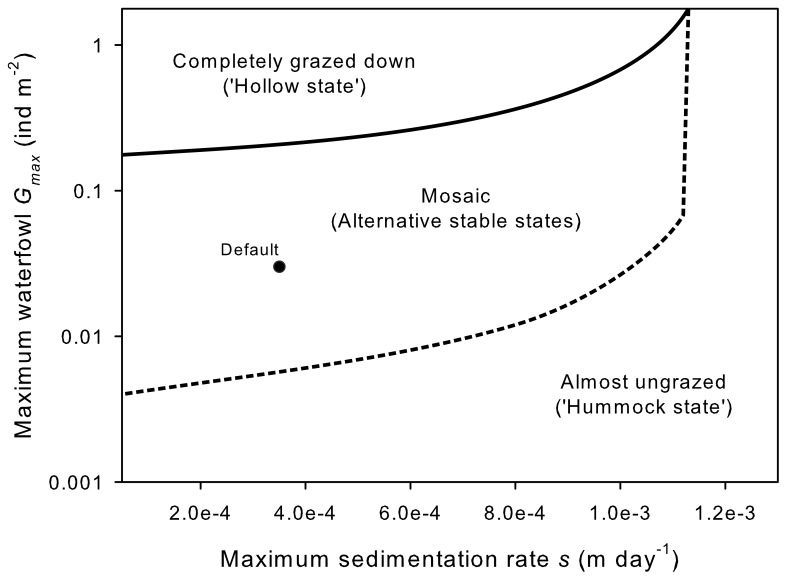
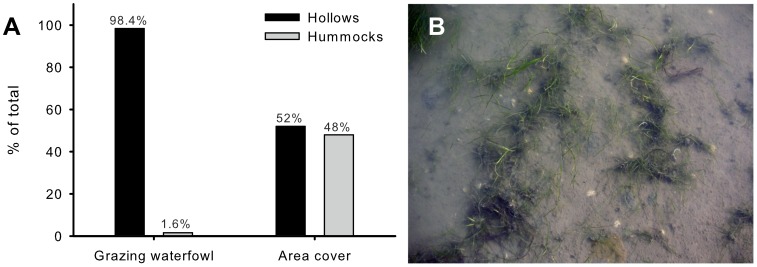
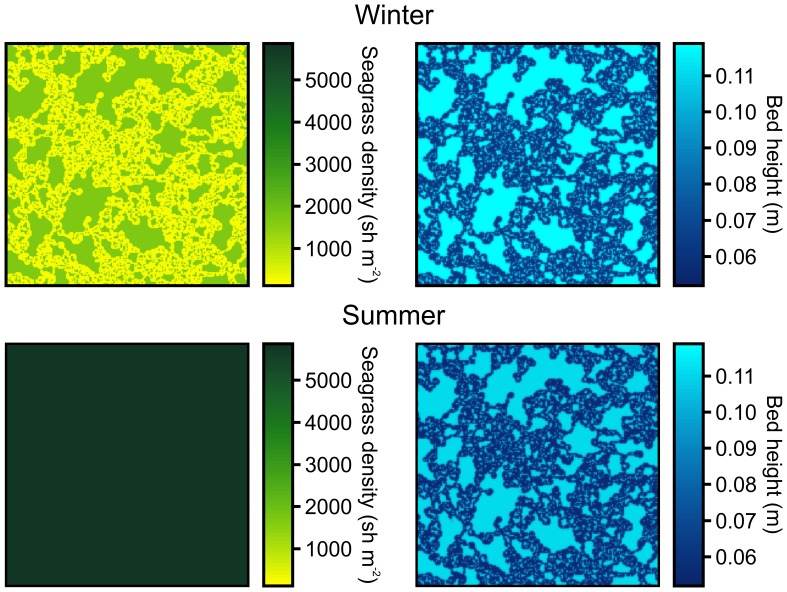
Self-facilitation through ecosystem engineering (i.e., organism modification of the abiotic environment) and consumer-resource interactions are both major determinants of spatial patchiness in ecosystems. However, interactive effects of these two mechanisms on spatial complexity have not been extensively studied. We investigated the mechanisms underlying a spatial mosaic of low-tide exposed hummocks and waterlogged hollows on an intertidal mudflat in the Wadden Sea dominated by the seagrass Zostera noltii. A combination of field measurements, an experiment and a spatially explicit model indicated that the mosaic resulted from localized sediment accretion by seagrass followed by selective waterfowl grazing. Hollows were bare in winter, but were rapidly colonized by seagrass during the growth season. Colonized hollows were heavily grazed by brent geese and widgeon in autumn, converting these patches to a bare state again and disrupting sediment accretion by seagrass. In contrast, hummocks were covered by seagrass throughout the year and were rarely grazed, most likely because the waterfowl were not able to employ their preferred but water requiring feeding strategy ('dabbling') here. Our study exemplifies that interactions between ecosystem engineering by a foundation species (seagrass) and consumption (waterfowl grazing) can increase spatial complexity at the landscape level.
通过生态系统工程(即生物体对非生物环境的改造)和消费者-资源相互作用进行的自我促进是决定生态系统空间斑块性的两个主要因素。然而,这两种机制对空间复杂性的相互影响还没有得到广泛的研究。我们研究了主导着瓦登海的海草北茨藻的潮间带泥滩上低潮水暴露的丘和水淹洼地的空间镶嵌现象的机制。现场测量、实验和空间显式模型的组合表明,这种镶嵌是由海草局部沉积作用,然后是选择性水禽放牧引起的。洼地在冬季是裸露的,但在生长季节迅速被海草殖民。在秋季,被殖民的洼地被黑鼻羊和赤颈鸭大量放牧,使这些斑块再次变为裸露状态,并破坏了海草的沉积作用。相比之下,丘全年都被海草覆盖,很少被放牧,这很可能是因为水禽无法在这里采用它们喜欢的但需要水的觅食策略(“涉禽”)。我们的研究例证表明,基础物种(海草)的生态系统工程和消费(水禽放牧)之间的相互作用可以增加景观水平的空间复杂性。