Department of Infection Genetics, Helmholtz Centre for Infection Research and University of Veterinary Medicine Hannover, 38124, Braunschweig, Germany.
BMC Genomics. 2012 Aug 20;13:411. doi: 10.1186/1471-2164-13-411.
There is strong but mostly circumstantial evidence that genetic factors modulate the severity of influenza infection in humans. Using genetically diverse but fully inbred strains of mice it has been shown that host sequence variants have a strong influence on the severity of influenza A disease progression. In particular, C57BL/6J, the most widely used mouse strain in biomedical research, is comparatively resistant. In contrast, DBA/2J is highly susceptible.
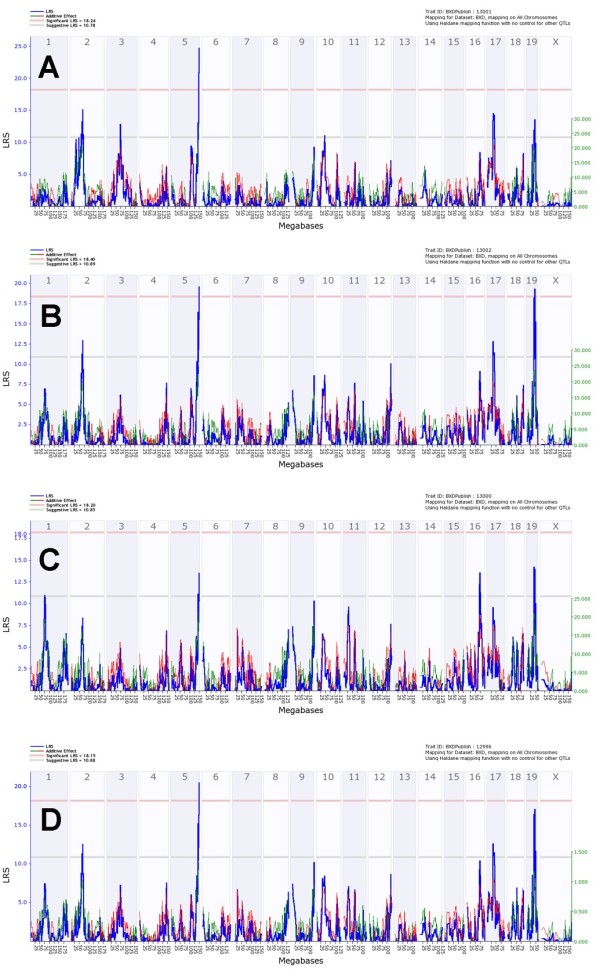
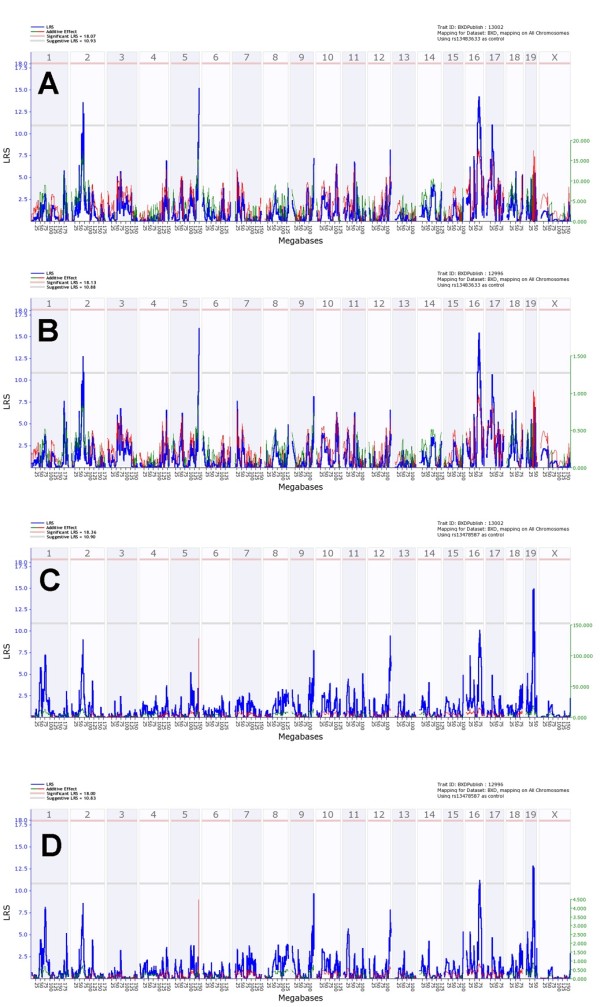
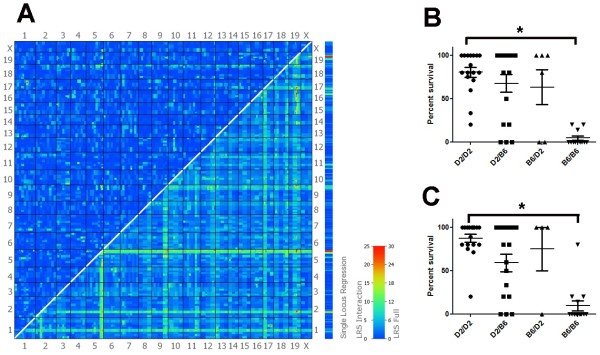
To map regions of the genome responsible for differences in influenza susceptibility, we infected a family of 53 BXD-type lines derived from a cross between C57BL/6J and DBA/2J strains with influenza A virus (PR8, H1N1). We monitored body weight, survival, and mean time to death for 13 days after infection. Qivr5 (quantitative trait for influenza virus resistance on chromosome 5) was the largest and most significant QTL for weight loss. The effect of Qivr5 was detectable on day 2 post infection, but was most pronounced on days 5 and 6. Survival rate mapped to Qivr5, but additionally revealed a second significant locus on chromosome 19 (Qivr19). Analysis of mean time to death affirmed both Qivr5 and Qivr19. In addition, we observed several regions of the genome with suggestive linkage. There are potentially complex combinatorial interactions of the parental alleles among loci. Analysis of multiple gene expression data sets and sequence variants in these strains highlights about 30 strong candidate genes across all loci that may control influenza A susceptibility and resistance.
We have mapped influenza susceptibility loci to chromosomes 2, 5, 16, 17, and 19. Body weight and survival loci have a time-dependent profile that presumably reflects the temporal dynamic of the response to infection. We highlight candidate genes in the respective intervals and review their possible biological function during infection.
有强有力的证据表明,遗传因素会影响人类流感感染的严重程度,但这些证据大多是间接的。使用遗传背景多样化但完全近交的小鼠品系,研究表明宿主序列变异对甲型流感疾病进展的严重程度有很强的影响。特别是在生物医学研究中应用最广泛的 C57BL/6J 小鼠品系,其相对具有抗性。相比之下,DBA/2J 则高度易感。
为了确定导致流感易感性差异的基因组区域,我们用甲型流感病毒(PR8,H1N1)感染了一组源自 C57BL/6J 和 DBA/2J 杂交的 53 条 BXD 品系。我们监测了感染后 13 天的体重、存活率和平均死亡时间。Qivr5(第 5 号染色体上的流感病毒抗性数量性状)是体重减轻的最大和最显著的 QTL。Qivr5 的作用在感染后第 2 天即可检测到,但在第 5 天和第 6 天最为明显。存活率映射到 Qivr5,但在第 19 号染色体上还发现了第二个显著位点(Qivr19)。平均死亡时间的分析证实了 Qivr5 和 Qivr19。此外,我们观察到基因组的几个区域具有暗示性的连锁。这些位点之间的亲本等位基因可能存在复杂的组合相互作用。对这些品系的多个基因表达数据集和序列变异的分析突出了大约 30 个横跨所有位点的强候选基因,这些基因可能控制着对甲型流感的易感性和抗性。
我们已经将流感易感性基因座映射到 2、5、16、17 和 19 号染色体上。体重和存活率基因座具有时间依赖性特征,这可能反映了感染时对感染的时间动态反应。我们突出了各自区间内的候选基因,并回顾了它们在感染过程中的可能生物学功能。