Department of Genetics, Genomics, and Informatics, University of Tennessee Health Science Center, Memphis, TN, United States.
Institute of Animal Husbandry and Veterinary Science, Shanghai Academy of Agricultural Sciences, Shanghai, China.
Front Immunol. 2021 Jan 8;11:607314. doi: 10.3389/fimmu.2020.607314. eCollection 2020.
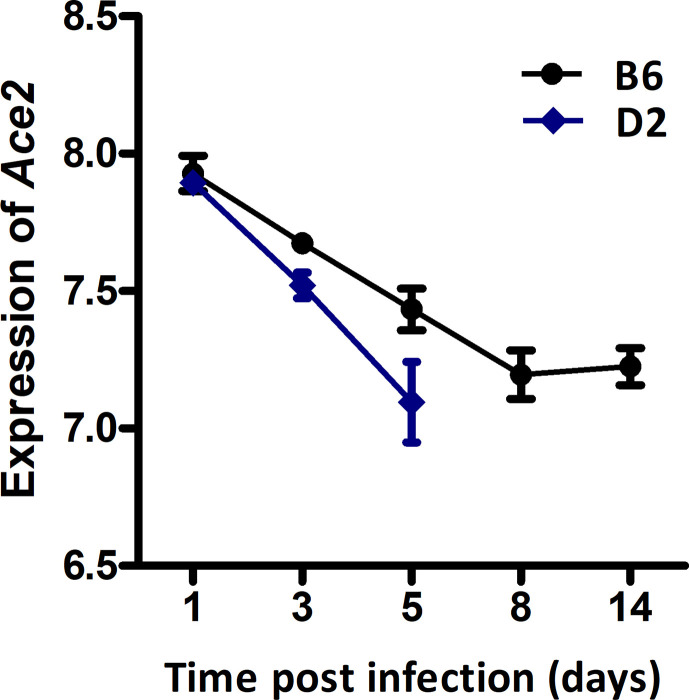
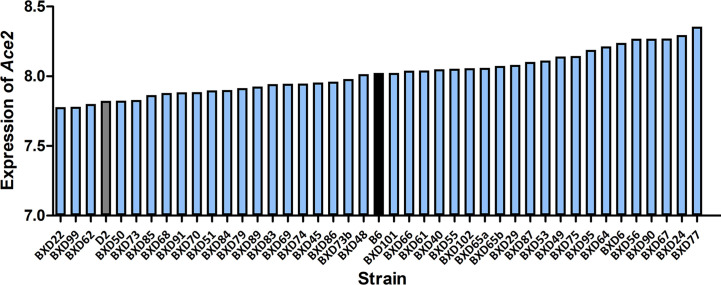
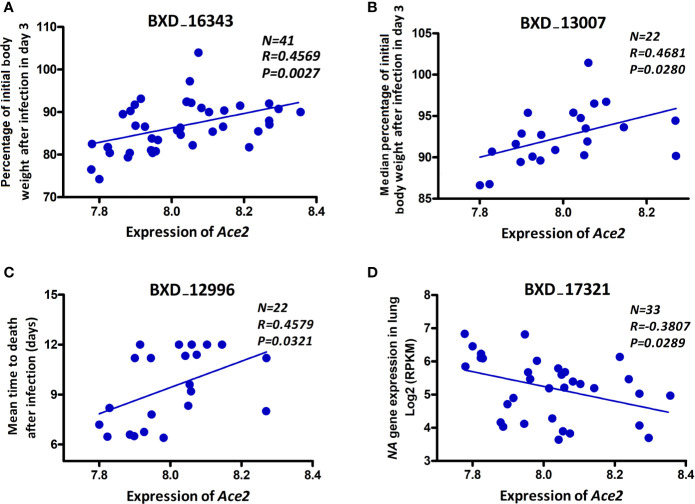
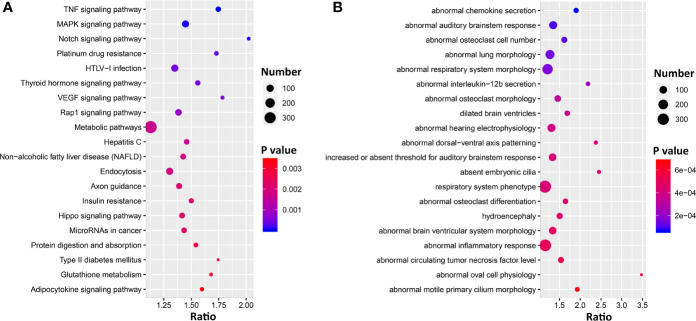
Acute lung injury (ALI) is an important cause of morbidity and mortality after viral infections, including influenza A virus H1N1, SARS-CoV, MERS-CoV, and SARS-CoV-2. The angiotensin I converting enzyme 2 (ACE2) is a key host membrane-bound protein that modulates ALI induced by viral infection, pulmonary acid aspiration, and sepsis. However, the contributions of sequence variants to individual differences in disease risk and severity after viral infection are not understood. In this study, we quantified H1N1 influenza-infected lung transcriptomes across a family of 41 BXD recombinant inbred strains of mice and both parents-C57BL/6J and DBA/2J. In response to infection mRNA levels decreased significantly for both parental strains and the expression levels was associated with disease severity (body weight loss) and viral load (expression levels of viral NA segment) across the BXD family members. Pulmonary RNA-seq for 43 lines was analyzed using weighted gene co-expression network analysis (WGCNA) and Bayesian network approaches. not only participated in virus-induced ALI by interacting with TNF, MAPK, and NOTCH signaling pathways, but was also linked with high confidence to gene products that have important functions in the pulmonary epithelium, including , , and . Comparable sets of transcripts were also highlighted in parallel studies of human SARS-CoV-infected primary human airway epithelial cells. Using conventional mapping methods, we determined that weight loss at two and three days after viral infection maps to chromosome X-the location of . This finding motivated the hierarchical Bayesian network analysis, which defined molecular endophenotypes of lung infection linked to expression and to a key disease outcome. Core members of this Bayesian network include , , , , , , , and . Collectively, these findings define a causally-rooted modulatory network relevant to host response to viral infection and identify potential therapeutic targets for virus-induced respiratory diseases, including those caused by influenza and coronaviruses.
急性肺损伤(ALI)是病毒感染后发病率和死亡率的重要原因,包括甲型 H1N1 流感病毒、严重急性呼吸综合征冠状病毒(SARS-CoV)、中东呼吸综合征冠状病毒(MERS-CoV)和严重急性呼吸综合征冠状病毒 2(SARS-CoV-2)。血管紧张素 I 转化酶 2(ACE2)是一种关键的宿主膜结合蛋白,可调节病毒感染、肺酸性吸入和败血症引起的 ALI。然而,序列变异对病毒感染后个体疾病风险和严重程度差异的贡献尚不清楚。在这项研究中,我们在 41 个 BXD 重组近交系小鼠及其父母(C57BL/6J 和 DBA/2J)的家族中量化了甲型 H1N1 流感感染的肺转录组。在感染后,两种亲本株和 BXD 家族成员的病毒载量(病毒 NA 片段的表达水平)均显著降低。对 43 条系谱的肺 RNA-seq 进行了分析,使用加权基因共表达网络分析(WGCNA)和贝叶斯网络方法。 不仅通过与 TNF、MAPK 和 NOTCH 信号通路相互作用参与病毒诱导的 ALI,而且还与具有肺上皮重要功能的基因产物高度相关,包括 、 、 。在平行的人类 SARS-CoV 感染原代人呼吸道上皮细胞的研究中也突出了类似的转录物集。使用传统的映射方法,我们确定病毒感染后两天和三天的体重减轻映射到染色体 X- 的位置。这一发现促使进行层次贝叶斯网络分析,该分析定义了与 表达和关键疾病结果相关的肺部感染的分子表型。该贝叶斯网络的核心成员包括 、 、 、 、 、 、 。总的来说,这些发现定义了一个因果相关的 调节网络,与宿主对病毒感染的反应有关,并确定了病毒诱导的呼吸道疾病(包括流感和冠状病毒引起的疾病)的潜在治疗靶点。