
CD38/cADPR/Ca2+ 信号通路抑制小鼠胚胎干细胞向心肌细胞的分化。
Inhibition of cardiomyocytes differentiation of mouse embryonic stem cells by CD38/cADPR/Ca2+ signaling pathway.
机构信息
Department of Physiology, The University of Hong Kong, Hong Kong, China.
State Key Laboratory of Natural and Biomimetic Drugs, School of Pharmaceutical Sciences, Peking University, Beijing 100191, China.
出版信息
J Biol Chem. 2012 Oct 12;287(42):35599-35611. doi: 10.1074/jbc.M112.392530. Epub 2012 Aug 20.
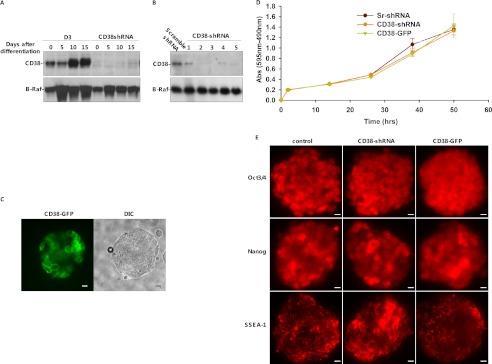
Cyclic adenosine diphosphoribose (cADPR) is an endogenous Ca(2+) mobilizing messenger that is formed by ADP-ribosyl cyclases from nicotinamide adenine dinucleotide (NAD). The main ADP-ribosyl cyclase in mammals is CD38, a multi-functional enzyme and a type II membrane protein. Here we explored the role of CD38-cADPR-Ca(2+) in the cardiomyogenesis of mouse embryonic stem (ES) cells. We found that the mouse ES cells are responsive to cADPR and possess the key components of the cADPR signaling pathway. In vitro cardiomyocyte (CM) differentiation of mouse ES cells was initiated by embryoid body (EB) formation. Interestingly, beating cells appeared earlier and were more abundant in CD38 knockdown EBs than in control EBs. Real-time RT-PCR and Western blot analyses further showed that the expression of several cardiac markers, including GATA4, MEF2C, NKX2.5, and α-MLC, were increased markedly in CD38 knockdown EBs than those in control EBs. Similarly, FACS analysis showed that more cardiac Troponin T-positive CMs existed in CD38 knockdown or 8-Br-cADPR, a cADPR antagonist, treated EBs compared with that in control EBs. On the other hand, overexpression of CD38 in mouse ES cells significantly inhibited CM differentiation. Moreover, CD38 knockdown ES cell-derived CMs possess the functional properties characteristic of normal ES cell-derived CMs. Last, we showed that the CD38-cADPR pathway negatively modulated the FGF4-Erks1/2 cascade during CM differentiation of ES cells, and transiently inhibition of Erk1/2 blocked the enhanced effects of CD38 knockdown on the differentiation of CM from ES cells. Taken together, our data indicate that the CD38-cADPR-Ca(2+) signaling pathway antagonizes the CM differentiation of mouse ES cells.
环腺苷二磷酸核糖(cADPR)是一种内源性 Ca(2+)动员信使,由烟酰胺腺嘌呤二核苷酸(NAD)的 ADP-核糖基环化酶形成。哺乳动物中的主要 ADP-核糖基环化酶是 CD38,一种多功能酶和 II 型膜蛋白。在这里,我们探讨了 CD38-cADPR-Ca(2+)在小鼠胚胎干细胞(ES 细胞)心肌发生中的作用。我们发现,小鼠 ES 细胞对 cADPR 有反应,并具有 cADPR 信号通路的关键组成部分。体外心肌细胞(CM)分化由胚胎体(EB)形成引发。有趣的是,与对照 EB 相比,CD38 敲低 EB 中的搏动细胞更早出现且更为丰富。实时 RT-PCR 和 Western blot 分析进一步表明,几种心脏标志物的表达,包括 GATA4、MEF2C、NKX2.5 和 α-MLC,在 CD38 敲低 EB 中明显高于对照 EB。同样,FACS 分析表明,与对照 EB 相比,CD38 敲低或 cADPR 拮抗剂 8-Br-cADPR 处理的 EB 中存在更多的心脏肌钙蛋白 T 阳性 CM。另一方面,CD38 在小鼠 ES 细胞中的过表达显著抑制了 CM 分化。此外,CD38 敲低 ES 细胞衍生的 CM 具有正常 ES 细胞衍生的 CM 的功能特性。最后,我们表明 CD38-cADPR 通路在 ES 细胞 CM 分化过程中负调控 FGF4-Erks1/2 级联,并且 Erk1/2 的短暂抑制阻断了 CD38 敲低对 ES 细胞 CM 分化的增强作用。总之,我们的数据表明 CD38-cADPR-Ca(2+)信号通路拮抗了小鼠 ES 细胞的 CM 分化。




 Zotero 插件